



Feldspar is one of the most abundant rock-forming minerals in the Earth’s crust, accounting for nearly 50% of its total composition. It plays a fundamental role in geological formations and is widely used across modern industrial systems.
In industry, feldspar is a key raw material for ceramics, glass, enamel, and construction materials. In mineral processing engineering, it is also a typical medium-hard material used in crushing, grinding, and classification systems.
From mining operations to processing plants, feldspar represents a classic example of industrial mineral engineering.
1. Feldspar Distribution in the Earth’s Crust
Feldspar is widely distributed in all major rock types, making it one of the most stable mineral resources on Earth.
In igneous rocks such as granite, feldspar forms a primary rock component alongside quartz and mica. In metamorphic rocks, it undergoes recrystallization under high pressure and temperature. In sedimentary rocks, it exists as fragmented particles derived from weathering.
This wide geological occurrence ensures consistent global supply and low extraction risk, making feldspar a highly reliable industrial raw material.
2. Origin and Meaning of Feldspar

The term “feldspar” originates from the German word “feldspath,” where:
- Feld = field or natural environment
- Spar = minerals with perfect cleavage properties
This naming reflects two key mineral characteristics: wide natural distribution and strong cleavage behavior.
From an engineering perspective, feldspar tends to break along natural planes during crushing, which affects particle shape distribution and fine powder generation in processing systems.
3. Physical and Chemical Properties
Feldspar belongs to the aluminosilicate mineral group with the general formula:
X(Al,Si)₄O₈ (X = K, Na, Ca)
| 財産 | Range | Engineering Meaning |
|---|---|---|
| モース硬度 | 6~6.5 | Suitable for crushing & grinding |
| Specific gravity | 2.2–2.6 | Stable material flow |
| Melting point | ~1150–1250°C | Important for ceramics |
| 切断 | Two perfect directions | Affects crushing behavior |
4. Color Formation Mechanism
The color of feldspar is not determined by a single chemical factor, but by a combination of crystal chemistry, trace elements, and internal microstructure. These interacting mechanisms create the wide color range observed in feldspar minerals.
Trace elements such as iron (Fe), rubidium (Rb), and manganese (Mn) influence how the crystal absorbs and reflects light. Even very small concentrations can significantly change the visual appearance, producing pink, green, gray, or blue tones depending on the geological formation environment.
In addition to chemical composition, internal inclusions also play a key role. Minerals such as hematite, mica, or other fine particles embedded inside feldspar crystals can scatter light, creating metallic flashes or shimmering effects known as aventurescence.
Another important factor is the layered crystal structure of feldspar. Light passing through these microscopic layers is refracted and interfered, generating optical phenomena such as adularescence (moonstone effect) or labradorescence (colorful spectral reflection).
5. Feldspar Classification

Feldspar is classified into two major mineral groups based on chemical composition and crystal structure: potassium feldspar and plagioclase feldspar. Each group behaves differently during industrial processing and has distinct application fields.
Potassium feldspar (K-feldspar) includes orthoclase, microcline, and sanidine. These minerals are rich in potassium oxide (K₂O), which plays a key role in reducing melting temperature in ceramic and glass production. Because of this property, K-feldspar is widely used as a fluxing agent in ceramic bodies and glazes.
Plagioclase feldspar is a continuous solid-solution series between sodium feldspar (albite) and calcium feldspar (anorthite). This group is more chemically variable and provides structural stability in glass and construction materials. Its Na₂O and CaO content improves thermal resistance and mechanical strength in final products.
| Feldspar Type | Main Minerals | Key Chemical Component | Primary Application |
|---|---|---|---|
| K-Feldspar | Orthoclase, Microcline | K₂O-rich | Ceramics, glaze, flux |
| Plagioclase | Albite, Labradorite | Na₂O / CaO | Glass, construction materials |
6. Feldspar Gemstone Group
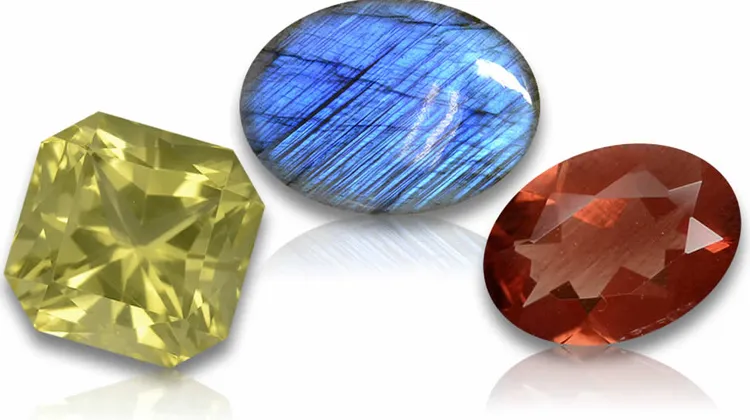
Within the feldspar group, several minerals exhibit strong optical phenomena that elevate them from industrial minerals to gemstone-grade materials. These varieties are primarily valued for their light interaction effects rather than chemical composition.
Moonstone is the most well-known feldspar gemstone, characterized by a soft bluish-white glow caused by light interference between alternating feldspar layers. This optical effect, known as adularescence, gives the stone a floating light appearance.
Amazonite is a green variety of microcline feldspar. Its stable color is caused by trace amounts of lead and water-related structural defects within the crystal lattice. Due to its consistent appearance, it is often used as a decorative substitute for jade-like materials.
Sunstone contains microscopic inclusions of hematite or copper minerals. When light enters the crystal, these inclusions reflect sunlight in a glittering effect known as aventurescence, producing a sparkling metallic appearance.
Labradorite is one of the most visually dynamic feldspars, showing labradorescence—a strong iridescent effect that shifts between blue, green, gold, and purple depending on viewing angle. This is caused by light diffraction within internal lamellar structures.
7. Industrial Applications of Feldspar

Feldspar plays a fundamental role in multiple industrial sectors, particularly ceramics, glass manufacturing, and construction materials. Its primary function is as a fluxing and stabilizing agent.
In ceramic production, feldspar reduces the melting temperature of raw materials, allowing the formation of a glassy phase during firing. This improves product density, reduces porosity, and enhances mechanical strength. It also contributes to better surface smoothness and glaze stability.
In glass manufacturing, feldspar acts as a source of alumina (Al₂O₃), which significantly improves chemical durability, hardness, and thermal resistance of glass products. It also helps stabilize the melting process in high-temperature furnaces.
In construction materials, feldspar is widely used in coatings, fillers, and surface treatment compounds. It improves abrasion resistance, surface brightness, and long-term durability of building materials.
| 業界 | Role of Feldspar | Key Benefit |
|---|---|---|
| セラミックス | Fluxing agent | Lower firing temperature, higher strength |
| Glass | Alumina source | Chemical durability & hardness |
| Construction | Filler & coating material | Surface quality & wear resistance |
8. Feldspar Processing Flow & Equipment System
Feldspar processing typically follows a four-stage system: crushing, grinding, classification, and impurity removal.
| Stage | 装置 | 関数 |
|---|---|---|
| 粉砕 | Jaw + Cone Crusher | 一次サイズ縮小 |
| 研削 | Ball / Vertical Mill | Fine powder production |
| 分類 | Air Classifier | Particle size control |
| Separation | 磁気分離器 | Iron removal |
9. Key Technical Challenges in Feldspar Processing
Feldspar processing faces three main engineering challenges.
Iron contamination is the most critical issue, as even small amounts of Fe₂O₃ can affect color and transparency in ceramics and glass. Particle size control is also essential because different industries require different fineness levels.
Equipment wear is another major challenge due to the medium hardness of feldspar, which causes continuous abrasion on liners, grinding media, and crusher components.
10. Feldspar Plant Optimization Strategy
Modern feldspar processing plants focus on efficiency, purity, and energy consumption optimization.
Proper equipment selection based on ore hardness and final product requirements is essential. Improving classification precision and magnetic separation efficiency directly enhances product quality.
Automation systems also play a key role by stabilizing production, reducing human error, and improving overall operational efficiency.
結論
Feldspar is not only the most abundant mineral in the Earth’s crust but also a key material connecting geological science and modern industrial applications.
From raw mining operations to advanced mineral processing systems, its value lies not only in abundance but also in its versatility and processability.
With optimized processing technology and equipment configuration, feldspar’s industrial value can be significantly enhanced, creating higher economic returns for mineral processing industries.
FAQ for Feldspar Blog
1. What is feldspar mainly used for in industry?
Feldspar is mainly used in ceramic and glass manufacturing. It acts as a fluxing agent that lowers melting temperature, improves product density, and enhances mechanical strength. It is also widely used in construction materials such as fillers and coatings.
2. Why is feldspar important in ceramic production?
Feldspar plays a key role in ceramic production because it helps form a glassy phase during firing. This reduces porosity, increases hardness, and improves surface smoothness. It also helps control the firing temperature, making production more energy-efficient.
3. What is the difference between potassium feldspar and plagioclase feldspar?
Potassium feldspar is mainly used in ceramics due to its high K₂O content, which reduces melting temperature. Plagioclase feldspar contains sodium and calcium and is more commonly used in glass and construction materials for improving structural stability.
4. Why does feldspar have different colors?
Feldspar colors are caused by trace elements, internal mineral inclusions, and crystal structure differences. Elements like iron or rubidium change light absorption, while layered structures create optical effects such as iridescence and shimmer.
5. Is feldspar used in glass manufacturing?
Yes, feldspar is an important raw material in glass production. It provides alumina (Al₂O₃), which increases hardness, improves chemical resistance, and enhances thermal stability of glass products.
6. What makes feldspar suitable for mineral processing?
Feldspar has medium hardness (Mohs 6–6.5), good cleavage, and stable chemical properties. These characteristics make it suitable for crushing, grinding, and classification in industrial mineral processing plants.
7. What are the main challenges in feldspar processing?
The main challenges include iron contamination, particle size control, and equipment wear. Even small amounts of iron can affect product color, while improper grinding can reduce product quality and industrial performance.


 Japanese
  English
  Russian
  Arabic
  Vietnamese
  Spanish
  French
  Portuguese
  Chinese