



バッチ式ボールミル
- 容量: 10 t/h – 100 t/h
- 給餌量: < 25mm
- 出力サイズ: 0.1mm – 1mm
- モーター出力: 30kW – 1000kW (adjustable based on model and requirements)
- スピード: 25rpm – 50rpm
- 応用: Batch ball mills are widely used for grinding various materials, including ores, chemicals, ceramics, pigments, and pharmaceutical raw materials. They are particularly suitable for processes requiring precise control over grinding time and product quality, such as mineral processing, chemical manufacturing, and laboratory-scale production.
What is a Batch Ball Mill?
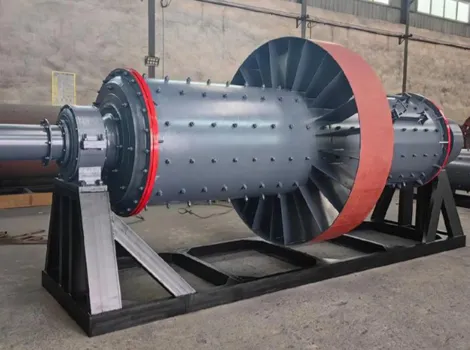
Batch ball mills are common material grinding equipment operating in an intermittent mode, processing one batch of material at a time. Unlike continuous ball mills, batch ball mills utilize a rotating cylinder to drive internal grinding media into collision and friction with the material, thereby achieving grinding. During the grinding process, the material continuously undergoes impact and compression from the grinding media, gradually achieving the desired particle size.
Batch ball mills find extensive application across mining, chemical, ceramic, pharmaceutical, and coating industries. They are particularly suited for processing small sample quantities or performing fine grinding, allowing adjustment of grinding time and media according to specific requirements. Their high operational flexibility makes them ideal for laboratory R&D, quality control, and small-scale production. These mills not only handle materials demanding high fineness but also accommodate diverse production needs, delivering more precise grinding results.
Working Principle of Batch Ball Mills
Batch ball mills operate in an intermittent mode, with each working cycle forming an independent loop. First, a measured quantity of material is loaded into the sealed cylinder along with grinding media such as steel balls or ceramic balls. The cylinder then begins rotating, and through the impact and friction forces of the grinding media, the material is progressively crushed to the desired fineness. Upon completion of the grinding process, rotation ceases and the finished product is fully discharged through the outlet.
This cyclical “loading-grinding-discharging” characteristic enables batch ball mills to achieve precise process control for each material batch. During operation, users can flexibly adjust the grinding time, grinding media, and formulation for each batch to meet specific grinding requirements. This efficient and flexible operating mode is particularly suitable for small-batch production, sample grinding, and R&D stages, perfectly aligning with the demands of multi-variety, small-scale manufacturing.
- Advantages of Batch Ball Mill
Batch ball mills offer high flexibility and precise control, meeting the demands of small-batch production and R&D. They enable rapid material and formula changes while ensuring consistent grinding results across each batch. Suitable for diverse industries, particularly those requiring high precision and multi-product manufacturing, these mills enhance production efficiency and guarantee product quality.
- Precise Process Control: Batch ball mills enable precise control over each grinding cycle. Since each batch is processed independently, you can adjust grinding time, media, and material formulations as needed to achieve optimal grinding results. This is particularly crucial for applications demanding fine control over particle size and consistency.
- Flexible Batch Production: The intermittent nature of batch processing makes it ideal for small-scale production or R&D. You can easily switch between different materials, formulations, or batch sizes without complex setup, significantly enhancing production flexibility.
- Wide Range of Applications: Batch ball mills offer high versatility, capable of processing materials ranging from metals to ceramics and chemicals. Their ability to handle diverse materials makes them ideal for laboratories, pilot-scale production, and industries requiring small-batch processing of multiple material types.
- Enhanced Product Quality: Batch ball mills allow precise adjustment of the grinding process for each batch, resulting in more uniform particle size distribution and higher-quality end products. Consistent grinding also effectively minimizes over-grinding, ensuring product uniformity.
- Rapid Batch Conversion: Switching between different materials and batches is quick and straightforward with batch ball mills, significantly reducing downtime. This makes them exceptionally well-suited for environments requiring frequent task changes.
- Cost-Effectiveness for Small-Scale Production: Compared to continuous ball mills, batch ball mills require lower initial investment, making them suitable for small-to-medium-scale production. They offer flexible processing solutions without the need for large-scale equipment, perfectly suited for small-batch production, pilot runs, or R&D testing, delivering high cost-effectiveness.

関連製品



Yes, batch ball mills are highly suitable for laboratory applications, particularly for small-batch grinding, formulation optimization, and material testing. They can process various types of materials and allow precise control over the grinding process to meet laboratory requirements for fineness, particle size distribution, and other specifications. The flexibility of batch ball mills makes them an ideal choice for R&D and laboratory environments.
Batch type is suitable for small-batch, multi-variety production and R&D scenarios, while continuous type is better for large-scale, single-variety industrial continuous production.
Processing time depends on material hardness and target fineness, typically taking 2-8 hours. The equipment is equipped with process monitoring function, allowing sampling and testing at any time.
We provide a quick cleaning system that can complete thorough cleaning within 15-30 minutes through special door design and inner wall polishing treatment.
By adjusting grinding time, media ratio and rotation speed, the product particle size distribution can be precisely controlled.
 Japanese
  English
  Russian
  Arabic
  Vietnamese
  Spanish
  French
  Portuguese
  Chinese