


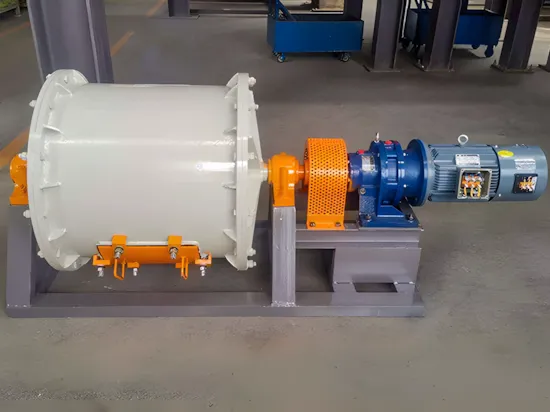
ミニボールミル
- 容量: 0.1–5 T/H
- モーター出力: 0.5–15 kW
- Cylinder Volume: 10–200 L
- 回転速度: 20–80 rpm
- Feed Size: ≤15mm
- 応用: Mini ball mills are ideal for laboratory and small-scale production, efficiently grinding metals, non-metal minerals, chemical powders, ceramics, and magnetic materials. Perfect for ultrafine powder preparation and small batch testing.
Mini Ball Mill for Sale
Mini ball mill is a versatile, high-performance grinding device suitable for use as a laboratory ball mill. It is ideal for pilot plants, research centers, and small-scale production lines. This equipment serves as a critical component for pulverizing materials after initial crushing. Based on discharge methods, mini ball mills are categorized into grid-type and overflow-type models, offering flexible solutions for diverse experimental or production requirements. Compact in size yet durable and precise, the mini ball mill rapidly and uniformly grinds metals, minerals, chemical powders, ceramics, and other solid materials. Its adjustable grinding speed and configurable grinding media ensure precise particle size control, making it highly suitable for preparing ultrafine powders, small-batch testing, and scientific research experiments.
Mini ball mill machine incorporates advanced safety features, operates with low noise levels, and employs an energy-efficient design that is both reliable and efficient. It delivers a user-friendly, cost-effective grinding solution for professional researchers and industrial users. Whether for scientific research, new material development, or industrial testing, the mini ball mill achieves stable, high-performance grinding within its compact footprint.
Working Principle of Mini Ball Mill
In a mini ball mill, also known as a portable ball mill, the material enters the drum through the feeding device. Inside the rotating cylinder, the grinding media—such as steel balls, forged steel balls, or ceramic balls—move together with the material as the drum turns. Due to centrifugal force, the grinding media are lifted along the inner wall of the drum and then fall freely once they reach a certain height.
This repeated falling and rising motion creates strong impact, friction, and shearing forces, which gradually break the material into finer particles. As grinding continues, the ground slurry is pushed toward the discharge opening by the combined force of new feeding material and flushing water. Finally, the finished product flows out of the mill, completing the entire grinding process.
This simple yet highly efficient mechanism makes mini ball mills ideal for laboratory testing, teaching, mineral analysis, and small-scale material preparation.
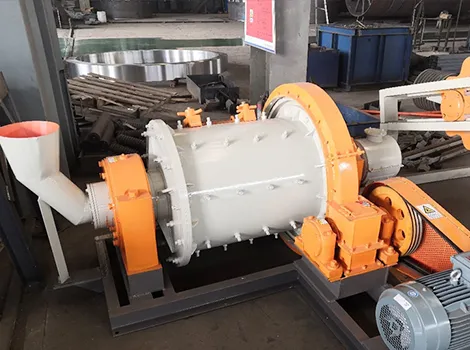
- Advantages of Mini Ball Mill
When selecting grinding equipment for experiments, you undoubtedly seek devices that are easy to operate, deliver consistent grinding results, and adapt to diverse material testing requirements. The Mini Ball Mill is specifically designed for such scenarios, offering multiple advantages that simplify your experimental grinding tasks.
Compact design, flexible installation
The mini ball mill is designed with a compact structure and lightweight body, allowing you to set it up easily in laboratories, small workshops, or teaching facilities. Whether used independently or combined with other laboratory equipment, it adapts to your workspace without requiring major infrastructure.
Perfect for research, testing, and small-batch production
As a professional laboratory ball mill, it plays a critical role in material characterisation, formula development, mineral testing, and powder preparation. It allows you to conduct repeated tests efficiently, helping you optimize production processes before scaling up to industrial equipment.
Excellent grinding performance for various materials
With support for dry grinding and wet grinding, the mini ball mill handles a wide range of materials—from minerals and cement clinker to chemicals, ceramics, and new energy materials. By selecting different grinding media (steel balls, ceramic balls, stainless balls), you can tailor the grinding effect to your specific research needs.
Consistent particle size & stable output
The rotating drum generates strong impact and friction forces, ensuring that materials are finely ground with a uniform particle size distribution. This stability is especially important for laboratory research, QC processes, and high-precision sample preparation.
Lower power consumption & reduced operating cost
Compared with large ball mills, mini ball mills require significantly less power. Their optimized internal structure enhances grinding efficiency while reducing energy loss, making your long-term laboratory operations more cost-effective.
Durable, low-maintenance structure
The mini ball mill features a simple mechanical design with fewer wearing parts. It is easy to clean, easy to maintain, and offers long service life—minimizing downtime and improving experiment efficiency.
Safe and user-friendly operation
Equipped with safety covers, overload protection, and simple control panels, it provides a safe grinding environment even for inexperienced users. This makes it ideal for schools, research institutes, and pilot labs.

関連製品




You can use steel balls, stainless steel balls, ceramic balls, or zirconia balls. The choice depends on hardness, contamination requirements, and the desired final fineness.
Depending on the material, it typically achieves fineness from several microns to tens of microns, with some materials reaching sub-micron level.
Suitable for most solid materials including minerals, chemicals, plant samples, etc. Supports both dry and wet grinding.
Features low-noise design with quiet operation, ideal for laboratory environments.
No special installation needed – just plug in and use, truly plug-and-play equipment.
 Japanese
  English
  Russian
  Arabic
  Vietnamese
  Spanish
  French
  Portuguese
  Chinese