


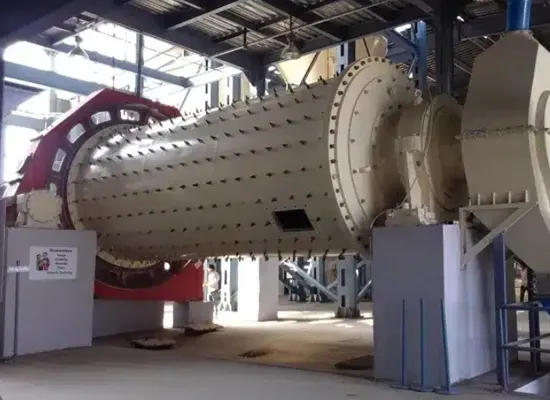
連続式ボールミル
- 容量: 1–150 t/h, adjustable based on material and grinding requirements.
- 研削媒体: Steel balls or ceramic balls, selected according to material specifications.
- モーター出力: 50–500 kW, offering flexible configurations.
- 応用: Continuous ball mills are grinding equipment widely used across multiple industrial sectors, meeting production demands in industries such as cement, refractories, fertilizers, metals, and glass ceramics. They are particularly well-suited for processing various ores and raw materials, ensuring the uniformity and fineness of the final product.
What is a Continuous Ball Mill?
Continuous ball mills are grinding equipment designed for large-scale production. They operate through continuous feeding and discharging, enabling stable, long-term operation. Compared to traditional batch ball mills, the continuous ball mill’s design achieves efficient material pulverization during uninterrupted operation. It is widely used in industries such as cement, ore processing, ceramics, and chemicals. This equipment can perform either dry or wet grinding based on material properties, accommodating various particle size requirements while ensuring excellent grinding uniformity at high throughput rates.
During operation, materials continuously collide and rub against grinding media (such as steel balls) within the grinding chamber, progressively achieving the desired fineness. Continuous ball mills are typically equipped with automated control systems that monitor grinding parameters in real time, ensuring stable and efficient production processes. Furthermore, the equipment can be customized to meet diverse production needs, accommodating various materials and capacity requirements, making it an indispensable piece of machinery in modern industrial production.
We Can Build Your Continuous Ball Mill
As a professional continuous ball mill manufacturer, we specialize in providing customized continuous ball mill solutions tailored to your requirements. Whether you need to process metal ores, non-metallic minerals, chemical raw materials, or special wet or sticky materials, we can deliver suitable designs and configurations. Our engineering team will thoroughly understand your production processes, material properties, and output demands to design the most suitable continuous ball mill specifically for your needs.
At our factory, we possess advanced production technology and equipment, enabling us to personalize machinery according to your requirements.
- Production Capacity Customization: Based on your production scale, we offer continuous ball mill machine with varying capacities to fully meet your operational needs.
- Material Processing Methods: Whether dry or wet grinding, we provide corresponding solutions to ensure efficient operation under diverse process conditions.
- Durability and Performance Optimization: We select appropriate grinding media and lining materials based on material properties to enhance wear resistance and service life, thereby reducing operational costs.
- Automated Control Systems: Upon request, we can equip your machinery with intelligent automated control systems for simplified operation, real-time monitoring of equipment status, and improved production efficiency.
- Energy Efficiency & Eco-Design: We optimize designs to reduce energy consumption while adhering to environmental standards. Our equipment operates dust-free and meets all regulatory requirements.
Through these customized services, we ensure each continuous ball mill precisely adapts to your production environment. This boosts efficiency, lowers maintenance costs, and helps you gain a competitive edge in the market.
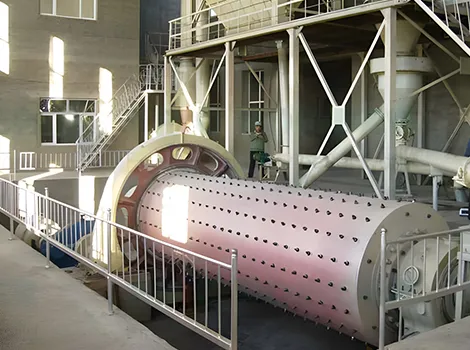
- Advantages of Continuous Ball Mill
- Continuous Ball Mill VS Batch Ball Mill
If you require efficient, continuous, and stable production equipment, the continuous ball mill is the ideal choice. Operating in an uninterrupted mode, it not only delivers high output and precise grinding results but also offers multiple advantages such as energy efficiency and environmental friendliness.
- High-Efficiency Continuous Production Capacity: Through continuous feeding and discharging, the continuous ball mill enables 24-hour uninterrupted high-efficiency production. This makes it particularly suitable for large-scale, long-running production lines, meeting high-output demands and enhancing production efficiency.
- Uniform Grinding Effect: The continuous feeding and discharging process ensures constant mixing and collision between grinding media and materials inside the mill, facilitating uniform grinding results. This is crucial for products requiring precise particle size distribution, particularly in industries like cement, ore processing, and ceramics.
- Energy Efficiency and Environmental Protection: Thanks to continuous operation and optimized design, continuous ball mills exhibit relatively low energy consumption. Through intelligent control systems, energy usage can be effectively minimized. Additionally, the liquid grinding process prevents dust generation, meeting environmental protection requirements.
- Flexible Customization: Continuous ball mills can be tailored to different material properties, particle size requirements, and production scales. Whether for wet or dry grinding, we optimize solutions to ensure stable operation under varied conditions.
- Automated Control Systems: Modern continuous ball mills feature automated control systems that monitor and adjust the grinding process in real time. This ensures production stability, reduces manual intervention, and enhances efficiency and precision.
- Low Maintenance Costs and High Reliability: The rational structural design of continuous ball mills ensures stable operation with minimal equipment wear, reducing downtime and maintenance expenses. Their high reliability guarantees continuous operation during production, lowering overall maintenance costs.
- Wide Range of Applications: Whether processing metal ores, non-metallic minerals, chemical raw materials, or moist/viscous materials, continuous ball mills deliver efficient handling across diverse applications, meeting production demands across various industries.
Selecting the appropriate ball mill depends on your production requirements. Continuous ball mills are suitable for large-scale, long-term production, while batch ball mills are ideal for small-batch, periodic production. Based on production volume, frequency, and budget, you can choose the most suitable type.
Operating Mode
- Continuous Ball Mill: Grinds materials through continuous feeding and discharging, suitable for prolonged, uninterrupted production operations. Materials flow within the mill, undergo multiple grinding cycles, and are ultimately discharged, ensuring sustained production capacity.
- Batch Ball Mill: Operates intermittently, grinding a fixed batch of materials per cycle. After grinding, the material must be removed before the next batch can be loaded. This method suits smaller batch production needs.
生産能力
- Continuous Ball Mill: Offers high production capacity, capable of sustained operation over extended periods. Suitable for large-scale, high-volume production demands.
- Batch Ball Mill: Typically features lower production capacity, ideal for small-scale, periodic, or experimental production tasks.
適用範囲
- Continuous Ball Mill: Suitable for industries requiring large-scale continuous production, such as cement, mining, and chemical plants.
- Batch Ball Mill: Suitable for small-batch production or applications with strict batch requirements, such as laboratory research or specialized custom product manufacturing.
Operational Simplicity
- Continuous Ball Mill: Requires complex feeding, discharging, and control systems. Operation demands seamless system flow to minimize downtime.
- Batch Ball Mill: Features relatively straightforward operation, allowing periodic material loading and unloading as needed. Suitable for diverse materials and batch-controlled processes.
料金
- Continuous Ball Mill: Typically requires higher initial investment due to complex equipment structure and high production capacity. However, long-term operational efficiency and reduced manual intervention lead to lower running costs.
- Batch Ball Mill: Features simpler equipment structure and lower initial investment, but offers lower production efficiency, making it suitable for cost-sensitive small-scale production.
Maintenance and Reliability
- Continuous Ball Mill: Requires higher reliability and more frequent maintenance to ensure long-term stable operation.
- Batch Ball Mill: Maintenance is relatively straightforward, and equipment failures have a smaller impact on production, making it suitable for low-frequency production environments.
Particle Size Distribution and Uniformity
- Continuous ball mills: Deliver more uniform particle size distribution due to uninterrupted grinding, suitable for applications with strict particle size requirements.
- Batch ball mills: Each grinding cycle is shorter, potentially resulting in less uniform particle size distribution compared to continuous mills. Suitable for production applications with less stringent particle size requirements.

関連製品



We guarantee particle size stability through multiple safeguards: First, a precise quantitative feeding system maintains consistent feed input. Second, the equipment features an advanced particle size analyzer for real-time monitoring of output fineness. Finally, an automated control system dynamically adjusts classifier parameters, forming a closed-loop control system to ensure product particle size consistently meets specifications.
This depends on material properties. Steel balls typically last 3-6 months, while liners last 6-12 months. We recommend inspecting wear every 2000 operating hours. The equipment features convenient access doors and replacement mechanisms, significantly reducing maintenance time.
Standard models are recommended for materials with moisture content <5%. For higher moisture content, we can customize anti-adhesion liners and integrate a hot air system to dry materials during grinding, enabling processing of materials with up to 15% moisture content.
Maintenance for the continuous ball mill is relatively straightforward, focusing primarily on regular inspections and lubrication. We recommend periodic checks of grinding media, liners, and sealing systems to ensure efficient operation. The equipment is designed to minimize maintenance frequency and costs.
For standard models, the process from equipment delivery to commissioning typically takes 4-6 weeks. The exact timeline depends on foundation construction progress and the complexity of supporting systems. We offer turnkey project services to ensure seamless coordination across all phases, minimizing the time to production.
 Japanese
  English
  Russian
  Arabic
  Vietnamese
  Spanish
  French
  Portuguese
  Chinese