


Building an integrated cement plant is a strategic investment that directly determines a cement producer’s competitiveness for decades. Unlike grinding-only projects, an integrated cement plant covers the entire production chain, including raw material mining, crushing, raw meal preparation, clinker production, cement grinding, and final product dispatch. Each process stage is technically connected, and any weakness in system design will gradually amplify during long-term operation.
For this reason, modern integrated cement plants are no longer designed around individual machines. Instead, they are developed as highly coordinated process systems where equipment selection, process configuration, automation level, and energy efficiency are considered as a whole. Only with a systematic engineering approach can a cement plant achieve stable production, low operating cost, and long-term environmental compliance.

Project Planning and Capacity Definition: The Starting Point of Equipment System Design
The first step in building an integrated cement plant is defining a realistic production capacity based on market demand, raw material availability, and investment strategy. Capacity selection directly affects the scale and technical parameters of major equipment such as raw material grinding mills, preheater towers, rotary kilns, clinker coolers, and cement grinding systems.
An oversized plant may face low utilization and financial pressure, while an undersized plant may suffer from high unit production costs. Therefore, capacity planning must be closely linked with equipment feasibility. Modern EPC cement plant projects often focus on flexible capacity design, allowing future expansion without disrupting existing systems.
Raw Material Resources and Plant Location: Defining Process Complexity
Raw material characteristics form the foundation of cement plant design. Limestone quality, chemical stability, moisture content, and hardness all influence the selection and configuration of cement production equipment. Stable raw materials allow simplified process flows and lower equipment load, while fluctuating raw materials require stronger blending systems and higher process control accuracy.
Plant location also plays a critical role. Sufficient land availability allows optimal equipment layout and smooth material flow. Reliable power supply, water resources, fuel logistics, and environmental conditions must all be evaluated during the early engineering stage to avoid long-term operational limitations.
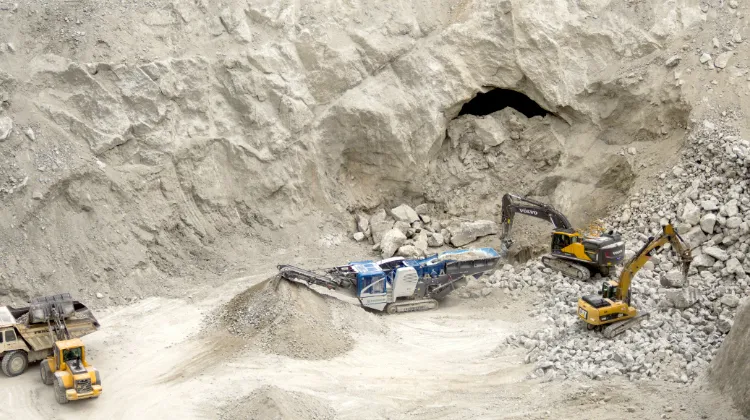
Mining Engineering and Crushing Systems: Optimizing the Front-End of Production
Mining engineering is the first physical step in cement production and has a direct impact on downstream equipment performance. Well-planned quarry operations ensure consistent limestone size and quality, reducing stress on crushing and grinding equipment.
Primary crushing systems usually consist of jaw crushers, hammer crushers, or impact crushers, depending on limestone hardness and production capacity. Proper crusher selection ensures stable feed size to the raw material system, lowering energy consumption and improving overall plant reliability. Continuous belt conveying systems are commonly adopted to transport crushed limestone efficiently from the quarry to the plant.
Pre-Blending and Raw Material Handling Systems: Stabilizing Material Quality
After crushing, raw materials are stored in pre-blending yards equipped with stackers and reclaimers. The purpose of pre-blending is to reduce chemical fluctuations before raw meal grinding. Effective pre-blending creates a buffer that protects downstream equipment from raw material instability.
Well-designed pre-blending systems significantly improve the operational stability of raw mills and kilns. From an EPC perspective, this stage is essential for long-term energy efficiency and production consistency.
Raw Material Grinding System: Vertical Roller Mills as Core Equipment
The raw material grinding system is one of the most important units in an integrated cement plant. Modern plants widely adopt vertical roller mills (VRMs) due to their high efficiency, compact layout, and integrated drying capability.
In a VRM system, grinding, drying, and classification are combined into a single unit. Hot exhaust gas from the preheater or kiln is used to dry raw materials, reducing the need for additional heat sources. High-efficiency dynamic separators ensure stable raw meal fineness, which directly affects clinker burning efficiency and fuel consumption.
Raw Meal Homogenization and Storage: Ensuring Stable Kiln Feed
After grinding, raw meal is stored in homogenization silos equipped with pneumatic or mechanical blending systems. These systems continuously mix raw meal to achieve consistent chemical composition over time.
Stable kiln feed is essential for smooth kiln operation. Good homogenization reduces thermal fluctuations in the kiln system, lowers refractory wear, and simplifies operational control. As a result, both equipment life and energy efficiency are improved.
Clinker Production System: Preheater, Calciner, and Rotary Kiln Integration
The clinker production line is the technological core of an integrated cement plant. Modern plants use multi-stage cyclone preheater systems to maximize heat exchange between raw meal and kiln exhaust gas. This significantly reduces thermal consumption and improves overall efficiency.
The calciner allows most of the limestone decarbonation to occur outside the rotary kiln, reducing kiln length and thermal load. Advanced calciners are designed for multi-fuel operation and low-NOx combustion, supporting both cost control and environmental compliance.
The rotary kiln remains the heart of clinker production. Its mechanical design, drive system reliability, burner performance, and refractory quality all determine long-term operational stability. High-quality kiln equipment is essential for continuous, trouble-free production.

Clinker Cooling System: Heat Recovery and Product Quality Control
After leaving the kiln, clinker must be rapidly cooled to stabilize mineral structure and recover heat. Fourth-generation grate coolers are now standard in modern integrated cement plants. These systems offer high cooling efficiency, low pressure drop, and excellent heat recovery performance.
Recovered heat is reused as secondary and tertiary air for combustion, significantly reducing fuel consumption. Efficient clinker cooling also improves clinker quality and reduces wear on downstream cement grinding equipment.

Cement Grinding System: Energy Efficiency and Product Flexibility
Cement grinding is the most power-intensive stage of cement production. To reduce energy consumption, modern plants use vertical cement mills or high-pressure grinding roll (HPGR) systems combined with ball mills.
HPGR systems create micro-cracks in clinker particles, improving grindability and reducing specific power consumption. Vertical cement mills offer compact layouts, high efficiency, and precise control of cement fineness and particle size distribution, making them ideal for multi-product cement plants.
Cement Storage, Packing, and Dispatch Systems: Connecting Production with the Market
Finished cement is stored in silos equipped with fluidization and reliable discharge systems. Efficient cement storage ensures smooth logistics and protects product quality.
Automatic packing machines, bulk loading systems, and truck or rail dispatch facilities are integrated into modern cement plants to ensure fast, accurate, and low-labor product delivery. These systems directly affect customer satisfaction and market competitiveness.
Environmental Protection, Waste Heat Recovery, and Automation Systems
Environmental protection is an integral part of integrated cement plant design. Bag filters, electrostatic precipitators, and denitrification systems are installed throughout the production line to meet emission standards.
Waste heat recovery power generation systems utilize exhaust gas from the kiln and clinker cooler to produce electricity, reducing operating costs and carbon emissions. Distributed control systems (DCS) integrate all production units, enabling centralized monitoring, precise control, and continuous optimization.
Conclusion: Integrated Equipment Systems Define Long-Term Success
Building an integrated cement plant is not simply about installing equipment. It is a long-term engineering project centered on system integration, equipment reliability, and operational efficiency. By carefully designing each process stage and selecting the right cement plant machinery, producers can achieve stable production, low energy consumption, and sustainable development throughout the plant’s lifecycle.

 Japanese
  English
  Russian
  Arabic
  Vietnamese
  Spanish
  French
  Portuguese
  Chinese