



Rare earth elements have become one of the most important material groups in modern industrial development. Although they are not rare in terms of natural abundance, they are rarely found in concentrated and economically viable deposits, which makes their extraction and processing complex and costly.
In recent decades, the importance of rare earth elements has grown significantly due to the rapid development of clean energy systems, electric vehicles, advanced electronics, and high-performance industrial equipment. These materials are now widely recognized as essential enablers of modern technology rather than simple raw materials.
Their role extends across multiple strategic industries, including energy storage, aerospace engineering, defense systems, and heavy industrial manufacturing. As a result, rare earth elements have become closely linked to global supply chain stability and technological competitiveness.
2. What Are Rare Earth Elements?
Rare earth elements (REEs) refer to a group of seventeen metallic elements that share similar chemical properties. These include fifteen lanthanide elements along with scandium and yttrium.
In nature, these elements are rarely found in pure form. Instead, they are typically dispersed within complex mineral structures, which require advanced extraction and separation technologies to isolate economically usable materials.
From an industrial perspective, rare earth elements are generally divided into two categories: light rare earth elements and heavy rare earth elements. Each group plays a different role in modern manufacturing and technology development.
Light rare earth elements are more commonly found and easier to process, which makes them widely used in large-scale industrial production. Heavy rare earth elements, on the other hand, are less abundant and more difficult to extract, but they are essential for high-performance technologies that require extreme stability and precision.
3. Global Distribution of Rare Earth Resources
The distribution of rare earth resources across the world is highly uneven, which has significant implications for global trade and industrial supply chains.
China currently holds the dominant position in both production and processing capacity, making it the most influential player in the global rare earth industry. Vietnam and Brazil also possess substantial reserves, although their development levels vary.
Australia has developed advanced mining and refining capabilities and plays an important role in supplying high-quality rare earth materials. The United States has notable deposits, particularly in regions such as California, while Russia, Canada, and India continue to explore and develop their resource potential.
This uneven distribution has led to a highly concentrated supply chain, making rare earth elements strategically important in international industrial competition.
4. Physical Properties of Rare Earth Elements
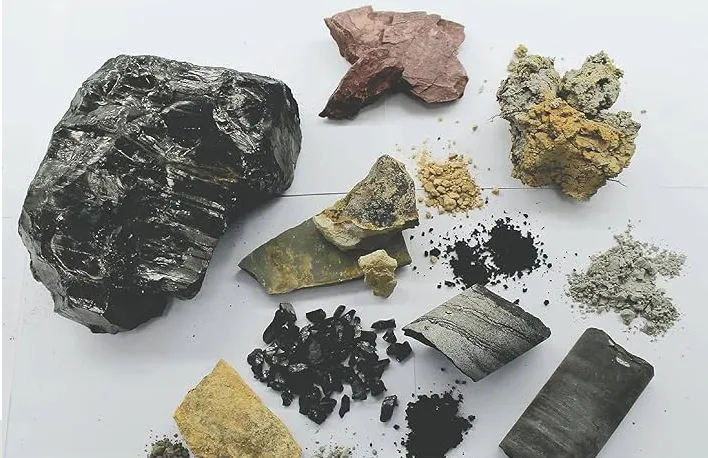
Rare earth elements possess a set of unique physical and chemical characteristics that distinguish them from other metals and make them indispensable in modern technologies.
One of their most important features is their exceptional magnetic performance. Certain rare earth elements are capable of producing extremely strong permanent magnets, which are essential for compact and efficient electric motors used in electric vehicles and wind turbines.
Another important property is their optical behavior. Many rare earth compounds exhibit strong luminescence, meaning they can absorb and emit light efficiently. This makes them widely used in display technologies, fiber-optic communication systems, and laser-based applications.
Rare earth elements also demonstrate high thermal stability, allowing them to maintain performance under extreme temperature conditions. This is particularly important in industrial machinery, aerospace systems, and energy-related applications where materials are exposed to continuous thermal stress.
In addition, their unique electron configuration enables unusual catalytic and electronic behaviors, which cannot be easily replicated by other elements. This is one of the reasons why rare earth elements are widely used in chemical processing and advanced material engineering.
5. Detailed Overview of the 17 Rare Earth Elements

Each rare earth element has specific industrial roles and material properties that contribute to its value in modern applications.
Lanthanum (La)
Lanthanum is widely used in industrial applications where material stability and optical performance are important. It plays a key role in nickel-metal hydride batteries, which are still used in hybrid vehicle systems. In addition, lanthanum improves the quality of optical glass by enhancing refractive properties, making it suitable for precision lenses and scientific instruments.
Cerium (Ce)
Cerium is one of the most widely utilized rare earth elements in industrial production. It is commonly used in automotive catalytic converters, where it helps reduce harmful emissions by supporting oxidation and reduction reactions. Cerium oxide is also widely applied in glass polishing, particularly in high-precision optical manufacturing.
Praseodymium (Pr)
Praseodymium is often used in combination with other rare earth elements to create high-strength alloys and advanced magnetic materials. It is also used in specialty glass and ceramic production, where it contributes to unique coloration and improved material stability in aerospace and industrial applications.
Neodymium (Nd)
Neodymium is one of the most commercially important rare earth elements due to its role in producing extremely powerful permanent magnets. These neodymium-iron-boron magnets are widely used in electric vehicle motors, wind turbines, robotics, and industrial automation systems. Its strong magnetic properties make it essential for energy-efficient mechanical and electrical systems.
Promethium (Pm)
Promethium is a radioactive rare earth element that does not occur naturally in significant quantities. It is mainly used in specialized industrial and aerospace applications, including auxiliary power sources and precision measurement devices.
Samarium (Sm)
Samarium is known for its ability to maintain strong magnetic properties even at high temperatures. It is widely used in samarium-cobalt magnets, which are essential in aerospace systems, military equipment, and high-temperature industrial environments. It is also used in laser technology and nuclear control systems.
Europium (Eu)
Europium plays a critical role in modern display and lighting technologies. It is used in phosphors that produce red and blue colors in LED screens and fluorescent lighting. Additionally, it contributes to advanced imaging systems used in medical diagnostics.
Gadolinium (Gd)
Gadolinium has strong magnetic characteristics and is widely used in medical imaging as a contrast agent in MRI scans. It is also used in nuclear reactors as a neutron absorber and has emerging applications in magnetic refrigeration technologies.
Terbium (Tb)
Terbium is used in advanced electronic materials and magneto-optical storage systems. It also plays an important role in producing green phosphors used in display technologies and contributes to high-performance electronic devices.
Dysprosium (Dy)
Dysprosium is essential for improving the thermal resistance of permanent magnets. It ensures that electric motors in electric vehicles and wind turbines can operate reliably under high-temperature conditions, making it a critical material in renewable energy systems.
Holmium (Ho)
Holmium is used in applications requiring extremely strong magnetic fields. It is also applied in medical laser systems and optical communication technologies where precision and stability are required.
Erbium (Er)
Erbium is widely used in fiber-optic communication systems, where it functions as a signal amplifier to enhance data transmission over long distances. It is also used in laser rangefinding systems and glass coloration technologies.
Thulium (Tm)
Thulium is used in medical imaging and portable X-ray devices. It also plays a role in advanced radiation-based cancer treatment technologies and specialized light source systems.
Ytterbium (Yb)
Ytterbium is commonly used in fiber laser systems and precision measurement equipment. It is also applied in industrial sensing technologies and pressure monitoring systems where high accuracy is required.
Lutetium (Lu)
Lutetium is used in petroleum refining catalysts and advanced medical imaging systems. It also plays a role in isotope-based geological dating, helping scientists determine the age of materials.
Scandium (Sc)
Scandium is highly valued in the production of aluminum alloys, where it significantly improves strength, corrosion resistance, and structural stability. It is also used in semiconductor technology and high-efficiency lighting systems.
Yttrium (Y)
Yttrium is widely used in ceramic materials, aerospace components, and superconducting technologies. It enhances oxidation resistance and improves the durability of advanced engineering materials used in extreme environments.
6. Industrial Applications of Rare Earth Elements
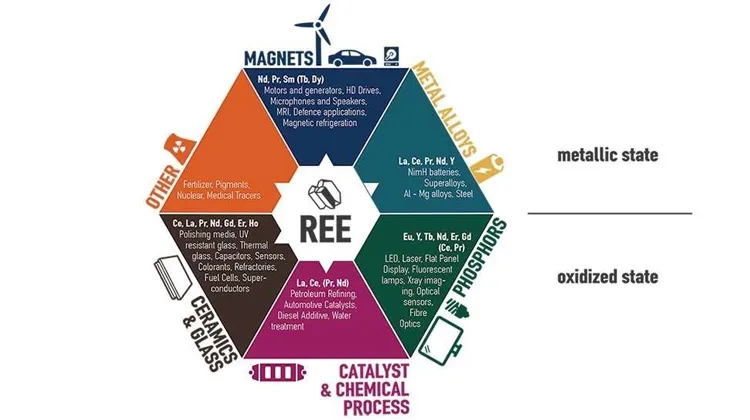
Rare earth elements are deeply integrated into modern industrial systems and advanced manufacturing processes.
Beyond their use in electronics and energy systems, they also play an important role in heavy industrial equipment. In industries such as cement production, mining machinery, and material processing systems, rare earth-based alloys are often used in components that require high resistance to wear, heat, and mechanical stress.
This makes them valuable not only for high-tech industries but also for large-scale industrial infrastructure where durability and operational stability are critical.
7. Future Trends of the Rare Earth Industry
The global rare earth industry is expected to continue evolving in response to technological and economic changes.
Demand is increasing steadily due to the expansion of electric vehicles and renewable energy systems. At the same time, more attention is being given to recycling rare earth materials from electronic waste to reduce dependency on mining.
In addition, many countries are investing in diversifying their supply chains to reduce reliance on a small number of producers. This is leading to the development of new mining projects and advanced material processing technologies around the world.
8. FAQ
What are rare earth elements used for?
Rare earth elements are used in electric vehicles, wind turbines, electronics, catalysts, medical imaging, and industrial machinery due to their unique magnetic, optical, and chemical properties.
Why are rare earth elements important?
They are essential for modern technology because they enable high-efficiency motors, renewable energy systems, and advanced electronic devices.
Which country has the most rare earth resources?
China currently holds the largest production capacity and supply chain dominance in the global rare earth market.
Are rare earth elements actually rare?
No, they are not rare in abundance, but they are rarely found in concentrated and economically exploitable deposits.
9. Conclusão
Rare earth elements are essential materials that form the foundation of many modern technologies. Their unique physical properties enable advancements in energy, transportation, electronics, and industrial manufacturing.
As global demand continues to grow, their importance in both technological innovation and industrial supply chains will only increase. Understanding rare earth elements is therefore crucial for industries that rely on high-performance materials and long-term technological development.


 Portuguese
  English
  Russian
  Arabic
  Vietnamese
  Spanish
  French
  Japanese
  Chinese