


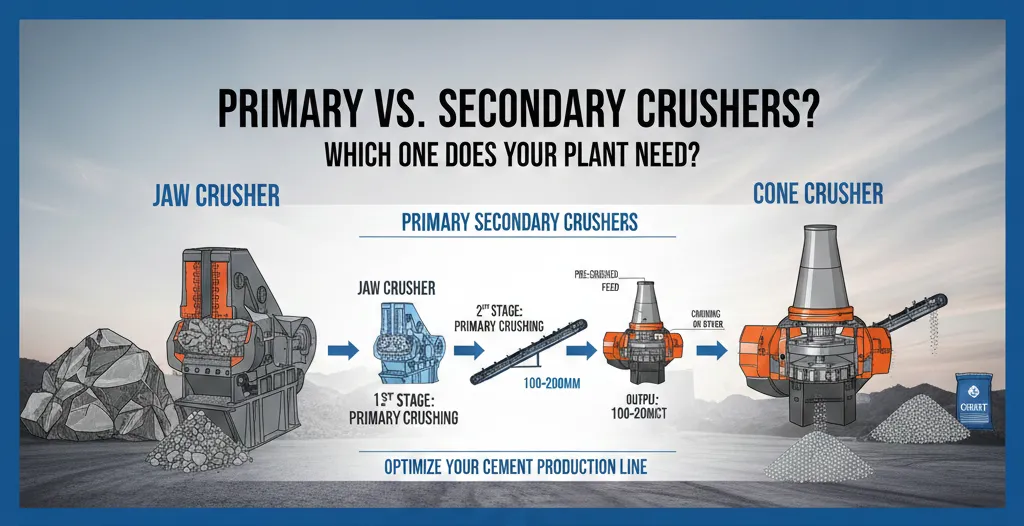
In cement plants, mining projects, and aggregate production lines, the crushing system is one of the most critical parts of the entire process. Whether the raw material is limestone, granite, basalt, or various types of ore, it must be properly crushed before it can enter the grinding, screening, or further processing stages. In modern industrial practice, crushing is rarely done by a single machine. Instead, it is usually divided into several stages according to the size reduction process, among which primary crushing and secondary crushing are the two most important steps.
When planning a crushing plant, many investors and engineers ask the same questions: What is the real difference between a primary クラッシャー and a secondary crusher? What roles do they play in a complete production line? And how does the choice of configuration affect capacity, energy consumption, and long-term operating cost? This article explains these questions from a practical engineering point of view and helps you better understand how to design a more efficient and reliable crushing system.
What Is a Primary Crusher?
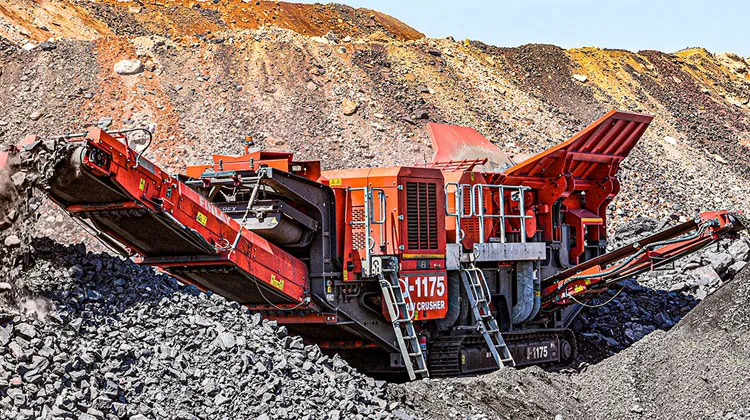
In any mining or quarrying operation, the raw material that comes directly from the blasting site or quarry face is usually extremely large, irregular in shape, and very hard. In many cases, single pieces of rock can be more than one meter in size. Such material cannot be transported, screened, or processed by downstream equipment without first being reduced in size. This is exactly where the primary crusher plays its role.
The main purpose of a primary crusher is to carry out the first stage of size reduction. Instead of trying to produce a final product size, it focuses on breaking large rocks into pieces that are small enough to be handled by conveyors and by the next stage of crushing equipment. In other words, the primary crusher acts as the “entrance” of the entire crushing system, and its stability and reliability largely determine whether the whole production line can run continuously and efficiently.
In the cement industry, for example, limestone is the most common raw material. The size of limestone blocks after blasting can be extremely large. A strong and heavy-duty primary crusher is therefore required to handle these materials under continuous impact and heavy load. For this reason, primary crushers are usually designed with very robust structures, large crushing chambers, and components that can withstand long-term high-stress operation.
Common Types of Primary Crushers
In industrial applications, jaw crushers, gyratory crushers, and heavy hammer crushers are the most widely used machines for primary crushing. Jaw crushers are popular because of their simple structure, easy maintenance, and strong adaptability to different types of materials, especially in cement plants and medium-size mining projects. Gyratory crushers are more often used in very large-scale mining operations, where extremely high capacity and continuous operation are required. Heavy hammer crushers, in some limestone projects, can achieve a very large reduction ratio and sometimes even allow a simplified process flow.
Although their structures and working principles are different, all these machines share the same design philosophy: they must be able to accept very large feed sizes and operate in a stable and reliable way, rather than focusing on producing a very fine or perfectly shaped final product at this stage.
Typical Working Characteristics of Primary Crushers
From a practical point of view, a primary crusher usually handles feed sizes in the range of 500 mm to 1500 mm, or even larger in some mining projects. After crushing, the discharge size is still relatively coarse, often around 100 mm to 300 mm. This material is not the final product, but an intermediate product that is suitable for further processing in the secondary crushing stage.
At this point in the process, engineers pay much more attention to capacity, mechanical strength, and resistance to impact loads than to energy consumption per ton or final product shape. The reason is simple: if the primary crushing stage becomes unstable or stops working, the entire plant will be forced to shut down, which can cause significant production losses.
| アイテム | Typical Characteristics |
|---|---|
| Feed size | Very large (usually 500–1500 mm) |
| Discharge size | Relatively coarse (about 100–300 mm) |
| Main objective | Stable handling of large rocks |
| Design focus | Strength, reliability, and capacity |
What Is a Secondary Crusher?
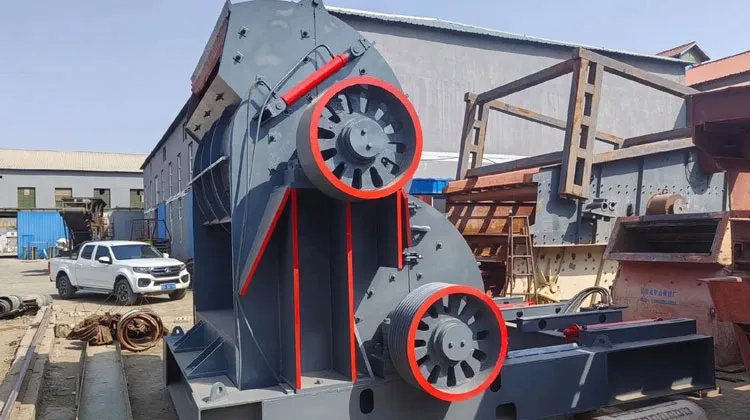
After the material has passed through the primary crusher, its size is already much smaller than before, but it is still far from suitable for final use. Whether the material is going to a raw mill in a cement plant or to a screening system in an aggregate plant, further size reduction is still necessary. This is the task of the secondary crusher.
The purpose of secondary crushing is not only to make the material smaller, but also to make it more suitable for the next processing stage. Compared with primary crushing, secondary crushing pays much more attention to the quality of the crushed product, including particle size distribution, particle shape, and the stability of the output size.
In many cement and aggregate projects, a well-designed secondary crushing stage can significantly reduce the workload of the grinding mill. This directly leads to lower energy consumption and lower operating costs for the whole plant. For this reason, secondary crushing is often regarded as a key step in optimizing the overall process and improving economic efficiency.
Common Types of Secondary Crushers
In real projects, impact crushers, cone crushers, and hammer crushers are the most common choices for secondary crushing. Impact crushers are widely used in limestone and medium-hard material applications because they can produce a good particle shape and have a relatively large reduction ratio. Cone crushers are more suitable for hard and abrasive materials and are therefore very popular in mining and hard-rock aggregate production lines. Hammer crushers are also used in some projects where both crushing and shaping are required at the same time.
Unlike primary crushers, these machines are designed with more emphasis on controlling the final product size and shape, rather than simply breaking large rocks into smaller ones.
Typical Working Characteristics of Secondary Crushers
In most cases, the feed size of a secondary crusher comes directly from the discharge of the primary crusher, which is usually in the range of 100 mm to 300 mm. After secondary crushing, the material size is further reduced to around 10 mm to 50 mm, or to another range that is suitable for the specific process requirements.
At this stage, factors such as reduction ratio, product shape, adjustability, and operating stability become very important. The performance of the secondary crusher often has a direct influence on screening efficiency, mill performance, and the quality stability of the final product.
| アイテム | Typical Characteristics |
|---|---|
| Feed size | Medium (about 100–300 mm) |
| Discharge size | Finer (about 10–50 mm) |
| Main objective | Size control and shape optimization |
| Design focus | Reduction ratio, product quality, and adjustability |
Key Differences Between Primary and Secondary Crushers

Although both primary and secondary crushers belong to the same general category of crushing equipment, their roles in the production line are fundamentally different. The primary crusher is more like a heavy-duty front-end machine whose main task is to ensure that any large rock can be processed and fed into the system without interruption. The secondary crusher, on the other hand, works more like a refining machine, focusing on improving the size distribution and quality of the material that has already been pre-crushed.
If we compare the whole crushing system to a processing line, the primary crusher solves the problem of “whether the material can enter the system smoothly,” while the secondary crusher solves the problem of “whether the material is suitable for efficient downstream processing.” This clear division of roles is the basis for designing a modern, efficient, and energy-saving crushing plant.
| Comparison Item | 一次破砕機 | 二次破砕機 |
|---|---|---|
| Position in line | First stage | Second stage |
| Main task | Handle very large rocks | Further reduce and refine material |
| Design priority | Strength and capacity | Size control and product quality |
| Typical machines | Jaw, Gyratory | Impact, Cone |
Typical Application in a Cement Production Line
In a standard limestone crushing system for a cement plant, the raw material is usually first fed into a jaw crusher for primary crushing. The large limestone blocks are reduced to a size that can be transported and further processed. Then, this material is sent to an impact crusher or hammer crusher for secondary crushing, where the size is further reduced and the particle shape is improved. After that, the material is sent to the raw mill system.
This “coarse first, then fine” configuration can significantly reduce the energy consumption of the grinding process and also reduce wear inside the mill. From the point of view of long-term operation, a well-designed two-stage crushing system is often much more economical and stable than a simple single-stage solution.
Is Secondary Crushing Always Necessary?
In engineering practice, not every project must strictly follow a two-stage crushing process. In some cases, especially when the material is relatively soft and the required capacity is not very high, a heavy hammer crusher can sometimes achieve one-stage crushing and produce a suitable product size directly. This can simplify the process flow and reduce initial investment.
However, for most cement plants and mining projects that aim for long-term stable operation, high capacity, and low unit energy consumption, a properly designed primary and secondary crushing system is still the safer and more economical choice. This is especially true when dealing with hard or highly abrasive materials, where a reasonable secondary crushing stage can significantly reduce overall maintenance costs.
How to Choose the Right Crushing System Configuration?
In real projects, there is no single standard solution that fits all situations. Engineers must consider many factors together, including the type and hardness of the raw material, the maximum feed size, the required capacity, the target product size, and the available investment budget. In many cases, adding a well-chosen secondary crusher may increase the initial equipment cost, but it can save much more money later through lower energy consumption and lower maintenance costs.
Therefore, a truly reasonable solution should always be evaluated from the perspective of total life-cycle cost, rather than only from the perspective of initial investment.
結論
In essence, the primary crusher solves the problem of how to handle very large rocks and feed them into the system smoothly, while the secondary crusher focuses on making this material more suitable for further processing and final use. They do not replace each other. Instead, they work together and support each other, and their combined performance determines the overall efficiency, stability, and long-term operating cost of a cement or mining crushing plant.


 Japanese
  English
  Russian
  Arabic
  Vietnamese
  Spanish
  French
  Portuguese
  Chinese