


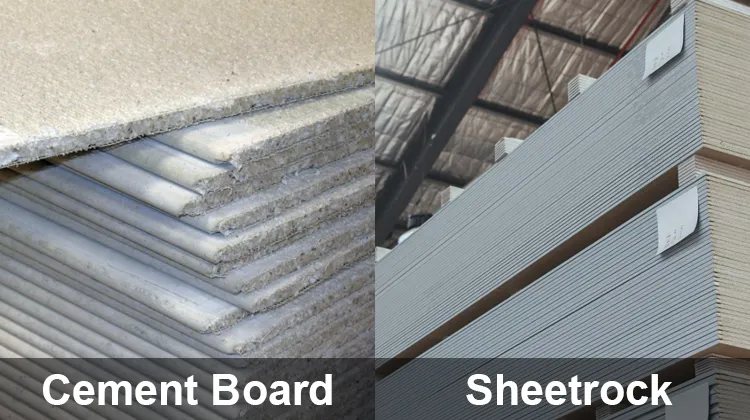
When choosing wall or backing materials, many people face the same question:
Sheetrock and Cement Board look similar — so what is the real difference between them?
In fact, these two materials are designed for very different purposes.
From moisture resistance and structural strength to installation methods and service life, Sheetrock and Cement Board perform differently and are suitable for completely different building applications.
What Is Sheetrock?

Sheetrock is a well-known brand name that has become synonymous with drywall in many markets, especially in North America.
Technically, Sheetrock refers to a gypsum-based panel consisting of a gypsum core sandwiched between paper facings.
Sheetrock is primarily designed for interior, non-load-bearing applications, where fast installation, low cost, and smooth finishing are required.
Because gypsum contains chemically bound water, Sheetrock also provides a basic level of fire resistance, making it suitable for standard residential and commercial interiors.
However, Sheetrock is not a structural or moisture-resistant material.
Its paper surface and gypsum core can deteriorate when exposed to water or high humidity, which limits its use to dry, controlled indoor environments.
Typical uses of Sheetrock include:
Interior partition walls
Ceilings and suspended ceiling systems
Residential housing and office buildings
Dry indoor spaces with low mechanical stress
In short, Sheetrock is valued for its lightweight nature, ease of installation, and cost efficiency, but it is not intended for wet areas, exterior walls, or heavy-duty applications.
What Is Cement Board?

Cement Board is a cement-based panel reinforced with fibers, designed for high-performance construction applications.
It is commonly used in areas where moisture resistance, strength, and durability are required.
Compared with drywall, Cement Board has a much denser and more rigid structure, which makes it resistant to water absorption, mold growth, and mechanical impact.
Because it is an inorganic material, Cement Board is also non-combustible and dimensionally stable under temperature changes.
In most projects, Cement Board is used as a backing or substrate material rather than a finished decorative surface.
It provides a solid and stable base for tiles, stone, coatings, and exterior cladding systems.
Although Cement Board is heavier and more demanding to install than Sheetrock, its long service life and low maintenance requirements make it a preferred solution for wet areas, exterior walls, and industrial or public buildings.
Sheetrock vs Cement Board: Key Differences
| Recurso | Sheetrock (Drywall) | Cement Board |
|---|---|---|
| Core Material | Gesso | Cement + Fibers |
| Surface | Paper-faced | Cementitious surface |
| Densidade | Baixo | Alto |
| Moisture Resistance | Pobre | Excelente |
| Força | Light-duty | High-strength |
| Fire Resistance | Basic | Non-combustible |
| Weight | Lightweight | Heavy |
| Thickness Options | Limitado | Wide range |
| Installation | Easy, fast | More labor-intensive |
| Uso típico | Interior dry areas | Wet, exterior, heavy-duty areas |
1. Material Composition
Sheetrock is manufactured with a gypsum core wrapped in paper facings, which makes it lightweight and easy to handle.
This composition is optimized for interior construction where speed, smooth finishing, and cost efficiency are priorities.
Cement Board, on the other hand, is produced from Portland cement combined with mineral fillers and reinforcing fibers.
Its fully inorganic structure results in higher density, increased rigidity, and much better resistance to environmental stress.
This fundamental difference in composition determines almost all performance differences between the two materials.
2. Moisture Resistance
Sheetrock is highly sensitive to moisture.
When exposed to water or prolonged humidity, the paper surface can deteriorate and promote mold growth, while the gypsum core may soften and lose structural integrity.
Cement Board is naturally moisture-resistant and does not degrade when exposed to water.
It remains dimensionally stable in humid environments, which is why it is widely used in bathrooms, kitchens, basements, and exterior wall systems.
3. Strength and Durability
Sheetrock is designed for light interior applications such as partitions and ceilings.
It performs well under normal indoor conditions but offers limited resistance to impact, vibration, or heavy loads.
Cement Board provides significantly higher mechanical strength.
Its dense cementitious structure allows it to withstand impact, support heavy finishes like tiles or stone, and maintain long-term stability in demanding environments.
4. Fire Resistance
Sheetrock offers basic fire resistance because gypsum contains chemically bound water that slows heat transfer when exposed to fire.
Cement Board is a non-combustible material.
It does not contribute to fire spread and maintains its structural properties at high temperatures, making it suitable for fire-rated assemblies and safety-critical construction.
5. Weight and Thickness
Sheetrock is relatively lightweight, which simplifies handling, transportation, and installation.
It is typically produced in standardized thicknesses suitable for interior wall and ceiling systems.
Cement Board is heavier and denser, with a wider range of thickness options.
This allows it to be used in applications requiring higher load capacity, improved rigidity, or enhanced structural performance.
6. Installation and Workability
Sheetrock is easy to cut, handle, and install, often using basic hand tools.
This leads to faster installation times, lower labor costs, and high construction efficiency.
Cement Board requires power tools, stronger fasteners, and stricter installation procedures.
While installation is more labor-intensive, the result is a more durable and reliable system in challenging environments.
7. Versatility and Customization
Sheetrock is mainly used for interior walls and ceilings and offers limited customization beyond size and thickness.
Cement Board provides greater versatility and customization options.
It can be manufactured in different sizes, thicknesses, and densities, and is suitable for walls, floors, exterior facades, and roofing substrates, supporting a wide variety of finishing systems.
8. Cost and Long-Term Value
Sheetrock has a lower upfront material and installation cost, making it suitable for cost-sensitive interior projects.
Cement Board involves a higher initial investment, but its long service life, reduced maintenance needs, and lower risk of failure often result in better overall value over the life of the building.
The key difference between Sheetrock and Cement Board lies in intended application and performance expectations.
Sheetrock prioritizes speed, simplicity, and cost efficiency for dry interior construction, while Cement Board focuses on durability, moisture resistance, fire safety, and long-term performance.
How to Choose Between Sheetrock and Cement Board?
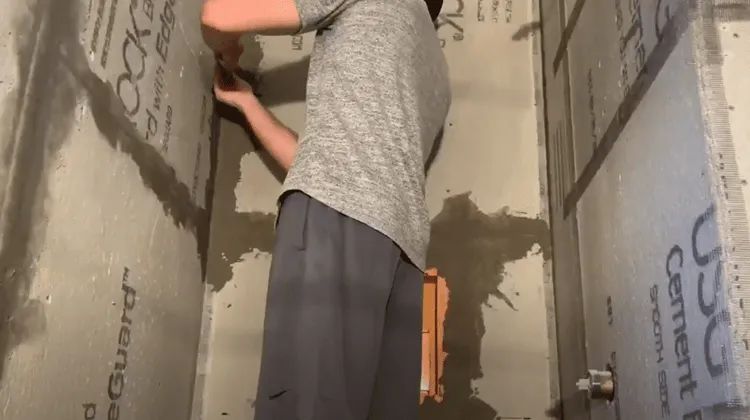
Choosing between Sheetrock and Cement Board depends largely on application environment, performance requirements, and long-term expectations.
Although both materials are commonly used in construction, selecting the wrong one can lead to durability issues, higher maintenance costs, or premature material failure.
The following factors can help guide the decision.
1. Consider the Application Environment
The first and most important factor is where the board will be installed.
Sheetrock is best suited for dry, climate-controlled interior spaces such as living rooms, bedrooms, offices, and corridors.
In these environments, moisture exposure is minimal, and the lightweight nature of Sheetrock offers efficiency and cost advantages.
Cement Board should be selected for wet, humid, or exterior environments, including bathrooms, kitchens, laundry rooms, basements, and exterior wall systems.
Its moisture-resistant and inorganic structure ensures long-term stability under harsh conditions.
2. Evaluate Moisture and Water Exposure
If there is any risk of water contact or high humidity, Cement Board is the safer and more reliable choice.
Sheetrock can deteriorate when exposed to moisture, leading to swelling, mold growth, and loss of strength.
Cement Board, by contrast, maintains its integrity even with repeated or prolonged water exposure.
For areas such as showers, tile backing, or exterior facades, Cement Board is generally considered the industry standard.
3. Assess Strength and Load Requirements
Sheetrock is designed for light-duty, non-structural applications.
It performs well for standard walls and ceilings but is not intended to support heavy finishes or withstand impact.
Cement Board offers higher mechanical strength and rigidity, making it suitable for applications involving tiles, stone, or other heavy surface materials.
It also performs better in high-traffic or industrial environments.
4. Installation Speed vs. Long-Term Performance
Installation efficiency is another key consideration.
Sheetrock is easy to cut, handle, and install, which reduces labor time and overall construction costs.
This makes it ideal for large-scale residential or commercial interior projects where speed is a priority.
Cement Board requires more time, tools, and labor to install.
However, this initial effort is often offset by longer service life, lower maintenance needs, and reduced risk of future repairs.
5. Fire Safety and Building Codes
Fire resistance may be a regulatory or safety requirement in certain projects.
Sheetrock provides basic fire resistance, suitable for standard interior building codes.
Cement Board is non-combustible and often preferred in fire-rated assemblies or safety-critical areas.
Local building codes and project specifications should always be considered when making the final choice.
6. Budget and Life-Cycle Cost
Sheetrock typically has a lower upfront cost, including both materials and installation.
It is often the economical choice for interior spaces with limited performance demands.
Cement Board has a higher initial cost, but its durability, moisture resistance, and long-term reliability often result in lower life-cycle costs, especially in demanding environments.
Em geral:
Choose Sheetrock for dry interior walls and ceilings where speed, cost efficiency, and smooth finishing are priorities.
Choose Cement Board for wet areas, exterior applications, heavy-duty installations, and projects requiring long-term durability.
Selecting the right material from the start ensures better performance, lower maintenance, and greater overall value throughout the life of the building.
Cement Board vs Drywall: Frequently Asked Questions
Can Cement Board replace drywall?
Yes, but it is not cost-effective for dry interior spaces.
Is Cement Board waterproof?
It is moisture-resistant, but waterproof membranes are recommended in wet areas.
Can drywall be used in bathrooms?
Standard drywall is not recommended. Cement Board is a better option.
Is Cement Board suitable for exterior walls?
Yes, it is widely used in exterior wall systems.
How long does Cement Board last?
With proper installation, it can last 30–50 years or more.
Cement Board Market Trend and Manufacturing Perspective
The growing demand for fire-resistant and moisture-resistant materials is driving global adoption of Cement Board, increasing the need for advanced cement board production equipment and automated manufacturing lines.
Conclusion: Sheetrock vs Cement Board
Sheetrock is ideal for lightweight interior construction, while Cement Board excels in durability, moisture resistance, and versatility.
For projects that prioritize long-term performance, Cement Board is becoming the preferred solution worldwide.


 Portuguese
  English
  Russian
  Arabic
  Vietnamese
  Spanish
  French
  Japanese
  Chinese