


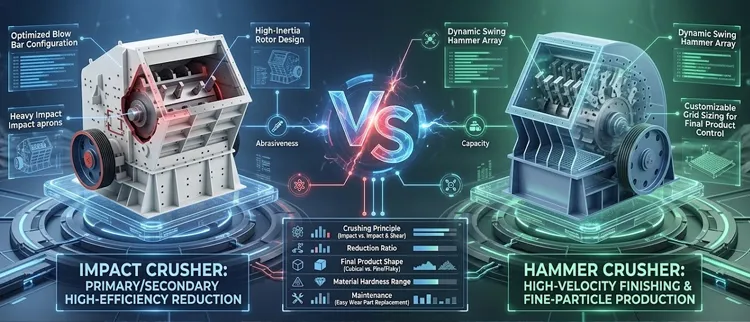
In crushing operations, the choice of equipment affects much more than just production capacity. It directly influences product quality, operational stability, and long-term cost.
Many buyers find themselves comparing britadores de impacto e britadores de martelo, especially in limestone, aggregate, and cement applications.
At first glance, both machines rely on impact force. However, once they are used in real production, the differences become significant.
Problems like poor particle shape, frequent downtime, or high maintenance cost are often the result of choosing the wrong machine at the beginning.
This guide explains the differences from a practical, real-world perspective, helping you make a better decision.
Quick Comparison
| Key Factor | Britador de impacto | Triturador de martelo |
|---|---|---|
| Materials | Medium-hard, wet | Brittle, dry |
| Output Shape | Cubic | Irregular |
| Capacidade | Médio | Alto |
| Blockage | Rare | Possible |
| Custo | Mais alto | Mais baixo |
Key Differences Explained: What Really Affects Your Decision?
When comparing an impact crusher and a hammer crusher, most differences go far beyond simple specifications. In real production environments, these differences directly affect efficiency, product quality, downtime, and overall profitability.
Instead of looking at them as two similar machines, it’s more useful to understand how each performs under real working conditions.
1. Material Adaptability: The Starting Point of Every Decision
One of the most important—but often underestimated—factors is how each crusher handles different types of materials.
An impact crusher is generally more flexible. It performs well with medium-hard materials such as limestone and dolomite, and it can also handle materials with higher moisture content without a significant drop in efficiency. This is mainly because it does not rely on a bottom screen to control output size.
A hammer crusher, on the other hand, works best with dry and brittle materials like coal, gypsum, or soft limestone. Once the material becomes sticky or contains more moisture, performance tends to decline, and the risk of blockage increases.
In projects where raw material conditions are not stable—for example, when moisture varies by season—this difference becomes critical.
2. Cost Structure: Initial Price vs. Long-Term Investment
When discussing price, many buyers focus only on the machine cost. However, in real projects, the total cost of ownership is much more important.
Hammer crushers are often more attractive at the beginning because they are relatively inexpensive and can sometimes achieve one-stage crushing, reducing the need for additional equipment. This makes them suitable for projects with limited budgets or where quick setup is required.
Impact crushers usually require a higher initial investment and are often used as secondary crushers. However, over time, they tend to have lower maintenance frequency, longer wear part life, e better product value, which can offset the higher upfront cost.
From a 3–5 year perspective, the overall investment difference is often smaller than expected.
3. Crushing Mechanism and Structure: Why the Output Is So Different
The internal working principle is where the fundamental difference lies.
Impact crushers use a multi-stage impact process. Materials are repeatedly struck by blow bars and then rebound against impact plates. This repeated action not only breaks the material but also reshapes it, resulting in more uniform and cubic particles.
Hammer crushers rely on direct impact from rotating hammers. The material is crushed quickly and discharged, with minimal reshaping during the process.
This is why impact crushers are typically chosen for applications where particle shape matters, while hammer crushers are preferred when high throughput is the main goal.
4. Blockage and Performance in Wet Conditions
Blockage is a practical issue that can significantly affect production efficiency, especially in regions with high humidity.
Impact crushers have a clear advantage here because they do not use a bottom screen. This allows materials to pass through more freely, even when moisture content is high.
Hammer crushers, however, depend on a screen to control output size. When processing wet or sticky materials, the screen openings can become clogged, leading to reduced efficiency or even unplanned shutdowns.
In real operations, frequent cleaning and downtime can quickly increase operating costs.
5. Capacity and Throughput: Speed vs. Control
If production capacity is the main concern, hammer crushers usually have the advantage.
Their simpler crushing path allows materials to pass through the machine more quickly, resulting in higher throughput. In some cases, the capacity can be 2–3 times higher than that of an impact crusher.
However, this higher speed comes with less control over the final product. Impact crushers, due to their multiple crushing stages, provide better shaping but slightly lower capacity.
This creates a typical trade-off between production speed and product quality.
6. Final Product Quality: A Direct Impact on Market Value
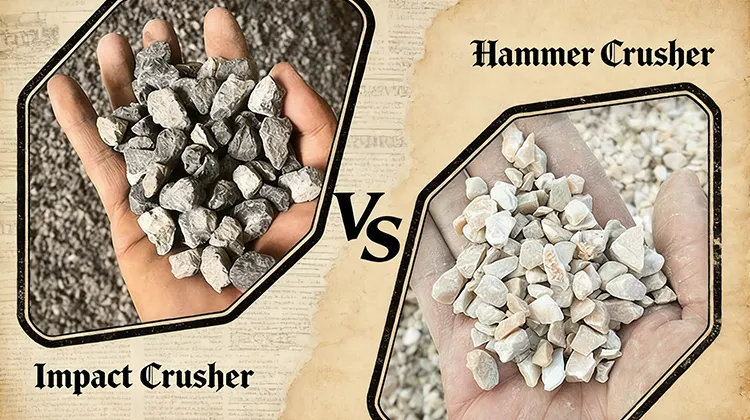
In many industries, especially construction and infrastructure, the shape of the final product is not just a technical detail—it directly affects selling price.
Impact crushers produce cubic, well-graded aggregates with lower flakiness and fewer fines. This makes them suitable for high-grade concrete and road construction.
Hammer crushers tend to generate more irregular particles and fine powder. While this may be acceptable for some applications, it often limits the material’s value in higher-end markets.
For many producers, this difference translates directly into profit margins.
7. Wear Parts and Durability: Hidden Long-Term Costs

Wear parts are a major contributor to long-term operating costs, but they are often underestimated during equipment selection.
In impact crushers, wear is usually concentrated on specific areas of the blow bars, which improves material utilization and extends service life.
In hammer crushers, multiple components—including hammers, screens, and rotors—are exposed to wear simultaneously. This leads to more frequent replacements and higher spare part consumption.
Over time, these differences can significantly affect overall operating expenses.
8. Maintenance and Downtime: The Cost You Don’t See at First
Maintenance is not just about replacing parts—it’s also about how long your production line is stopped.
Impact crushers generally have fewer critical components and are easier to maintain. Replacing blow bars is relatively straightforward and can be done quickly.
Hammer crushers may involve replacing a large number of hammers, sometimes over a hundred, which increases both labor time and downtime.
In regions where labor costs are high, or where production continuity is critical, this becomes an important factor.
How to Choose Between an Impact Crusher and a Hammer Crusher?
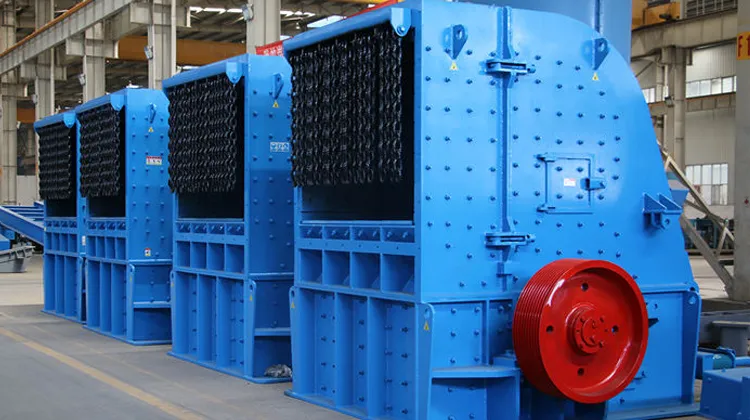
Choosing between an impact crusher and a hammer crusher depends mainly on your material type, production requirements, and budget. Instead of focusing only on machine specifications, it’s better to match the crusher with your actual working conditions.
1. Based on Material
If your material is medium-hard, abrasive, or contains moisture, an britador de impacto is usually the better choice because it handles wet and variable materials more reliably.
If your material is dry, brittle, and consistent (such as limestone, coal, or gypsum), a hammer crusher can deliver efficient and stable performance.
2. Based on Output Requirements
If you need high-quality aggregates with good particle shape, especially for concrete or road construction, an britador de impacto is more suitable.
Se a sua prioridade for high production capacity and particle shape is less critical, a hammer crusher is often preferred.
3. Based on Investment and Cost
A hammer crusher usually has a lower initial cost and can simplify the crushing process in some cases.
An britador de impacto may require a higher upfront investment but often offers melhor valor a longo prazo due to lower maintenance frequency and higher product quality.
Guia de Seleção Rápida
Choose Britador de impacto → better shape, wet materials, stable performance
Choose Triturador de martelo → higher output, lower cost, simple process
Conclusão
In the end, there is no single “best” crusher. The choice between an britador de impacto and a hammer crusher depends on your material characteristics, production requirements, and budget.
Key takeaways:
Impact Crusher: Best for medium-hard or abrasive materials, wet conditions, and applications requiring high-quality cubic aggregates. Offers stable performance and lower long-term maintenance costs.
Hammer Crusher: Suitable for dry, brittle, and uniform materials where high production capacity is the priority. Typically has lower initial investment and simpler operation.
When making your decision, consider not only the equipment cost but also product quality, production efficiency, maintenance needs, and long-term ROI. Choosing the right crusher ensures that your operation runs efficiently, delivers the right product for your market, and maximizes profitability.
FAQ – Impact Crusher & Hammer Crusher
1. Which industries use these crushers?
Impact Crusher: Construction, highway, railway, high-grade concrete aggregates.
Hammer Crusher: Coal, gypsum, limestone, cement raw material processing.
2. Does feed size matter?
Impact Crusher: Works best with medium-sized feed, often after primary crushing.
Hammer Crusher: Suitable for small or uniform feed sizes.
3. Are there environmental considerations?
Impact Crusher: Less dust with proper design, suitable for sensitive areas.
Hammer Crusher: Produces more fines, may need dust control.
4. Can these crushers be automated?
Yes. Impact crushers allow more precise size control; hammer crushers focus on high throughput.
5. Are spare parts availability important?
Yes. Easy access to blow bars, hammers, and screens reduces downtime and production costs.


 Portuguese
  English
  Russian
  Arabic
  Vietnamese
  Spanish
  French
  Japanese
  Chinese