



1. Introduction: Why Gypsum Plays a Critical Role in Industry
Gypsum is a naturally occurring industrial mineral mainly composed of calcium sulfate dihydrate (CaSO₄·2H₂O). It is widely used in construction, cement production, agriculture, ceramics, and many chemical processes.
Although gypsum is not a structural or load-bearing material, its real value lies in its functional role. It directly affects setting time control, material stability, and processing performance in industrial systems.
In modern cement and building material industries, gypsum is an essential additive that ensures workability, consistency, and controlled hydration reactions. Without gypsum, many cement-based materials would lose their practical usability due to extremely fast setting behavior.
2. Properties and Types of Gypsum
The performance of gypsum is strongly influenced by its physical properties and crystal structure. In industrial applications, selection is not based only on chemical composition, but also on fineness, strength, and forming behavior.
2.1 Physical Properties of Gypsum
In industrial production, fineness is one of the most important parameters affecting gypsum performance.
例如:
- 300 mesh gypsum powder is relatively coarse and is typically used in general construction materials such as wall leveling mortar and basic plastering applications.
- 1100 mesh gypsum powder is extremely fine and is used in high-end applications such as precision molding, coatings, and advanced industrial fillers.
Finer gypsum powder generally provides better surface reactivity and smoother finishing performance, but it also requires higher grinding energy and more advanced processing equipment.
In addition to fineness, gypsum also exhibits different levels of compressive strength and flexural strength depending on its crystal structure and production process. These mechanical properties directly influence its suitability for mold-making, construction finishing, and industrial forming applications.
2.2 Alpha Gypsum vs Beta Gypsum
Alpha Gypsum (High-Strength Gypsum)
Alpha gypsum is formed under controlled hydrothermal conditions, resulting in well-developed crystals and higher density.
It is known for:
- Higher mechanical strength
- Lower water demand during mixing
- Better dimensional stability
Because of these properties, it is widely used in:
- Ceramic molds and precision casting
- Sculpture and artistic modeling
- High-end architectural decoration materials
In industrial terms, alpha gypsum is considered a high-value engineered gypsum product.
Beta Gypsum (Construction Gypsum)
Beta gypsum is produced under atmospheric pressure conditions, resulting in a more porous crystal structure and lower production cost.
It is widely used in mass construction applications such as:
- Gypsum board (drywall) production
- Wall plaster and leveling materials
- Surface finishing in building construction
Although its strength is lower compared to alpha gypsum, it remains the most widely used form due to its cost efficiency and stable supply.
3. The Production Process of Gypsum (From Ore to Industrial Material)
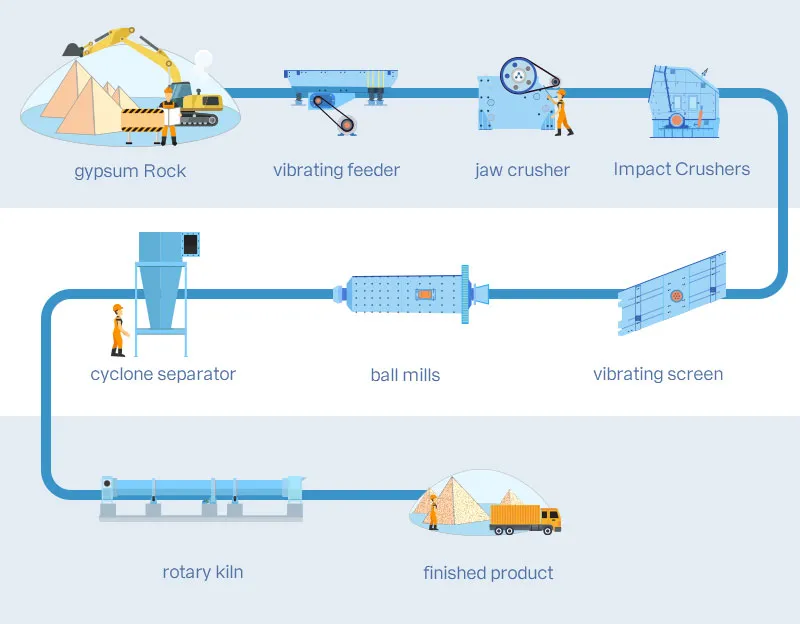
Gypsum production is not a single-step process. It involves a complete industrial chain from mining to thermal processing.
3.1 Mining and Raw Material Preparation
The process begins with gypsum mining, followed by primary crushing and screening.
At this stage, the goal is to produce uniform raw material size to ensure stable downstream processing. Particle consistency directly affects grinding efficiency and calcination stability.
3.2 Grinding Stage (Size Reduction Process)
After crushing, gypsum rock is sent to grinding systems such as Raymond mills, 立式辊磨机, or ultrafine grinding equipment.
The purpose of this stage is to reduce particle size and improve material uniformity before thermal treatment.
In industrial production lines, grinding fineness has a direct impact on calcination efficiency and final product quality.
3.3 Calcining Process (Core Transformation Stage)
Calcination is the most critical step in gypsum processing.
During this process, natural gypsum (CaSO₄·2H₂O) is heated to remove part of its crystal water, transforming it into hemihydrate gypsum (CaSO₄·0.5H₂O), also known as plaster of Paris.
This chemical transformation determines:
- Setting time behavior
- 力量发展
- Final product stability
If temperature control is unstable during calcination, the final gypsum product may suffer from inconsistent setting time, poor strength, or reduced workability.
Therefore, calcination control is considered the core technical point in industrial gypsum production systems.
4. Advantages of Gypsum in Construction

Gypsum is one of the most important materials in modern construction systems because of its functional performance rather than structural strength.
4.1 Fire Resistance Performance
Gypsum-based materials, especially gypsum boards, are non-combustible. When exposed to high temperatures, gypsum releases chemically bound water, which slows down heat transfer and helps delay fire spread.
This makes it widely used as a fire protection layer in steel structure buildings.
4.2 “Breathing” and Indoor Climate Regulation
Gypsum has the ability to absorb and release moisture depending on environmental conditions. This natural humidity regulation improves indoor comfort and helps stabilize air quality.
It also contributes to thermal insulation and acoustic performance, making it an ideal material for modern interior systems.
4.3 Environmental and Sustainability Benefits
From a sustainability perspective, gypsum is considered an environmentally friendly construction material.
主要优势包括:
- Low emissions during production
- Reduced environmental impact compared to cement-based materials
- 100% recyclability of waste gypsum products
These properties make gypsum highly aligned with modern green building standards.
5. How to Choose High-Quality Gypsum Powder

In industrial procurement, gypsum quality directly affects production stability and final product performance. Therefore, selection should be based on technical indicators rather than price alone.
5.1 Appearance and Purity Inspection
High-quality gypsum powder should have:
- Uniform and clean white color
- No visible impurities or foreign particles
- Stable physical texture
Visual inspection is often the first step in quality evaluation.
5.2 Performance Testing
Industrial users typically evaluate gypsum based on:
- Setting time consistency
- Powder fineness distribution
- Surface hardness after curing
- Workability during mixing and application
These parameters determine whether gypsum can meet industrial production standards.
5.3 Market Price Factors
Gypsum pricing is influenced by several industrial factors, including:
- Raw gypsum ore quality and availability
- Energy consumption during calcination
- Grinding and processing costs
- Transportation and logistics conditions
- Regional supply-demand balance
As a result, gypsum prices can vary significantly across different markets.
6. Versatile Uses of Gypsum

Gypsum is a highly versatile industrial material used across multiple sectors.
6.1 Construction Industry Applications
In construction, gypsum is widely used for:
- Gypsum board (drywall) systems
- Wall plastering and leveling compounds
- Cement retarders to control setting time
Its ability to regulate cement hydration makes it essential in cement-based systems.
6.2 Industrial and Daily Life Applications
Gypsum is also widely used in industrial manufacturing and daily products, such as:
- Ceramic mold production
- Food industry (tofu coagulant)
- Medical applications (dental molds, plaster bandages)
These applications rely on gypsum’s stable forming and chemical properties.
6.3 Agricultural Applications
In agriculture, gypsum is used as a soil conditioner and nutrient source.
It helps:
- Improve soil structure
- Supply calcium and sulfur
- Treat saline and alkaline soils
This makes it an important material in modern sustainable agriculture.
7. Conclusion: Gypsum as a Key Functional Material in Industrial Systems
Although gypsum is often considered a low-cost mineral, its role in industrial systems is extremely important.
From controlling cement hydration to enabling advanced construction materials, and from ceramic manufacturing to agricultural soil improvement, gypsum plays a multi-functional role across industries.
For cement plants and industrial equipment projects, understanding gypsum properties, production processes, and applications is essential for optimizing system design and improving overall production efficiency.
常问问题
1. What is gypsum mainly used for in industry?
Gypsum is mainly used in construction and cement production. In cement, it is added to control setting time and improve workability. It is also widely used in gypsum boards, plastering materials, ceramics, and agriculture as a soil conditioner.
2. What is the difference between alpha gypsum and beta gypsum?
Alpha gypsum has a stronger crystal structure, higher strength, and lower water demand, making it suitable for ceramic molds and high-end applications. Beta gypsum is more commonly used in construction materials such as gypsum boards, wall plaster, and leveling compounds due to its lower cost.
3. Why is gypsum added to cement?
Gypsum is added to cement to control the setting time. Without gypsum, cement would harden too quickly after mixing with water, making it difficult to use in construction. Gypsum slows down this reaction and ensures proper workability and stable performance.


 Chinese
  English
  Russian
  Arabic
  Vietnamese
  Spanish
  French
  Portuguese
  Japanese