


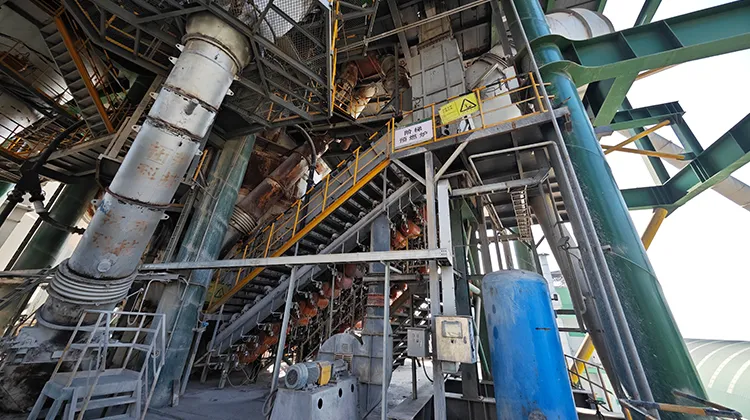
A Case Study from a 5000tpd Clinker Production Line in China
Abstract
As the cement industry faces increasing pressure to reduce carbon emissions, the use of 替代燃料 (AFs) in clinker production continues to expand. However, fuels with high moisture content, low calorific value and unstable composition often cause thermal instability, incomplete combustion and build-up formation when directly injected into conventional calciner systems.
This article presents the application of a stair-step precalciner (SSP) system at Jincheng Shanshui Heju Cement Co Ltd in China. By introducing a dedicated combustion chamber upstream of the calciner, the system enables staged drying, pyrolysis and combustion of alternative fuels before entering the kiln system. Operating results demonstrate stable substitution rates of 20–25% together with improved kiln stability, higher combustion efficiency, reduced CO₂ emissions and significant economic benefits.
1 Introduction
As decarbonisation targets continue to tighten globally, the cement industry is under growing pressure to reduce fossil fuel consumption and lower CO₂ emissions.
In recent years, increasing attention has been given to the use of biomass, industrial solid waste, RDF and other alternative fuels in clinker production. Compared with conventional coal, these fuels offer clear environmental advantages. However, their large-scale utilisation also introduces significant operational challenges.
Many alternative fuels contain high moisture levels, unstable calorific value and inconsistent particle size distribution. When these materials are directly injected into the calciner, rapid moisture evaporation can disturb the thermal balance of the system and create fluctuations in calciner temperature.
At the same time, large fuel particles often experience insufficient residence time, resulting in incomplete combustion. Unburned materials entering the kiln inlet may intensify sulphur and alkali circulation, increasing the risk of build-ups, coating instability and clinker quality problems.
Providing sufficient combustion time and space for difficult fuels has therefore become a key requirement for achieving higher substitution rates without compromising kiln stability.
To address these challenges, Jincheng Shanshui Heju Cement Co Ltd implemented a stair-step precalciner system on its 5000tpd clinker production line.
2 Project overview
2.1 Project background
The project was implemented at a clinker production line located in Shanxi Province, China.
The main objectives included:
- reducing coal consumption
- increasing alternative fuel utilisation
- lowering CO₂ emissions
- improving kiln operation stability
The designed alternative fuel processing capacity was 10–15tph, with a target substitution rate of 20–25% and a maximum design potential of 28%.
2.2 Fuel types
The project mainly utilises:
- furfural residue
- biomass waste
- waste textiles
- RDF fuel pellets
- industrial solid waste
Furfural residue represents a particularly difficult fuel due to its high moisture content of 40–50% and relatively low calorific value of approximately 2000kCal/kg.
3 Limitations of direct AF injection
Conventional direct calciner injection creates several operational challenges when handling low-grade alternative fuels.
3.1 Thermal instability
Rapid evaporation of moisture inside the calciner absorbs large amounts of heat and creates local temperature drops, disturbing calciner stability.
3.2 Incomplete combustion
Large fuel particles often fail to burn out completely due to insufficient residence time inside the calciner.
3.3 Increased sulphur and alkali circulation
Partially combusted materials may create reducing conditions that intensify sulphur and alkali cycles, increasing the risk of build-ups and ring formation.
3.4 Clinker quality fluctuations
Unburned particles entering the kiln system may contribute to yellow-core clinker and unstable clinker quality.
Operating experience shows that the major limitation is not only fuel quality itself, but also the lack of sufficient combustion space within the existing calciner configuration.
4 Stair-step precalciner solution

4.1 System concept
The SSP introduces a dedicated combustion chamber upstream of the calciner, allowing alternative fuels to complete drying, pyrolysis and most of the combustion process before entering the main kiln system.
Compared with direct injection, this configuration significantly reduces thermal disturbance to kiln operation.
4.2 Main system components
The SSP system mainly consists of:
- fuel storage and conveying system
- dual screw feeding system
- stair-step combustion chamber
- tertiary air combustion system
- air cannon agitation system
- online temperature monitoring system
- high-temperature camera monitoring system
- PLC automatic control system
The system includes 17 stages in total:
- one drying and ignition platform
- 15 combustion steps
- one discharge section
5 Process description

Alternative fuels are transported to a buffer silo before entering the SSP through dual screw feeders.
5.1 Drying stage
Fuel first enters the upper drying platform.
High-temperature tertiary air from the clinker cooler, at approximately 880°C, provides both heat and combustion air.
Moisture evaporation takes place gradually inside the dedicated chamber, preventing severe temperature fluctuations inside the calciner.
5.2 Pyrolysis and combustion stage
After drying, fuels move downward through the combustion steps.
Air cannon nozzles periodically agitate the fuel bed, improving turbulence and increasing oxygen contact.
Fine and lightweight particles are carried into the calciner with the hot gas stream, while larger particles remain on the lower steps for further combustion.
This staged combustion mechanism significantly improves burnout efficiency.
5.3 Residence time control
Residence time can be adjusted by modifying air cannon frequency, tertiary air volume and feeding rate.
Depending on fuel characteristics, materials may remain inside the SSP for up to 20 minutes.
6 Operating performance

6.1 Higher substitution rates
The system achieved stable substitution rates of 20–25%, with a maximum design potential of 28%.
6.2 Improved kiln stability
Because moisture evaporation and primary combustion occur inside the SSP, calciner temperature fluctuations were significantly reduced.
Operating results showed:
- more stable kiln operation
- reduced thermal disturbance
- lower build-up risk
- improved system continuity
6.3 Improved clinker quality
Reduced carryover of unburned material led to fewer yellow-core clinker issues and more stable clinker quality.
6.4 Environmental benefits
The project is expected to reduce CO₂ emissions by approximately 20,000t/yr.
The integrated online design creates no additional emission points, while high-temperature conditions inside the kiln system support the destruction of VOCs and other organic pollutants.
Local reducing conditions inside the system also contribute to lower NOx emissions and reduced ammonia consumption.
6.5 Economic benefits
Using furfural residue as an example:
- annual coal savings: approximately 11,300t
- annual fuel cost savings: approximately RMB7.9m
- annual electricity savings: approximately RMB170,000
- annual carbon reduction value: approximately RMB2m
Total annual economic benefit exceeds RMB3.6m.
7 Operational recommendations
7.1 Fuel quality management
Blending fuels with different calorific values and moisture content is recommended to reduce thermal fluctuations.
7.2 Temperature control
A raw meal inlet is included to absorb excess heat and prevent local overheating.
7.3 Advanced automation
Automatic control of feeding rate, tertiary air flow and air cannon operation further improves system stability and combustion efficiency.
8 Conclusion
As alternative fuel utilisation continues to increase across the cement industry, conventional direct injection methods are becoming increasingly insufficient for handling difficult low-grade fuels.
The Jincheng project demonstrates that the stair-step precalciner provides a stable and efficient combustion environment for high-moisture, low-calorific fuels, significantly improving burnout efficiency and substitution rates while reducing thermal disturbance to the kiln system.
In addition to achieving substantial coal savings and carbon reduction, the technology also improves kiln stability and clinker quality, providing a practical pathway for the cement industry’s low-carbon transition.


 Chinese
  English
  Russian
  Arabic
  Vietnamese
  Spanish
  French
  Portuguese
  Japanese