



Concrete is one of the most widely used construction materials in the world, but it also generates a significant amount of waste when buildings, roads, bridges, and other structures reach the end of their service life. Traditionally, demolished concrete was transported to landfills, resulting in high disposal costs and unnecessary consumption of landfill space.
Today, recycled concrete aggregate (RCA) provides a more sustainable and cost-effective alternative. By crushing and processing waste concrete, contractors and recycling companies can produce reusable aggregate materials suitable for a wide range of construction applications. This not only reduces environmental impact but also creates valuable products that can replace natural aggregates in many projects.
In this article, we will explore what recycled concrete aggregate is, how it is produced, the equipment required, and the most common applications of RCA in modern construction.
What Is Recycled Concrete Aggregate (RCA)?

Recycled concrete aggregate, commonly known as RCA, is a construction material produced by processing demolished concrete from buildings, highways, bridges, airports, industrial facilities, and other infrastructure projects.
Instead of treating old concrete as waste, recycling facilities process the material through a series of crushing, screening, and separation stages to create usable aggregates of different sizes. These recycled aggregates can then be used in road construction, backfilling, drainage systems, concrete production, and many other engineering applications.
The increasing adoption of RCA is largely driven by two factors. First, many regions face growing pressure to reduce construction and demolition waste. Second, the rising cost of natural aggregates has encouraged contractors to seek more economical alternatives.
Modern recycling technologies have significantly improved the quality of recycled concrete aggregate. In many applications, properly processed RCA can provide performance comparable to conventional crushed stone while offering additional environmental and economic benefits.
Why Is Concrete Recycling Becoming More Important?
The construction industry consumes enormous quantities of natural aggregates every year. Producing these materials requires quarrying operations that can impact landscapes, ecosystems, and local communities. At the same time, demolition activities continue to generate large volumes of waste concrete that must be transported, handled, and disposed of.
Concrete recycling addresses both challenges simultaneously.
By converting demolition waste into reusable aggregate, contractors can reduce disposal costs while creating a secondary source of construction materials. This approach supports circular economy principles by keeping valuable resources in use for as long as possible.
In urban areas, where landfill space is increasingly limited and transportation costs continue to rise, recycling concrete directly at or near demolition sites can provide substantial economic advantages. Instead of transporting waste to disposal facilities and purchasing new aggregates from distant quarries, project owners can often process and reuse materials locally.
In addition to cost savings, recycled aggregate helps reduce demand for virgin materials. This decreases the environmental impact associated with quarrying, material transportation, and aggregate production.
As governments continue to introduce stricter environmental regulations and sustainability targets, the demand for recycled aggregate is expected to grow steadily in both developed and emerging markets.
How Recycled Concrete Aggregate Is Made

Producing high-quality recycled concrete aggregate involves several carefully controlled stages. Each stage plays an important role in ensuring that the final product meets the requirements of specific construction applications.
Step 1: Pre-Sorting and Removing Impurities
The recycling process begins with the collection of concrete waste from demolition sites, road reconstruction projects, bridge removals, and construction activities.
However, concrete waste rarely arrives in a completely clean condition. It is often mixed with reinforcing steel, wood, plastic, paper, asphalt, insulation materials, and other construction debris. These contaminants must be removed before the material enters the crushing process.
In most recycling facilities, workers perform an initial inspection and manual sorting process to remove large unwanted materials. Magnetic separators are then used to extract reinforcing steel and other ferrous metals embedded within the concrete.
Effective pre-sorting is one of the most important steps in producing high-quality recycled aggregate because contaminants can negatively affect both equipment performance and final product quality.
Step 2: Primary Crushing
Once the concrete has been cleaned and prepared, it enters the primary crushing stage.
The goal of primary crushing is to reduce large concrete blocks into smaller pieces that can be processed more efficiently during subsequent stages.
颚式破碎机 for Primary Concrete Crushing
A jaw crusher is typically the first machine used in a recycled concrete aggregate production line. The machine applies compressive force between a fixed jaw and a moving jaw, breaking large concrete chunks into smaller particles.
Jaw crushers are particularly suitable for recycling applications because they can handle large feed sizes and process heavily reinforced concrete with excellent reliability. Their simple design, high throughput capacity, and low maintenance requirements make them one of the most widely used crushing machines in the construction waste recycling industry.
After primary crushing, the material is usually reduced to a size below 100 mm, preparing it for secondary processing.
Step 3: Secondary Crushing and Aggregate Shaping
Although primary crushing reduces the material size significantly, the resulting aggregate may still contain irregular particles and attached cement mortar.
To improve aggregate quality, a secondary crushing stage is commonly employed.
冲击式破碎机 for Concrete Recycling
In many recycled concrete aggregate plants, impact crushers are preferred for secondary crushing. Unlike compression-based crushing methods, impact crushers use high-speed impact forces to break the material.
One of the major advantages of impact crushing is its ability to separate old mortar from the aggregate surface. This helps produce cleaner recycled aggregates with better particle shape and improved performance in downstream applications.
The cubical shape generated by impact crushers is particularly beneficial for road construction and concrete production because it improves compaction characteristics and overall material stability.
圆锥破碎机 as an Alternative
Cone crushers may also be used in certain recycling applications, particularly when processing harder materials or when lower wear costs are desired.
The choice between an impact crusher and a cone crusher often depends on project requirements, material characteristics, and final product specifications.
Step 4: Screening and Classification
After crushing, the material must be separated into different size categories.
This process is performed using vibrating screens, which classify aggregates according to particle size.
Common aggregate sizes include:
- 0–5 mm
- 5–10 mm
- 10–20 毫米
- 20–40 mm
Different construction applications require different aggregate sizes. For example, fine aggregates may be used for trench backfill, while larger aggregates are commonly used in road base construction.
Accurate screening ensures consistent product quality and allows recycling facilities to serve multiple market segments with a single production line.
Step 5: Iron Removal and Final Product Grading
Even after several processing stages, small steel fragments may remain within the recycled aggregate.
To ensure product purity, the material passes through additional magnetic separation systems before final stockpiling.
Removing residual metal contaminants not only improves aggregate quality but also reduces wear on downstream equipment and creates an additional source of revenue through scrap metal recovery.
Once the material has been cleaned and graded, it is ready for transportation or direct use in construction projects.
Best Equipment for Making Recycled Concrete Aggregate
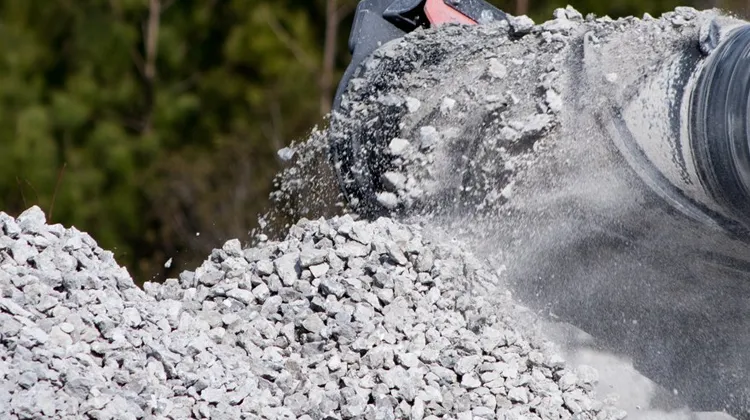
The efficiency and profitability of a concrete recycling operation depend heavily on equipment selection.
A complete recycled concrete aggregate production line typically includes feeding equipment, crushing equipment, screening systems, magnetic separators, and material handling conveyors.
For fixed recycling facilities that process large volumes of material continuously, stationary crushing plants often provide the highest production capacity and lowest operating cost per ton.
However, many contractors are increasingly choosing mobile crushing plants because they offer greater flexibility.
Mobile Crushing Plant for Concrete Recycling
Mobile crushing and screening plants integrate feeding, crushing, screening, and conveying functions into a single system.
These units can be transported directly to demolition sites, road reconstruction projects, or temporary recycling locations. Instead of hauling large quantities of waste concrete to a distant processing facility, contractors can recycle material on-site and immediately reuse the finished aggregate.
This approach reduces transportation costs, lowers fuel consumption, shortens project schedules, and minimizes environmental impact.
For infrastructure projects involving highways, bridges, airports, and urban redevelopment, mobile crushing plants have become one of the most efficient solutions available for concrete recycling.
What Is Recycled Concrete Aggregate Used For?
The final application of recycled concrete aggregate depends largely on its particle size, cleanliness, and processing quality.
Applications of Processed RCA
Processed recycled concrete aggregate is widely used in transportation infrastructure projects.
One of the most common applications is road base construction. RCA provides excellent load-bearing characteristics and can serve as a stable foundation layer beneath asphalt or concrete pavements. Many transportation agencies now approve recycled aggregate for road base and sub-base applications because of its proven performance and cost advantages.
Processed RCA can also be incorporated into lean concrete mixtures and various non-structural concrete products. Sidewalks, curbs, gutters, parking areas, and concrete blocks are common examples where recycled aggregates can successfully replace a portion of natural aggregates.
In some regions, recycled aggregate is also used in asphalt production. When properly processed, RCA can contribute to pavement mixtures while helping reduce material costs.
Fine recycled aggregate smaller than 5 mm is frequently used for trench backfill, pipe bedding, and road maintenance projects where good compaction characteristics are required.
Applications of Unprocessed RCA
Not all recycled concrete needs to undergo extensive processing.
Larger concrete fragments can often be used directly in civil engineering projects where appearance and precise grading are less critical.
For example, unprocessed RCA is commonly used for bulk fill applications, embankment construction, and site development projects. The material provides a stable foundation while reducing the need for virgin fill materials.
Large recycled concrete pieces may also be used for shoreline protection, riverbank stabilization, and erosion control projects. Their weight and durability make them effective for resisting water movement and protecting vulnerable areas from erosion.
In addition, unprocessed RCA can serve as subgrade material beneath roads and industrial facilities, providing a cost-effective alternative to natural stone.
常见问题解答
What Are the Main Advantages of Recycled Concrete Aggregate?
Recycled concrete aggregate offers both economic and environmental benefits. By reusing materials that would otherwise be discarded, contractors can reduce landfill disposal costs while lowering the demand for newly quarried aggregates. RCA also supports sustainable construction practices and can contribute to green building initiatives.
When combined with modern mobile crushing plants, concrete recycling can further improve project efficiency by allowing materials to be processed directly at the job site.
Can Recycled Concrete Aggregate Achieve Similar Strength to Natural Aggregate?
The strength of recycled aggregate concrete depends on several factors, including aggregate quality, replacement ratio, water-cement ratio, and overall mix design.
High-quality RCA produced from properly processed concrete can achieve performance levels comparable to conventional aggregate in many applications. In some cases, well-designed recycled aggregate concrete mixtures can even meet the requirements of structural construction projects.
Is Recycled Concrete Cheaper Than Crushed Stone?
In many markets, recycled concrete aggregate is more affordable than natural crushed stone.
Because the raw material originates from demolition waste, recycling facilities can often obtain feedstock at lower costs than quarry operators. In addition, on-site recycling significantly reduces transportation and disposal expenses.
The exact cost difference varies by region, but RCA is generally considered one of the most cost-effective aggregate materials available for construction and infrastructure projects.
Does Recycled Aggregate Concrete Crack More Easily?
Research has shown that recycled aggregate concrete may exhibit slightly different cracking behavior compared with conventional concrete. While individual cracks may occasionally be wider, they are often more evenly distributed throughout the structure.
When proper mix design and construction practices are followed, these differences typically have minimal impact on overall structural performance. As a result, recycled aggregate concrete can be safely used in many structural and non-structural applications.
结论
Recycled concrete aggregate has become an important solution for reducing construction waste and conserving natural resources. Through a carefully controlled process that includes sorting, crushing, screening, metal removal, and grading, demolished concrete can be transformed into a valuable construction material suitable for numerous applications.
Whether used in road construction, backfilling, drainage systems, or concrete production, RCA provides a practical balance between performance, sustainability, and cost efficiency. With the growing adoption of concrete recycling technologies and mobile crushing equipment, recycled aggregate is expected to play an increasingly important role in the future of the global construction industry.


 Chinese
  English
  Russian
  Arabic
  Vietnamese
  Spanish
  French
  Portuguese
  Japanese