



Identifying gold ore accurately is one of the most important steps in gold exploration and mining. Whether you are a geological prospector, small-scale miner, or mining investor, understanding how to identify gold ore in the field can significantly improve exploration success and reduce unnecessary costs.
Many gold-bearing rocks look similar to ordinary stones, making visual inspection alone unreliable. In most cases, effective gold ore identification requires combining geological knowledge, physical property testing, mineral association analysis, and laboratory verification.
This guide explains how to identify gold ore effectively, including geological deposit types, physical characteristics, field testing methods, and professional assay techniques, helping you determine whether a rock may contain economically valuable gold.
What is Gold Ore?

Gold ore refers to rocks or mineral aggregates that contain economically recoverable gold. Gold rarely occurs alone in nature and is typically associated with quartz veins, sulfide minerals, or oxidized zones.
Common types of gold ore include:
| Ore Type | 特征 | Typical Environment |
|---|---|---|
| Quartz Vein Gold Ore | Visible gold in quartz | Hydrothermal deposits |
| Placer Gold Ore | Loose gold particles | Rivers and alluvial deposits |
| Sulfide Gold Ore | Gold with sulfide minerals | Hydrothermal systems |
| 氧化金矿石 | Weathered gold ore | Surface oxidation zones |
Quartz vein deposits represent one of the most common sources of primary gold ore worldwide.
Identify Gold Ore Deposits by Location
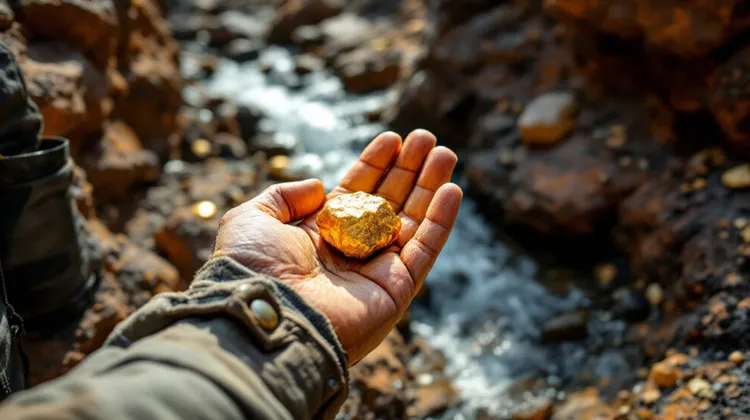
Understanding the geological environment is one of the most reliable ways to identify gold ore deposits. Different types of gold deposits form under different geological conditions, and recognizing these environments can significantly improve exploration success.
Epithermal Gold Deposits
Epithermal gold deposits form in volcanic regions at shallow depths, typically less than 1.5 kilometers below the Earth’s surface.
These deposits are commonly associated with:
Volcanic rocks
Silica-rich veins
Hot spring systems
Hydrothermal alteration zones
Epithermal deposits often contain high-grade gold mineralization and are widely mined in volcanic belts around the world.
Orogenic Gold Deposits
Orogenic gold deposits form during mountain-building processes and are among the most important sources of global gold production.
They are commonly found in:
Metamorphic rocks
Shear zones
Fault structures
Quartz veins
Orogenic deposits usually occur at moderate crustal depths and often contain visible gold in quartz veins.
Carlin-Type Gold Deposits
Carlin-type deposits contain extremely fine gold particles that are usually invisible to the naked eye.
Typical characteristics include:
Micron-sized gold particles
Sedimentary host rocks
Rift zones and back-arc basins
Disseminated mineralization
These deposits require laboratory testing because visible gold is rarely present.
Porphyry Copper-Gold Deposits
Porphyry copper-gold deposits are large-scale mineral systems associated with magma chambers.
Typical features include:
Low gold grades
Large ore volumes
Altered intrusive rocks
Copper mineralization
Although the grade is relatively low, porphyry deposits are economically important because of their large size.
Iron Oxide Copper Gold (IOCG) Deposits
IOCG deposits are large mineral systems characterized by iron oxide minerals.
Typical characteristics include:
Magnetite and hematite
Strong magnetic anomalies
Large ore bodies
Copper and gold mineralization
These deposits are often detected using geophysical exploration methods.
Sandstone-Type Gold Deposits
Sandstone-type gold deposits form when gold particles accumulate through gravity processes.
They are typically found in:
River channels
Sandstone formations
Alluvial plains
Basin depressions
Gold particles in these deposits are often rounded due to long-distance transport.
Identify Gold Ore by Physical Properties

Physical characteristics provide some of the most reliable indicators for identifying gold ore in the field.
Color and Tarnish
Natural gold has a distinctive metallic yellow color and maintains its brightness over time.
Real gold nuggets usually appear:
Bright and clean
Untarnished
Stable in color
If a sample shows rust or tarnish, it is often pyrite or another sulfide mineral rather than gold.
Gold commonly forms natural alloys with silver. When silver content is high, gold may appear pale yellow or whitish-yellow.
Shape Characteristics
Gold particles found in rivers or placer deposits typically have rounded edges due to long-term erosion and transport.
Irregular but smooth shapes often indicate natural gold.
Sharp crystal shapes usually indicate other minerals.
Surface Striations
Natural gold typically has a smooth surface and does not show parallel striations or crystal lines.
Parallel lines or crystal faces often indicate pyrite or other metallic minerals rather than gold.
比重
Gold has a specific gravity of approximately 19.3, which is significantly higher than most minerals.
Gold-bearing rocks often feel unusually heavy for their size.
Density testing is one of the most reliable identification methods.
Malleability
Gold is highly malleable and ductile.
When struck with a hammer:
Gold flattens or bends
It does not shatter
Most look-alike minerals will break instead of deforming.
Associated Minerals of Gold Ore
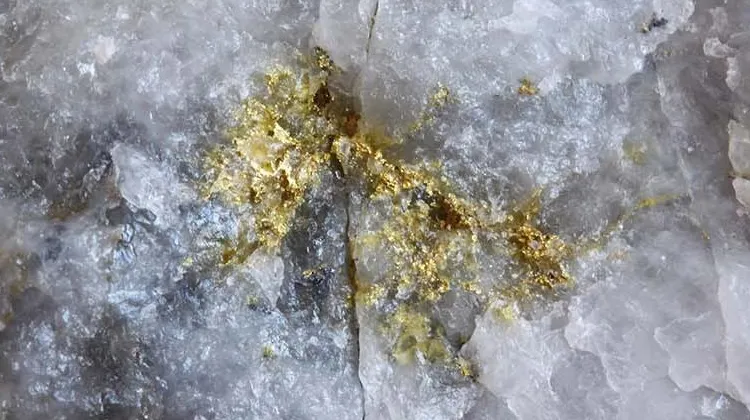
Gold-bearing ores commonly occur together with specific minerals that can indicate the presence of gold.
| Mineral | 意义 |
|---|---|
| 石英 | Major gold host mineral |
| 黄铁矿 | Common indicator mineral |
| 方解石 | Hydrothermal indicator |
| 赤铁矿 | Oxidized ore indicator |
| 磁铁矿 | Heavy mineral indicator |
Finding several of these minerals together increases the probability of gold mineralization.
Simple Methods to Detect Gold Ore
Several simple field tests can help determine whether a rock contains gold.
Burning Test
Heating a sample with a torch or fire can provide clues.
Real gold:
Remains yellow
Does not oxidize
Some other minerals turn black after heating.
Scratch Test
Scratching the surface with a hard object can reveal fresh metal.
Real gold produces a yellow streak or mark.
Crushing and Washing Test
Crushing ore samples and washing the powder in water is a simple gravity separation method.
Steps include:
Crush the sample
Wash with water
Observe heavy yellow particles
Gold particles settle quickly due to their high density.
Acid Test
Applying nitric acid or vinegar to a sample can help identify gold.
Real gold:
Does not react
Does not bubble
Many sulfide minerals react with acids.
Magnet Test
Gold is non-magnetic.
If the sample is attracted to a magnet, it likely contains magnetite or iron minerals rather than gold.
Metal Detector Testing
Metal detectors can identify metallic objects below the surface.
Professional detectors can locate buried gold-bearing rocks and nuggets.
Professional Gold Ore Testing

Hire a Professional Assayer
The most reliable way to identify gold ore is to send samples to a professional laboratory for assay testing.
Professional assayers determine:
Gold grade
Mineral composition
Economic value
Laboratory assays provide precise and reliable results that cannot be achieved by field testing alone.
Fire Assay
Fire assay is considered the most accurate method for determining gold content.
优势包括:
High accuracy
Reliable results
Industry standard method
XRF Analysis
X-ray fluorescence analyzers provide rapid mineral analysis.
优势包括:
Fast testing
Non-destructive
Portable instruments available
Common Mistakes When Identifying Gold Ore
Many minerals look similar to gold and are often mistaken for it.
Pyrite vs Gold
Pyrite is the mineral most commonly mistaken for gold.
Differences include:
Pyrite often shows rust or tarnish
Pyrite may have parallel crystal lines
Pyrite reacts with acid
Pyrite breaks easily
Gold remains bright and malleable.
Chalcopyrite vs Gold
Chalcopyrite has a yellow color similar to gold.
Differences include:
Lower hardness
Greenish-black streak
Turns black when heated due to copper oxidation
Mica vs Gold
Mica sheets can appear shiny and gold-colored.
Differences include:
Mica flakes break easily
Gold bends instead of breaking
Mica is very light
Gold is extremely dense
How to Improve Gold Ore Identification Accuracy
Reliable gold ore identification usually requires combining multiple methods.
Best practices include:
Observing geological environment
Testing physical properties
Conducting field tests
Using laboratory analysis
Sampling multiple locations
Using only one method often leads to incorrect conclusions.
FAQ – Gold Ore Identification
How can you tell if a rock contains gold?
Check density, color, and malleability, then confirm with laboratory testing.
Is visible gold always present in gold ore?
No. Many gold ores contain microscopic gold that cannot be seen.
Where is gold ore usually found?
Gold ore is commonly found in quartz veins, volcanic regions, river deposits, and metamorphic rocks.
Can magnets detect gold?
No. Gold is not magnetic.
What is the most accurate way to identify gold ore?
Fire assay laboratory testing provides the most accurate results.


 Chinese
  English
  Russian
  Arabic
  Vietnamese
  Spanish
  French
  Portuguese
  Japanese