



Gold ore is the fundamental raw material of the gold mining industry. The physical and chemical characteristics of gold ore directly determine the processing route, equipment configuration, operating cost, and ultimately the profitability of a mining project. In practice, even ores with similar gold grades may show completely different processing performance due to differences in mineral composition and gold occurrence.
For this reason, a systematic understanding of gold ore is essential not only during mine development and plant design, but also for selecting suitable processing equipment and optimizing long-term operation. This article provides a detailed and practical overview of gold ore definition, classification, six major gold ore types, ore analysis methods, processing flows, and equipment selection principles.
What Is Gold Ore?
Gold ore refers to rock or mineral material that contains gold in sufficient concentration and form to allow economic recovery through industrial processing methods. It is important to note that not all gold-bearing rocks can be classified as gold ore. Whether a deposit is considered economically viable depends on several factors:
Gold grade (usually expressed in g/t)
Occurrence state of gold
Applicable processing technology
Processing cost relative to gold price
Gold commonly occurs in ores in the following forms:
Native gold: Metallic gold particles, usually easier to recover
Encapsulated gold: Gold locked within quartz or sulfide minerals, requiring fine grinding
Chemical gold compounds: Such as telluride gold minerals, which are more difficult to process
In mineral processing practice, gold grade alone does not define ore value. Recovery rate, operating cost, and plant stability are equally critical.
Main Classification Methods of Gold Ore
From an industrial processing perspective, gold ore is classified primarily based on processing behavior rather than geological origin. Common classification approaches include:
By gold occurrence: Free-milling gold, partially refractory gold, refractory gold
By mineral composition: Quartz-type, sulfide-type, polymetallic-type
By processing difficulty: Easy-to-process ore, complex ore, refractory ore
This classification helps engineers determine suitable process flows early in project development, reducing technical and financial risks.
Six Major Types of Gold Ore: Characteristics and Processing Technologies
Gold ores differ significantly in mineral composition, gold occurrence, physical behavior, and metallurgical response. These differences directly affect process selection, equipment configuration, operating stability, and overall project economics. A clear understanding of each gold ore type allows engineers to design efficient processing flows and avoid costly operational issues.
Below is an in-depth technical discussion of six major gold ore types commonly encountered in industrial gold processing.
1. Quartz Gold Ore

Geological and Mineralogical Characteristics
Quartz gold ore typically forms in hydrothermal vein systems, where gold-bearing fluids precipitate quartz and native gold within fractures and fissures of host rocks. Quartz is the dominant gangue mineral, often exceeding 80–90% of the ore mass. Minor gangue minerals may include feldspar, calcite, or chlorite.
Gold in quartz ore occurs primarily as native gold, either as free particles along grain boundaries or locked within microfractures of quartz. Gold particle size distribution is usually wide, ranging from visible gold to fine particles below 50 microns.
Metallurgical Behavior
Quartz gold ore is generally classified as free-milling ore, meaning gold can be recovered without complex chemical pre-treatment. However, quartz’s high hardness (Mohs ~7) leads to relatively high crushing and grinding energy consumption.
处理挑战
The key challenge lies in achieving sufficient liberation without excessive grinding. Over-grinding produces fine gold slimes, which are difficult to recover and increase gold losses.
Processing Strategy
Processing strategies emphasize:
Stage-wise size reduction
Early recovery of coarse and medium-sized gold
Minimizing fine gold generation
Typical Processing Technologies
Multi-stage crushing with screening
Controlled ball milling
Gravity separation (jigs, centrifugal concentrators)
Cyanidation or flotation for fine gold
Impact on Equipment and Operation
Crushers must withstand high wear from quartz
Grinding mills require efficient liner design
Gravity equipment must be optimized for wide gold size distribution
2. Silver Gold Ore

Geological and Mineralogical Characteristics
Silver gold ore forms in polymetallic hydrothermal systems. Gold and silver commonly occur together as electrum (gold-silver alloy) or as separate minerals within sulfide matrices. Silver minerals may include argentite, acanthite, or silver-bearing galena.
The ratio of gold to silver varies significantly, affecting both economic evaluation and metallurgical design.
Metallurgical Behavior
Silver and gold often exhibit different flotation and leaching behaviors. Silver may dissolve more readily during cyanidation, while some silver minerals are refractory and require flotation or roasting.
处理挑战
Balancing gold and silver recovery
Preventing silver losses during gold-focused processing
Managing increased reagent consumption
Processing Strategy
Most operations adopt a bulk recovery approach, followed by downstream separation.
Typical Processing Technologies
Crushing and fine grinding
Bulk flotation of gold-silver minerals
Cyanidation or smelting of concentrates
Impact on Equipment and Operation
Grinding circuits must deliver uniform particle size
Flotation machines require stable aeration control
Dewatering efficiency directly affects metallurgical separation
3. Sulfide Gold Ore

Geological and Mineralogical Characteristics
Sulfide gold ore is typically associated with orogenic or Carlin-type deposits. Gold is finely disseminated within sulfide minerals such as pyrite, arsenopyrite, and pyrrhotite. Gold particles are often smaller than 10 microns and are physically locked within sulfide crystal lattices.
Metallurgical Behavior
These ores are classified as refractory gold ores. Direct cyanidation results in poor gold recovery because cyanide cannot access encapsulated gold.
处理挑战
Extremely fine gold grain size
Sulfide minerals consume oxygen and cyanide
High processing cost
Processing Strategy
Gold recovery relies on concentrate upgrading + chemical or biological pre-treatment.
Typical Processing Technologies
Fine grinding (often below 75 μm)
Sulfide flotation
Roasting, pressure oxidation (POX), or bio-oxidation
Cyanide leaching
Impact on Equipment and Operation
Grinding mills face high abrasion
Flotation stability is critical for concentrate quality
Pre-treatment units dominate capital investment
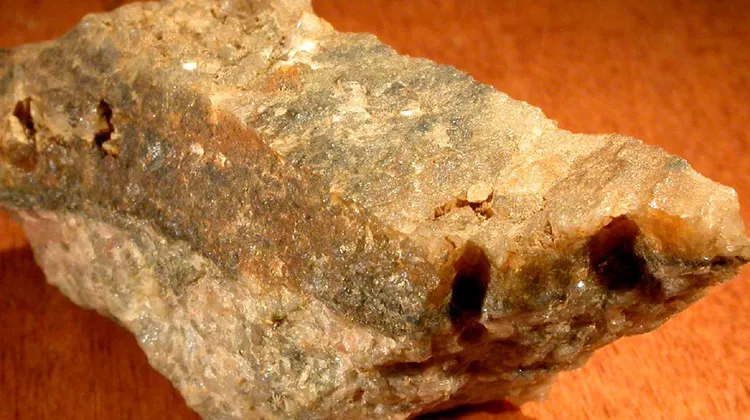
4. Telluride Gold Ore
Geological and Mineralogical Characteristics
Telluride gold ores occur in specific geological environments and contain gold chemically bonded with tellurium in minerals such as calaverite and sylvanite. These ores often have high gold grades but limited distribution.
Metallurgical Behavior
Telluride minerals are chemically stable and show poor cyanide solubility unless pre-treated.
处理挑战
Chemical bond between gold and tellurium
Limited effectiveness of conventional beneficiation
Processing Strategy
Processing focuses on mineral concentration followed by thermal decomposition.
Typical Processing Technologies
Fine grinding
Selective flotation of telluride minerals
Roasting to alter chemical structure
Cyanidation
Impact on Equipment and Operation
Grinding efficiency strongly affects flotation recovery
Roasting systems require strict temperature control
Environmental control systems are critical
5. Blue Clay Gold Ore

Geological and Mineralogical Characteristics
Blue clay gold ore contains high levels of clay minerals such as montmorillonite. These ores absorb water rapidly, swell, and disintegrate into fine slimes.
Gold is often free or weakly associated with gangue but becomes difficult to recover due to clay interference.
Metallurgical Behavior
Clay particles coat gold surfaces and disrupt gravity and flotation separation, significantly reducing recovery.
处理挑战
Slime generation
Equipment blockage
Poor classification efficiency
Processing Strategy
The processing philosophy emphasizes clay removal before grinding.
Typical Processing Technologies
Washing and scrubbing
筛查
Desliming
Gravity separation
Impact on Equipment and Operation
Washing equipment must handle high clay loads
Classification units must resist clogging
Equipment design must allow easy maintenance
6. Epithermal Gold Ore

Geological and Mineralogical Characteristics
Epithermal gold ore forms at shallow depths and shows complex mineralogy. Gold may occur as free particles, electrum, or finely disseminated in sulfides. Silver content is often high.
Metallurgical Behavior
Ore behavior can vary significantly across the same deposit, requiring flexible process design.
处理挑战
Variable ore characteristics
Risk of over-grinding
Presence of penalty elements
Processing Strategy
Flowsheets are designed to be adaptable, combining flotation and leaching as required.
Typical Processing Technologies
Multi-stage grinding
Flotation and/or direct cyanidation
Tight classification control
Impact on Equipment and Operation
Grinding circuits require precise control
Flotation stability is essential
Classification efficiency affects overall recovery
Technical Summary Table
| Gold Ore Type | Gold Occurrence | 处理难度 | Typical Technologies |
|---|---|---|---|
| Quartz Gold Ore | Native gold | 低的 | Gravity, Cyanidation |
| Silver Gold Ore | Au–Ag alloy | 中等的 | Flotation + Leaching |
| Sulfide Gold Ore | Encapsulated | 高的 | Flotation + Pre-treatment |
| Telluride Gold Ore | Chemical compound | 高的 | Flotation + Roasting |
| Blue Clay Gold Ore | Free gold with clay | 中等的 | Washing + Gravity |
| Epithermal Gold Ore | Mixed | Medium–High | Flexible flowsheets |
Gold Ore Analysis Methods
Before designing a processing plant or selecting equipment, comprehensive gold ore analysis is essential to reduce technical uncertainty.
Chemical Analysis
Used to accurately determine gold and associated metal grades. Fire assay remains the most reliable method for gold determination, while ICP and AAS are widely used for multi-element analysis.
Mineralogical Analysis
Identifies gold occurrence and mineral associations, helping determine whether the ore is refractory and which processing route is suitable.
Particle Size and Liberation Analysis
Determines the optimal grinding fineness and avoids excessive energy consumption and gold losses due to over-grinding.
Beneficiation Test Work
Pilot-scale and laboratory test work validate process routes and provide key parameters for equipment selection and plant design.
Typical Gold Ore Processing Flow
A typical gold ore processing flow is designed to liberate gold from the host rock and recover it in the most economical and efficient manner. While the exact flowsheet varies depending on ore type and project scale, most gold processing plants follow a common sequence of unit operations.
Understanding the purpose and technical requirements of each stage is critical for designing a stable plant and selecting suitable equipment.
1. 粉碎
Purpose
Crushing is the first size-reduction stage in gold ore processing. Its primary objective is to reduce run-of-mine (ROM) ore to a size suitable for downstream grinding, while minimizing energy consumption and equipment wear.
Technical Considerations
Crushing should achieve gradual size reduction to avoid excessive fines
Over-crushing generates slimes that negatively affect gold recovery
Ore hardness and abrasiveness strongly influence crusher selection
Typical Crushing Configuration
Primary crushing using jaw crushers
Secondary and tertiary crushing using cone crushers
Multi-stage crushing with screening to control product size
Equipment Implications
Crushers must be robust, wear-resistant, and capable of handling variable ore feed. Stable crushing performance directly affects grinding efficiency and plant throughput.
2. 研磨
Purpose
Grinding further reduces particle size to liberate gold from gangue minerals. It is one of the most energy-intensive stages in the entire processing plant.
Technical Considerations
The target grinding size depends on gold liberation characteristics
Over-grinding leads to gold losses in slimes
Under-grinding results in poor gold recovery
Typical Grinding Configuration
Ball mills or rod mills in closed circuit
Grinding circuit combined with classification equipment
Multiple grinding stages for complex ores
Equipment Implications
Grinding equipment must provide consistent particle size, high grinding efficiency, and long liner service life to reduce operating costs.
3. Classification
Purpose
Classification separates ground material into coarse and fine fractions, ensuring only correctly sized particles proceed to beneficiation.
Technical Considerations
Classification efficiency directly impacts grinding performance
Poor classification increases circulating load and energy consumption
Slime management is critical, especially for clay-rich ores
Typical Classification Equipment
螺旋分类器
水力旋流器
Equipment Implications
Classification equipment must operate stably under varying slurry densities and maintain sharp separation to protect downstream processes.
4. Beneficiation (Gold Recovery)
Purpose
Beneficiation is the core stage where gold is physically or chemically recovered from the ore.
Technical Considerations
The recovery method depends on gold occurrence
Multiple beneficiation methods are often combined
Recovery efficiency determines overall plant profitability
Common Beneficiation Methods
Gravity separation for free-milling gold
Flotation for sulfide and complex ores
Cyanide leaching for fine or refractory gold
Equipment Implications
Beneficiation equipment must be precisely matched to ore characteristics to achieve high recovery and stable operation.
5. Dewatering
Purpose
Dewatering removes excess water from concentrates and tailings, facilitating downstream processing and waste management.
Technical Considerations
Moisture content affects transport and metallurgy
Insufficient dewatering increases operating costs
Tailings management requires reliable water recovery
Typical Dewatering Equipment
Thickeners
Filters
Equipment Implications
Dewatering systems must be sized correctly to handle plant throughput and provide consistent moisture control.
6. Tailings Treatment and Disposal
Purpose
Tailings treatment ensures environmental compliance and sustainable plant operation.
Technical Considerations
Tailings composition affects disposal method
Water recovery is a key economic factor
Long-term stability of tailings storage facilities is critical
Typical Tailings Handling Methods
Thickened tailings disposal
Dry stacking (for suitable ores)
Equipment Implications
Tailings equipment must be reliable and designed for continuous operation to minimize environmental and operational risks.
Summary of a Typical Gold Ore Processing Flow
| Processing Stage | Main Objective | Typical Equipment |
|---|---|---|
| 粉碎 | Reduce ROM ore size | Jaw Crusher, Cone Crusher |
| 研磨 | Liberate gold | Ball Mill, Rod Mill |
| 分类 | Control particle size | Hydrocyclone, Spiral Classifier |
| Beneficiation | Recover gold | Flotation Machine, Gravity Separator |
| Dewatering | Remove water | Thickener, Filter |
| Tailings Treatment | Waste management | Thickener, Tailings Equipment |
Why a Well-Designed Processing Flow Matters
A well-designed gold ore processing flow ensures:
Higher gold recovery
Lower energy consumption
长期稳定运行
Reduced equipment wear and maintenance costs
The processing flow must always be tailored to ore characteristics through test work and engineering design.
Common Gold Ore Processing Equipment
| Processing Stage | 主要设备 |
|---|---|
| 粉碎 | Jaw Crusher, Cone Crusher |
| 研磨 | Ball Mill, Rod Mill |
| 分类 | Spiral Classifier, Hydrocyclone |
| Beneficiation | Flotation Machine, Jig |
| Dewatering | Thickener, Filter |
How to Select Suitable Gold Ore Processing Equipment
Selecting suitable gold ore processing equipment is not simply a matter of choosing machines with high capacity or low price. In practice, improper equipment selection often leads to low gold recovery, high operating costs, frequent downtime, and long-term instability of the processing plant.
Effective equipment selection must be based on a systematic understanding of ore characteristics, processing requirements, plant capacity, and life-cycle cost.
1. Start from Gold Ore Characteristics
The first and most important step in equipment selection is a thorough understanding of gold ore characteristics. Different ore types behave very differently during crushing, grinding, and beneficiation.
Key ore parameters that directly influence equipment choice include:
Gold occurrence (free gold, encapsulated gold, or chemical compounds)
Ore hardness and abrasiveness
Clay content and slime generation tendency
Association with sulfides or other metals
For example, quartz-rich ores require wear-resistant crushing and grinding equipment, while clay-rich ores demand robust washing and desliming systems before grinding.
2. Match Equipment to the Processing Flow
Gold processing equipment must always be selected after the processing flow has been defined, not before. Each piece of equipment serves a specific function within the overall flowsheet.
主要考虑因素包括:
Whether gravity separation, flotation, or cyanidation is used
The required grinding fineness for gold liberation
The number of processing stages and circulation load
Selecting equipment without considering the full flowsheet often results in mismatched capacities and bottlenecks.
3. Consider Plant Capacity and Scalability
Processing capacity determines equipment size, quantity, and configuration. Equipment must be capable of handling both current design capacity and future expansion.
Important capacity-related factors include:
Daily ore throughput
Ore feed variability
Peak vs. average operating loads
Oversized equipment increases capital cost, while undersized equipment leads to overload, excessive wear, and reduced availability.
4. Focus on Recovery Efficiency, Not Only Throughput
High throughput does not necessarily mean high gold recovery. Equipment should be selected based on its ability to maximize recovery while maintaining stable operation.
例如:
Grinding mills that provide consistent particle size rather than maximum output
Flotation machines with stable aeration and froth control
Gravity concentrators optimized for fine gold recovery
Equipment performance should be evaluated based on metallurgical results, not just nameplate capacity.
5. Evaluate Equipment Durability and Wear Resistance
Gold ores often contain abrasive minerals such as quartz and sulfides, which cause rapid equipment wear. Poor wear resistance leads to frequent maintenance, production interruptions, and high spare-part costs.
主要考虑因素包括:
Quality of liners and wear parts
Ease of replacement and maintenance
Equipment structural strength and rigidity
Durable equipment reduces downtime and lowers long-term operating costs.
6. Adapt Equipment to Local Operating Conditions
Gold processing plants are often located in remote areas with limited infrastructure. Equipment must be suitable for local operating conditions.
Factors to consider include:
Power supply stability
Water availability and quality
Local maintenance capabilities
Environmental and climate conditions
Simple, robust, and easy-to-maintain equipment is often more valuable than complex systems in remote mining environments.
7. Consider Energy and Operating Costs
Grinding and crushing consume the majority of energy in a gold processing plant. Equipment selection should aim to minimize energy consumption per ton of ore processed.
Important factors include:
研磨效率
Motor efficiency
Circuit design and automation level
Lower operating costs directly improve project profitability over the equipment’s life cycle.
8. Ensure Compatibility with Environmental and Safety Requirements
Modern gold processing plants must comply with increasingly strict environmental and safety regulations.
Equipment should support:
Efficient water recycling
Safe handling of tailings
Dust and noise control
Safe operation and maintenance
Choosing equipment that aligns with environmental standards reduces regulatory risk and improves project sustainability.
9. Think in Terms of Complete Systems, Not Individual Machines
Gold ore processing equipment should be selected as part of an integrated system, not as isolated machines.
System-level optimization includes:
Balanced capacity between processing stages
Stable material flow
Smooth integration of automation and control systems
Well-integrated systems deliver higher reliability and better metallurgical performance.
10. Work with Equipment Suppliers Who Understand Processing Technology
Finally, equipment suppliers should offer more than machines. A reliable supplier understands gold processing technology and can provide:
Technical consultation
Equipment selection guidance
Process optimization support
Long-term service and spare parts
This reduces project risk and ensures sustainable plant operation.
Key Factors in Equipment Selection
| 因素 | Why It Matters |
|---|---|
| 矿石特征 | Determines processing behavior |
| Processing flow | Defines equipment function |
| 容量 | Affects sizing and stability |
| Recovery efficiency | Impacts profitability |
| Durability | Reduces downtime |
| Operating conditions | Ensures practicality |
| Energy cost | Controls OPEX |
| 环境合规性 | Reduces risk |
| System integration | Improves reliability |
结论
There is no universal solution for gold ore processing. Only by fully understanding ore characteristics and applying appropriate processing technologies and equipment can a gold mining project achieve sustainable and profitable operation.
If you are looking for reliable gold ore processing equipment or complete processing solutions, please feel free to contact us.


 Chinese
  English
  Russian
  Arabic
  Vietnamese
  Spanish
  French
  Portuguese
  Japanese