



Copper recovery rate and concentrate grade are two of the most important indicators of a successful copper processing plant. Regardless of how rich a copper deposit may be, poor process design can result in low recovery, excessive energy consumption, and reduced profitability.
From crushing newly mined ore to producing high-purity copper cathodes, every stage of the copper extraction process plays a critical role in determining the overall efficiency of the operation. Understanding how these stages work together allows plant operators to improve recovery rates, reduce operating costs, and maximize the value of their mineral resources.
This guide explores the four key stages of copper ore processing, the equipment commonly used at each step, and the factors that influence plant performance.
Understanding Common Types of Copper Ores
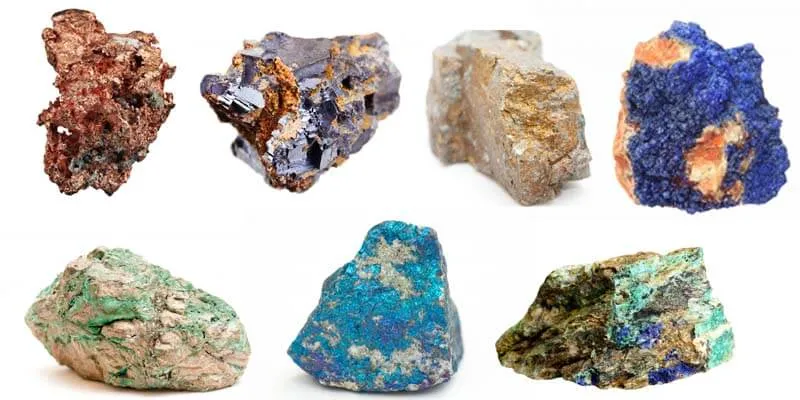
Before selecting equipment or designing a processing plant, it is essential to understand the characteristics of the ore being treated. Different copper minerals respond differently to beneficiation methods, which directly affects process selection and recovery performance.
Copper ores are generally divided into two major categories: sulfide ores and oxide ores.
Sulfide Copper Ores
Sulfide ores account for the majority of global copper production and are typically processed through flotation.
The most common sulfide copper minerals include:
Chalcopyrite (CuFeS₂)
Chalcopyrite is the most abundant copper-bearing mineral in the world and serves as the primary source of copper for many large-scale mining operations. Due to its relatively stable flotation characteristics, it is widely processed using conventional crushing, grinding, and flotation circuits.
Bornite (Cu₅FeS₄)
Bornite contains a higher copper content than chalcopyrite and is often found in association with other sulfide minerals. It generally exhibits good flotation performance when properly liberated.
Chalcocite (Cu₂S)
Chalcocite is one of the richest copper minerals and can achieve excellent recovery rates when suitable beneficiation processes are applied.
Oxide Copper Ores
Oxide copper ores are commonly formed through weathering and oxidation of sulfide deposits near the earth’s surface.
Typical oxide copper minerals include:
Malachite
Recognizable by its distinctive green color, malachite is one of the most common oxide copper minerals. Depending on the deposit characteristics, it may require flotation, leaching, or combined processing methods.
Azurite
Azurite is a blue copper carbonate mineral that frequently occurs alongside malachite in oxidized zones.
Cuprite
Cuprite contains a relatively high percentage of copper and is considered an important source of oxide copper resources.
Where Are Copper Ores Mainly Found?
Some of the world’s largest copper reserves are located in countries such as Chile, Peru, the United States, Zambia, Australia, and the Democratic Republic of Congo. These regions host numerous large-scale copper concentrators and smelters that process millions of tons of ore annually.
Because ore characteristics vary significantly from one deposit to another, successful copper processing plants are usually designed based on detailed mineralogical studies and metallurgical testing rather than relying on a standard process alone.
Copper Extraction Process Flow Chart
For most sulfide copper deposits, the beneficiation process follows a relatively standard workflow:
Mining
↓
粉碎
↓
研磨
↓
浮选
↓
Concentrate Dewatering
↓
Smelting
↓
Electrolytic Refining
↓
99.99% Copper Cathode
Although this flow sheet appears straightforward, the efficiency of each stage has a direct impact on the final recovery rate and concentrate quality.
Four Key Stages in Copper Ore Processing
Stage 1: Copper Ore Crushing and Screening

Copper ore extracted from open-pit or underground mines is typically too large to be processed directly. The first objective of a processing plant is therefore to reduce the ore to a suitable size for grinding.
A properly designed crushing circuit not only prepares the material for downstream operations but also reduces the energy required during grinding, which is often the most power-intensive stage of the entire process.
Most copper concentrators use a combination of:
The jaw crusher handles large run-of-mine ore and performs the initial size reduction. The crushed material is then further reduced by cone crushers until it reaches the target size required for grinding.
In modern processing plants, two-stage or three-stage crushing circuits are commonly adopted to achieve a final product size of approximately 10–20 mm. Consistent particle size at this stage helps stabilize downstream grinding performance and improve overall plant efficiency.
Stage 2: Copper Ore Grinding
Grinding is often considered the foundation of successful copper beneficiation because it determines the degree of mineral liberation.
Even the most advanced flotation system cannot achieve high recovery if valuable copper minerals remain locked within waste rock particles.
The purpose of grinding is to reduce ore particles to a size at which copper minerals can be effectively separated from gangue minerals during flotation.
Ball mills remain one of the most widely used grinding machines in copper processing plants due to their versatility, reliability, and ability to handle a wide range of ore types.
A well-designed grinding circuit typically aims to achieve a grinding fineness of approximately 70–85% passing 200 mesh, although the optimal value depends on the mineralogy of the ore.
Modern ball mills are often equipped with high-chromium cast iron liners that provide excellent wear resistance and extended service life, helping operators reduce maintenance costs and downtime.
For different plant capacities, common 球磨机 models include:
| 模型 | Capacity Range |
|---|---|
| Φ2200×7000 | 15–28 t/h |
| Φ2700×4500 | 30–90 t/h |
| Φ4000×5000 | 80–200 t/h |
The final equipment selection should be based on ore hardness, processing capacity, feed size, and target product fineness.
Stage 3: Copper Ore Flotation

Among all beneficiation stages, flotation typically has the greatest influence on plant profitability.
Even a small increase in flotation recovery can result in substantial additional copper production over the life of a mine.
The flotation process relies on differences in the surface properties of minerals. Through the addition of carefully selected reagents, copper-bearing particles become hydrophobic and attach to air bubbles introduced into the flotation cell. These bubbles rise to the surface and form a mineral-rich froth that is collected as concentrate.
A typical flotation circuit consists of three stages:
- Roughing
- Scavenging
- Cleaning
This arrangement allows valuable minerals to be recovered efficiently while maintaining the desired concentrate grade.
Stage 4: Copper Concentrate Dewatering and Smelting
After flotation, the copper concentrate still contains a significant amount of water and must be dewatered before transportation and smelting.
Effective dewatering reduces transportation costs, improves concentrate handling, and enhances smelter efficiency.
Most copper concentrators use a combination of thickeners and filter presses.
The thickener increases slurry density and recovers process water for reuse within the plant. This not only reduces water consumption but also lowers operating costs.
The filter press then removes additional moisture and produces a concentrate cake suitable for storage and transportation.
From Copper Concentrate to High-Purity Copper
Producing copper concentrate is not the end of the extraction process. To obtain refined copper products suitable for industrial applications, further metallurgical treatment is required.
Smelting and Converting
Copper concentrate is first subjected to high-temperature smelting. During this process, sulfur and other impurities are removed while copper becomes increasingly concentrated.
The resulting blister copper typically contains approximately 99% copper.
Electrolytic Refining
To achieve the purity required by modern industries, blister copper undergoes electrolytic refining.
During electrolysis, impurities are removed and pure copper is deposited onto cathode plates.
The final product is copper cathode with a purity of approximately 99.99%.
These cathodes are widely used in power cables, transformers, electric vehicles, renewable energy systems, consumer electronics, and countless industrial applications.
How to Improve Copper Processing Efficiency
Improving plant performance requires more than simply installing larger equipment.
Successful operations usually focus on optimizing the entire processing circuit through detailed ore testing, proper equipment selection, process control, and continuous performance monitoring.
Many high-performing concentrators regularly evaluate grinding efficiency, flotation recovery, reagent consumption, and water usage to identify opportunities for improvement.
Increasing recovery by just one or two percentage points can often generate significant economic benefits over the life of a mining project.
结论
Successful copper ore processing is not the result of a single machine or a single beneficiation stage. It depends on how effectively crushing, grinding, flotation, dewatering, and smelting work together as an integrated system.
By understanding the characteristics of the ore and optimizing each stage of the process, mining companies can improve recovery rates, increase concentrate quality, and achieve more sustainable long-term operations.
Whether you are planning a new copper processing plant or upgrading an existing operation, selecting the right process configuration and equipment can have a lasting impact on productivity, operating costs, and overall profitability.
常见问题解答
What is the most common method used for copper ore processing?
For sulfide copper ores, flotation is the most widely used beneficiation method. It allows copper minerals to be separated from gangue minerals efficiently and can achieve high recovery rates when combined with proper grinding and reagent selection.
What is the ideal grinding fineness for copper ore?
The optimal grinding fineness depends on ore characteristics. However, many copper concentrators operate at approximately 70–85% passing 200 mesh to achieve sufficient mineral liberation before flotation.
Why is flotation important in copper beneficiation?
Flotation is the stage where valuable copper minerals are actually separated from waste materials. Because of its direct impact on recovery rate and concentrate grade, flotation is often considered the most important stage in a copper processing plant.
What equipment is commonly used in a copper processing plant?
A typical copper processing plant includes jaw crushers, cone crushers, vibrating screens, ball mills, flotation machines, thickeners, filter presses, and auxiliary equipment for material handling and process control.
What is the difference between sulfide and oxide copper ores?
Sulfide ores contain copper combined with sulfur and are usually processed through flotation. Oxide ores contain copper combined with oxygen-bearing minerals and may be treated using flotation, leaching, or a combination of extraction methods depending on the ore characteristics.
What purity can be achieved after copper refining?
After electrolytic refining, copper cathodes can reach a purity of approximately 99.99%, making them suitable for electrical, industrial, and high-tech applications.
How can a copper processing plant improve recovery rates?
Recovery rates can be improved through detailed ore testing, optimized grinding fineness, proper reagent selection, efficient flotation circuits, and advanced process control systems.
What factors should be considered when selecting copper processing equipment?
Important considerations include ore type, plant capacity, feed size, target recovery rate, operating costs, energy consumption, maintenance requirements, and future expansion plans.


 Chinese
  English
  Russian
  Arabic
  Vietnamese
  Spanish
  French
  Portuguese
  Japanese