



“How many yards of concrete are in a cement truck?” is one of the first questions asked when planning a slab, foundation, driveway, equipment base, or commercial concrete pour. In practice, the vehicle is usually a ready-mix concrete truck carrying freshly mixed concrete, rather than a truck carrying cement alone.
A standard ready-mix concrete truck commonly delivers about 8 to 12 cubic yards of concrete, with 10 cubic yards being a common reference capacity. Smaller mixer trucks may carry 4 to 6 cubic yards, while larger trucks may deliver more when vehicle weight limits, concrete density, and local road conditions allow.
However, concrete truck capacity is not one fixed number. The actual load depends on the truck model, concrete mix design, aggregate density, permitted vehicle weight, delivery route, and supplier operating policy.
How Many Cubic Yards Does a Standard Concrete Truck Hold?
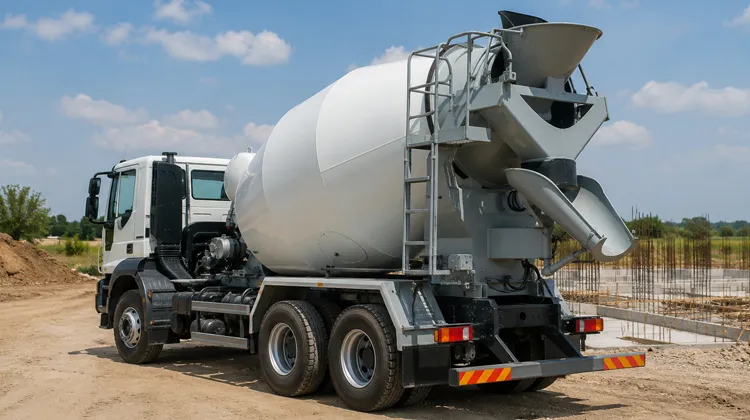
For most residential, commercial, and industrial projects, the following ranges are useful planning references:
| Concrete Truck Type | Typical Concrete Load | Common Applications |
|---|---|---|
| Small mixer truck | 4–6 cubic yards | Tight-access sites, repairs, small residential pours |
| Standard ready-mix truck | 8–10 cubic yards | Slabs, foundations, driveways, and general commercial work |
| Large-capacity mixer truck | 10–12 cubic yards | Larger slabs, industrial floors, and continuous pours |
| Multiple-truck delivery | More than 12 cubic yards | Large foundations, plant floors, roads, and structural pours |
One cubic yard equals 27 cubic feet, or about 0.765 cubic metres. A truck carrying 10 cubic yards therefore delivers roughly 7.65 cubic metres of fresh concrete.
The mixer drum itself has more physical volume than the concrete it carries. Space must be left inside the drum so the material can rotate, mix, and remain uniform during transportation. For that reason, the drum is not filled to its total geometric capacity.
Why Does Concrete Truck Capacity Vary?
Vehicle Weight Limits
Concrete is heavy. Normal-weight concrete commonly weighs about 3,800 to 4,100 lb per cubic yard. That is approximately 1.7 to 1.9 metric tonnes per cubic yard.
Even if there appears to be more room in the mixing drum, the truck may already be close to its legal gross vehicle weight limit. This is why the same truck may deliver different cubic-yard quantities when carrying normal-weight concrete, lightweight concrete, or heavyweight concrete.
Concrete Density and Mix Design
Concrete made with conventional sand and stone aggregate does not weigh the same as concrete made with lightweight aggregate, heavyweight aggregate, high fiber content, or specialized admixtures.
The denser the concrete, the more carefully the delivery quantity may need to be controlled. High-strength, radiation-shielding, heavyweight, or fiber-reinforced concrete may require suppliers to reduce the cubic yards delivered per truck.
Delivery Route and Local Regulations
Bridge ratings, local road rules, delivery permits, seasonal restrictions, and jobsite access can all affect truck capacity. A supplier may operate a large mixer truck but still limit its load for a specific route or project location.
Slump, Discharge Method, and Site Conditions
Concrete slump, travel time, discharge method, and weather conditions also affect delivery planning. Pumped concrete, long-haul deliveries, hot-weather work, and mixes containing specialized admixtures may be scheduled more conservatively to maintain workability and quality when the truck reaches the jobsite.
How Do You Calculate How Many Concrete Trucks You Need?
Use this simple formula:
Number of trucks = Total concrete volume ÷ Actual cubic yards delivered per truck
For example, if a project requires 45 cubic yards of concrete and the supplier schedules 9 cubic yards per truck:
45 ÷ 9 = 5 trucks
Do not rely only on the theoretical concrete volume. Formwork variation, uneven subgrade, reinforcement layout, thickened edges, placement losses, and small site corrections can increase actual demand.
For most pours, plan a sensible allowance beyond the calculated volume. The right allowance depends on the project size, placement accuracy, structural design, and supplier minimum-order policy. The goal is to avoid both a shortage that creates a cold joint and unnecessary excess that becomes returned concrete.
How to Calculate Concrete Volume in Cubic Yards

In the United States and Canada, ready-mix concrete is commonly ordered by the cubic yard. Use this formula:
Concrete volume in cubic yards = Length in feet × Width in feet × Thickness in feet ÷ 27
For example, consider a concrete slab that is 40 ft long, 25 ft wide, and 4 in. thick:
- Convert thickness to feet:
4 in. ÷ 12 = 0.333 ft - Calculate volume in cubic feet:
40 × 25 × 0.333 = 333 cubic feet - Convert to cubic yards:
333 ÷ 27 ≈ 12.33 cubic yards
This project would normally require about 12.5 to 13 cubic yards of concrete, with the final order quantity adjusted for site conditions and a suitable placement allowance.
How Much Area Can One Concrete Truck Cover?
Coverage depends on placement thickness. Using a 10-cubic-yard concrete truck as an example:
| Slab Thickness | Approximate Area Covered by 10 Cubic Yards |
|---|---|
| 4 in. | About 810 sq. ft. |
| 5 in. | About 650 sq. ft. |
| 6 in. | About 540 sq. ft. |
| 8 in. | About 405 sq. ft. |
These values are intended for preliminary estimating. Actual quantities should account for slopes, thickened sections, beams, footings, edge details, and local elevation changes.
How Should You Schedule Concrete Trucks for a Large Pour?
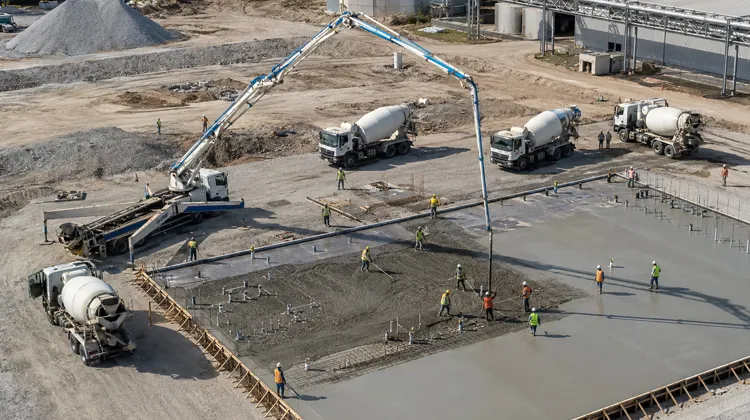
For a large placement, calculating the number of trucks is only the starting point. The delivery sequence must match the site’s actual placing capacity.
For example, a 90-cubic-yard project supplied in 9-cubic-yard loads requires 10 trucks in theory. If the site can place about 27 cubic yards per hour, a truck arrival interval of roughly every 20 minutes may help maintain a continuous pour without excessive waiting or long truck hold times.
A reliable delivery plan should also consider:
- Travel distance from the batch plant and peak traffic conditions;
- Actual capacity of the concrete pump, chute, or conveyor placement system;
- Truck access, turning space, discharge locations, and queueing area;
- Crew size, vibration capacity, finishing equipment, and curing preparation;
- Weather conditions that affect setting time, including heat, rain, and cold;
- Backup trucks and contingency plans for traffic or plant delays.
For industrial floors, equipment foundations, mass concrete, and plant structures, consistent delivery coordination directly affects placement quality.
What Should You Confirm Before Ordering Ready-Mix Concrete?
Before placing an order, confirm the following details with the supplier:
- Total concrete volume, including an appropriate placement allowance;
- Required strength, slump, maximum aggregate size, and special performance needs;
- Whether pumping, fibers, retarders, accelerators, or other admixtures are required;
- Maximum cubic yards that can be delivered per truck;
- Site entrance width, pavement capacity, and truck turning space;
- Whether rear-discharge, front-discharge, or small mixer trucks are needed;
- Discharge method, pump location, and expected placing rate;
- First truck arrival time, spacing between loads, and returned-concrete policy;
- Local restrictions on heavy vehicles, delivery windows, or road loading.
This information allows the supplier to assign suitable equipment and helps prevent delays, interrupted placement, and unnecessary waste.
Why Does Concrete Truck Capacity Matter for Cement Equipment Projects?
In cement plants, grinding stations, conveying systems, silos, dust collection systems, and bulk material handling projects, concrete is widely used for equipment foundations, support bases, floors, roads, anchor-bolt zones, and structural strengthening.
These works may involve large foundation volumes, dense reinforcement, many embedded items, or a requirement for continuous placement. Calculating the concrete delivered per truck in advance and matching deliveries to pumping and placing capacity reduces the risk of supply interruptions, cold joints, uneven strength development, and equipment installation delays.
For large equipment foundations, do not focus only on total concrete volume. Confirm continuous-pour duration, temperature-control needs, layer thickness, vibration procedures, and curing preparation. Truck quantity is only one part of a dependable concrete placement plan.
结论
A standard ready-mix concrete truck usually carries about 8 to 12 cubic yards of concrete, with 10 cubic yards being a common planning reference. The actual amount delivered depends on concrete density, truck payload limits, local road regulations, jobsite conditions, and the supplier’s dispatch plan.
Before ordering concrete, calculate the required volume accurately, then confirm the actual per-truck capacity and delivery interval with the supplier. For continuous pours, industrial foundations, and large slabs, a well-planned delivery schedule is just as important as the concrete mix itself.
常见问题解答
How many yards are usually in a concrete truck?
A standard ready-mix truck commonly carries about 8 to 12 cubic yards. Ten cubic yards is a widely used reference capacity.
How much does a 10-yard concrete truck weigh?
Normal-weight concrete is often about 3,800 to 4,100 lb per cubic yard. Ten cubic yards of concrete alone may weigh approximately 38,000 to 41,000 lb, before adding the truck’s own weight.
How many trucks are needed for 20 yards of concrete?
If each truck can deliver 10 cubic yards, two trucks are required in theory. If each truck carries 8 cubic yards, three trucks are normally needed. Always confirm actual truck capacity with the supplier.
Can one concrete truck pour an entire residential slab?
It depends on slab area and thickness. Ten cubic yards at a 4-inch thickness can cover approximately 810 sq. ft. Larger slabs usually require multiple trucks delivered in sequence.
Why can’t a concrete mixer truck carry more concrete?
Concrete is extremely heavy, so trucks must comply with vehicle and bridge weight limits. The mixer drum also needs free space to rotate and keep the concrete properly mixed during transport.


 Chinese
  English
  Russian
  Arabic
  Vietnamese
  Spanish
  French
  Portuguese
  Japanese