



Raw material grinding is a critical stage in cement manufacturing, directly affecting kiln efficiency, clinker quality, and overall production costs. As cement plants pursue higher productivity, lower energy consumption, and more sustainable operations, modern grinding systems are increasingly moving toward integrated drying and grinding technologies.
Among the available solutions, Ball Mills and Vertical Roller Mills (VRMs) are the two most widely used technologies for raw meal preparation and clinker grinding. Each offers distinct advantages in terms of grinding efficiency, investment cost, operational flexibility, and maintenance requirements.
This article explores the role of raw milling in cement production, explains the fundamental differences between raw mills and cement mills, and compares Ball Mill and Vertical Roller Mill technologies to help cement producers select the most suitable grinding solution.
Why Raw Material Grinding Is Important in Cement Production

Before clinker can be produced in a rotary kiln, raw materials such as limestone, clay, silica, and iron-bearing additives must be ground into a fine and homogeneous powder known as raw meal.
The quality of this raw meal has a direct influence on the entire cement manufacturing process. When particle size distribution is uniform and chemical composition is stable, the kiln can operate more efficiently, heat transfer becomes more effective, and clinker quality remains consistent. Conversely, poorly prepared raw meal can lead to unstable kiln conditions, increased fuel consumption, and reduced production efficiency.
Because raw milling is one of the most energy-intensive processes in cement production, optimizing grinding efficiency has become a key objective for cement producers seeking to reduce operating costs and improve plant performance.
The Development Trend of Modern Raw Milling Systems

In the past, drying and grinding were often performed using separate equipment. However, modern cement plants increasingly favor integrated systems that combine these functions into a single process.
This development is driven by several factors. Raw materials frequently contain varying levels of moisture, particularly in regions with humid climates. Drying these materials before grinding requires significant energy. By integrating drying and grinding operations, plants can utilize waste heat from the kiln preheater system, reducing both fuel consumption and operating costs.
Modern grinding systems are also expected to provide higher levels of automation, lower maintenance requirements, and greater environmental performance. As a result, Vertical Roller Mills have become a preferred solution in many new cement projects due to their ability to combine drying, grinding, and classification within a compact design.
Composition of Cement Raw Meal and Its Impact on Grinding Equipment
The selection of grinding equipment depends heavily on the characteristics of the materials being processed.
A typical cement raw meal is composed of:
- Limestone
- Clay
- Shale
- Sandstone
- Iron ore
- Silica-bearing materials
- Various industrial by-products
Each material presents different challenges. Limestone is generally easy to grind, while silica-rich materials can be highly abrasive and accelerate wear on grinding components. Moisture content also varies significantly depending on the source of the raw materials.
Because of these differences, grinding equipment must be selected not only based on production capacity but also on material hardness, abrasiveness, moisture content, and desired product fineness.
The Essential Difference Between a Raw Material Mill and a Cement Mill
Although both systems perform grinding operations, they serve different purposes within the cement manufacturing process.
Raw Material Mill
A raw mill processes natural materials before they enter the kiln. Its primary task is to prepare a stable and homogeneous raw meal suitable for clinker production.
In addition to grinding, raw mills often perform drying functions because incoming materials may contain significant moisture. Therefore, raw mill systems must efficiently manage both material size reduction and moisture removal.
Cement Mill
A cement mill operates after clinker production. It grinds clinker together with gypsum and supplementary cementitious materials such as slag, fly ash, or limestone to produce finished cement products.
Unlike raw mills, cement mills focus primarily on achieving precise cement fineness and particle size distribution rather than drying wet materials.
Comparison Between Raw Mill and Cement Mill
| Item | Raw Material Mill | Cement Mill |
|---|---|---|
| Material Type | Natural raw materials | Clinker and additives |
| Moisture Content | Higher | Lower |
| Drying Requirement | High | Limited |
| Primary Objective | Raw meal preparation | Cement production |
| Key Challenge | Drying and grinding | Fine grinding and quality control |
Understanding these differences is important when selecting grinding technologies and designing plant layouts.
Vertical Roller Mill for Raw Material Grinding
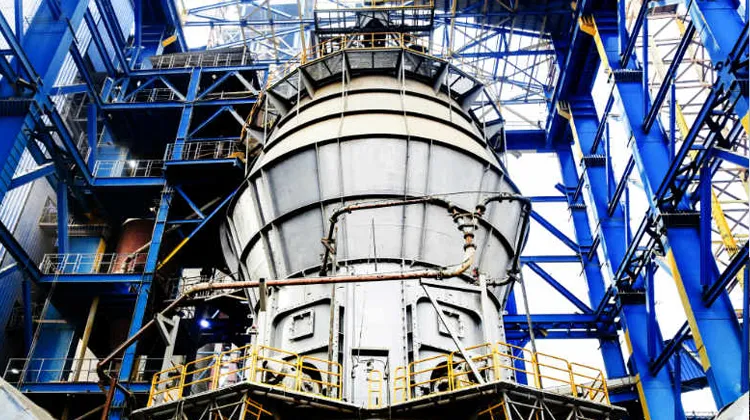
How a Vertical Roller Mill Works
A Vertical Roller Mill uses a grinding table and multiple grinding rollers to crush and grind materials through compression.
Raw material is fed onto the center of the rotating grinding table. As centrifugal force moves the material outward, it passes beneath the grinding rollers, where hydraulic pressure generates the force necessary for size reduction.
At the same time, hot gases rise through the nozzle ring and carry fine particles toward the dynamic separator. Qualified particles are collected as finished product, while oversized particles return to the grinding zone for further processing.
This integrated process allows grinding, drying, and classification to occur simultaneously within a single machine.
Main Components of a Vertical Roller Mill
A modern VRM typically includes:
- Base support structure
- Grinding table and wear liners
- Grinding rollers
- Dynamic separator
- Hydraulic tensioning system
- Nozzle ring
- Main drive system
- Auxiliary drive unit
- Rocker arm assembly
- Rotary feeder
Many advanced VRM designs incorporate finite element analysis during development to optimize structural strength, reduce vibration, and extend service life.
Why Vertical Roller Mills Are Widely Used Today
One of the primary reasons for the growing popularity of VRMs is their superior energy efficiency. Because grinding pressure is applied directly to the material bed, energy is transferred more effectively than in traditional impact-based grinding systems.
Another significant advantage is drying capacity. By utilizing hot gases from the preheater system, a VRM can efficiently process materials with higher moisture content without requiring separate drying equipment.
The compact design also reduces building requirements and simplifies plant layouts. For large-scale cement plants, these advantages often translate into lower long-term operating costs and improved environmental performance.
Ball Mill for Raw Material Grinding
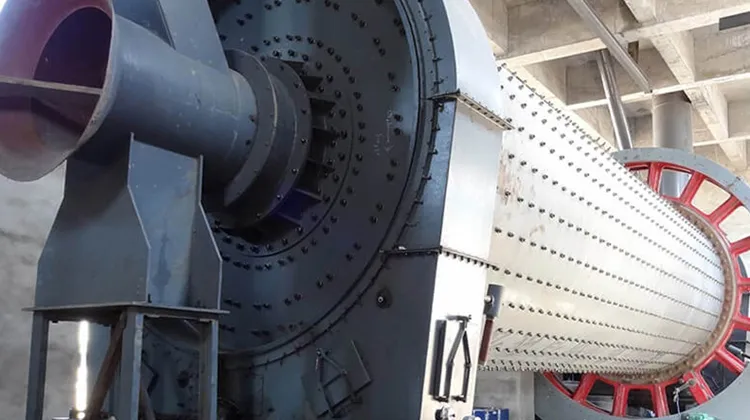
How a Ball Mill Works
A Ball Mill consists of a rotating cylindrical shell filled with steel grinding media.
As the mill rotates, the grinding media rise and fall, creating impact and friction forces that gradually reduce material size. The material moves through multiple compartments separated by diaphragms, becoming progressively finer before leaving the mill.
Although the principle is relatively simple, Ball Mills have demonstrated reliable performance in cement plants for decades.
Advantages of Ball Mills
Ball Mills continue to be widely used because of their proven technology and operational flexibility.
They can process a broad range of materials and are generally easier to operate and maintain than more sophisticated grinding systems. In addition, their lower initial investment makes them attractive for small and medium-sized projects.
Many cement producers also value the familiarity of Ball Mill technology, which simplifies training, maintenance, and spare parts management.
Intermediate-Discharge Circulating Grinding System
This system combines characteristics of both air-swept and end-discharge grinding circuits.
Its design improves airflow distribution and heat utilization throughout the grinding process. As a result, it offers strong drying capability, lower ventilation resistance, and stable operating conditions.
These advantages make it particularly suitable for raw materials with varying moisture content.
End-Discharge Circulating Grinding System
The end-discharge system is commonly applied in cement grinding applications requiring stable classification performance and consistent product quality.
Its relatively straightforward design contributes to reliable operation and simplified maintenance.
Ball Mill vs Vertical Roller Mill: Which Is Better?
The answer depends largely on project requirements and operational priorities.
Vertical Roller Mills generally offer superior energy efficiency, higher production capacity, and better drying capability. These advantages make them highly attractive for large-scale cement plants focused on reducing operating costs and improving sustainability.
Ball Mills, however, continue to offer important advantages. Their lower investment cost, simpler operation, and proven reliability make them a practical solution for many projects, particularly where budget constraints are a major consideration.
| Factor | Ball Mill | Vertical Roller Mill |
|---|---|---|
| Initial Investment | Lower | Higher |
| Energy Consumption | Higher | Lower |
| Drying Capability | Moderate | Excellent |
| Feed Size | Smaller | Larger |
| Plant Footprint | Larger | Smaller |
| Automation Level | Moderate | High |
| Maintenance Complexity | Lower | Higher |
| Long-Term Operating Cost | Higher | Lower |
Rather than asking which technology is universally better, plant owners should evaluate which solution best aligns with their production goals, raw material characteristics, and investment strategy.
How to Choose the Right Grinding Solution
Selecting the right grinding system requires a comprehensive assessment of several factors.
Production capacity is often the first consideration. Large-capacity plants may benefit more from the efficiency advantages of a Vertical Roller Mill, while smaller facilities may find a Ball Mill system more economical.
Raw material properties must also be carefully evaluated. Moisture content, hardness, and abrasiveness all influence grinding performance and equipment wear.
In addition, long-term operating costs should be considered alongside initial investment. Although VRMs generally require higher capital expenditure, their lower energy consumption can generate substantial savings throughout the life of the plant.
The most effective solution is often achieved through detailed technical analysis and consultation with experienced cement equipment specialists.
FAQs
What is the difference between a raw mill and a cement mill?
A raw mill processes natural materials such as limestone and clay before clinker production, while a cement mill grinds clinker and additives into finished cement. Raw mills typically require significant drying capability, whereas cement mills focus on achieving precise product fineness.
Why are Vertical Roller Mills widely used for raw meal grinding?
Vertical Roller Mills combine grinding, drying, and classification in one machine. This integrated design improves energy efficiency, reduces equipment footprint, and allows effective processing of materials with higher moisture content.
Is a Ball Mill still a good choice for cement plants?
Yes. Ball Mills remain a reliable and cost-effective solution for many cement plants. Their mature technology, operational flexibility, and lower investment cost make them suitable for a wide range of grinding applications.
Which grinding technology is more energy-efficient?
In most cases, Vertical Roller Mills consume less electricity than conventional Ball Mill systems. Depending on material characteristics and operating conditions, energy savings can often range from 10% to 30%.
Conclusion
Raw material grinding plays a fundamental role in cement production, influencing everything from kiln efficiency and clinker quality to energy consumption and overall plant profitability.
Both Ball Mills and Vertical Roller Mills have proven their value in cement raw meal preparation and clinker grinding applications. While Ball Mills continue to provide dependable performance and investment flexibility, Vertical Roller Mills have become the preferred choice for many modern cement plants due to their higher efficiency, integrated drying capability, and lower long-term operating costs.
By carefully evaluating raw material characteristics, production objectives, and project economics, cement producers can select the grinding technology that delivers the best balance between performance, reliability, and return on investment.


 English
  Russian
  Arabic
  Vietnamese
  Spanish
  French
  Portuguese
  Japanese
  Chinese