



Wollastonite is an important industrial mineral widely used in construction materials, engineering plastics, coatings, ceramics, and metallurgy. With the increasing demand for sustainable building materials, high-performance composites, and environmentally friendly fillers, global consumption of wollastonite powder continues to grow.
The value of wollastonite depends not only on resource availability but also on processing technology and product quality control. Understanding its formation, global distribution, and industrial processing methods is essential for mineral processing companies and equipment manufacturers seeking to compete in international markets.
1. What is Wollastonite

Wollastonite is a naturally occurring calcium silicate mineral with the chemical formula CaSiO₃. It belongs to the chain silicate group and is recognized for its unique acicular, or needle-like, crystal structure. Unlike many common industrial fillers that are granular or plate-like in shape, wollastonite crystals grow in elongated forms, which gives the mineral reinforcing characteristics when incorporated into composite materials.
The mineral was first identified in the early nineteenth century and named after English chemist and mineralogist William Hyde Wollaston. Today, wollastonite is classified as an industrial mineral rather than a metallic ore, and it is widely used in construction materials, plastics, ceramics, coatings, and metallurgical applications.
1.1 Chemical Composition and Mineral Classification
Chemically, wollastonite is composed of calcium oxide (CaO) and silicon dioxide (SiO₂) combined in a single-chain silicate structure. Its ideal chemical formula is CaSiO₃, although natural samples may contain trace elements such as iron, magnesium, or manganese depending on geological conditions.
From a mineralogical perspective, wollastonite is part of the pyroxenoid group. It is closely related to pyroxenes but differs in crystal symmetry and chain configuration. This structural difference contributes to its distinct physical behavior and industrial performance.
Because wollastonite contains no chemically bound water and does not release hazardous fibers, it is often considered a safer alternative to certain fibrous minerals previously used in construction materials.
1.2 How is Wollastonite Formed
Wollastonite forms primarily through contact metamorphism. This geological process occurs when silica-rich fluids interact with limestone or dolomite under conditions of elevated temperature and pressure. During this reaction, calcium carbonate (CaCO₃) reacts with silica (SiO₂), producing calcium silicate (CaSiO₃) and carbon dioxide gas.
The simplified chemical reaction can be expressed as:
CaCO₃ + SiO₂ → CaSiO₃ + CO₂
This transformation typically takes place near igneous intrusions, where heat from magma alters surrounding carbonate rocks. As a result, wollastonite deposits are often associated with skarn formations and marble-hosted metamorphic environments.
The geological origin of wollastonite influences its purity, crystal size, and aspect ratio, all of which are critical factors for industrial applications.
1.3 Physical Properties of Wollastonite
Wollastonite exhibits several physical characteristics that make it suitable for industrial use.
It typically appears white, off-white, or light gray in color and has a vitreous to pearly luster. Its Mohs hardness ranges between 4.5 and 5.0, placing it in a moderate hardness category that allows for relatively easy grinding during mineral processing.
The density of wollastonite generally ranges from 2.8 to 3.1 g/cm³. It has a relatively low oil absorption value compared to many other mineral fillers, which makes it desirable in coatings and polymer systems where controlled viscosity is important.
One of its most important characteristics is its high aspect ratio. The needle-like particles can improve tensile strength, flexural strength, and dimensional stability in plastics and composites.
1.4 Thermal and Electrical Properties
Wollastonite has a low coefficient of thermal expansion, meaning it maintains dimensional stability under temperature fluctuations. This property makes it valuable in ceramic bodies, friction materials, and heat-resistant composites.
In addition, wollastonite offers excellent dielectric properties and electrical insulation performance. It does not conduct electricity and does not degrade easily under high temperatures, which is why it is frequently used in engineering plastics and electrical components.
Its thermal stability also allows it to act as a fluxing agent in ceramics, lowering firing temperature while maintaining structural integrity.
1.5 Comparison with Other Industrial Minerals
Wollastonite is often compared with other industrial fillers such as talc, calcium carbonate, and mica.
Compared to calcium carbonate, wollastonite provides better reinforcement due to its acicular structure. While calcium carbonate is primarily used as a cost-reducing filler, wollastonite contributes both structural and functional benefits.
Compared to talc, wollastonite has higher hardness and better heat resistance. Talc is plate-like and improves surface smoothness, whereas wollastonite enhances mechanical strength.
Unlike asbestos, which was historically used for reinforcement and fire resistance, wollastonite does not pose the same health risks because it does not form hazardous respirable fibers under normal industrial use conditions.
1.6 Is Wollastonite Natural and Safe
Wollastonite is a naturally occurring mineral extracted from open-pit or underground mines. After mining, it undergoes crushing, grinding, and beneficiation before being used in industrial applications.
In terms of safety, wollastonite is generally regarded as a low-toxicity mineral when handled according to industrial safety standards. Regulatory assessments in various countries have not classified it as a carcinogenic material. However, like all mineral powders, appropriate dust control and protective measures are recommended during processing and handling.
1.7 Why Wollastonite is Important in Modern Industry
The growing demand for high-performance materials, sustainable construction solutions, and environmentally friendly fillers has increased the importance of wollastonite in global markets.
Its combination of reinforcement capability, thermal stability, chemical resistance, and electrical insulation makes it a multifunctional industrial mineral. As industries move toward lightweight composites and asbestos-free construction materials, wollastonite continues to gain relevance as a reliable and cost-effective alternative.
2. Global Distribution and Resources

Wollastonite resources are distributed across several continents, but commercially viable deposits are concentrated in a few key regions. Economically extractable ore depends on factors such as purity, crystal morphology, deposit size, and accessibility.
2.1 Asia: Major Wollastonite Producers
Asia is the world’s leading wollastonite-producing region.
China dominates global production with multiple large-scale deposits, including skarn-type ore bodies in Hubei, Liaoning, and Jilin provinces. These deposits are widely used for ceramics, plastics, and construction materials.
India has marble-hosted wollastonite deposits in Rajasthan, supplying both domestic and international markets for ceramics, polymers, and friction materials.
Kazakhstan contains smaller deposits with distinct mineral compositions, often requiring careful beneficiation before industrial use.
Asia not only provides high-volume supply but also a diverse range of ore grades suitable for different applications.
2.2 North America: High-Quality and Specialized Deposits
North America has notable commercial deposits, mainly in the United States and Mexico.
The Willsboro deposit in New York is known for long acicular crystals, ideal for polymer reinforcement.
Mexico supplies wollastonite for ceramics and cement applications, serving local and export markets.
Although North American production costs are higher than in Asia, the mineral quality and consistent acicular structure make it desirable for high-performance applications.
2.3 Europe: Niche High-Purity Resources
Europe’s wollastonite resources are smaller but focused on specialized, high-value applications.
Finland produces high-purity wollastonite used in advanced ceramics, specialty coatings, and engineered composites.
European producers emphasize precise particle size control, chemical purity, and sustainable mining practices to meet demanding industrial standards.
2.4 Geological Types and Their Industrial Implications
The two main geological types are:
Skarn-type deposits, formed at the contact between igneous intrusions and carbonate rocks, often producing long, needle-like crystals suitable for reinforcement.
Marble-hosted deposits, resulting from regional metamorphism, offering high chemical purity but sometimes shorter crystal structures.
Deposit type affects ore grade, impurity content, and the processing approach needed to produce commercial-grade wollastonite powder.
2.5 Market Relevance and Supply Trends
Global demand for wollastonite continues to rise due to growth in ceramics, plastics, construction materials, and asbestos-free applications. Countries with large, high-quality reserves and efficient processing infrastructure maintain a competitive advantage in international trade.
Key factors influencing supply include ore quality, mining scale, beneficiation technology, and proximity to industrial markets.
3. Industrial Processing of Wollastonite
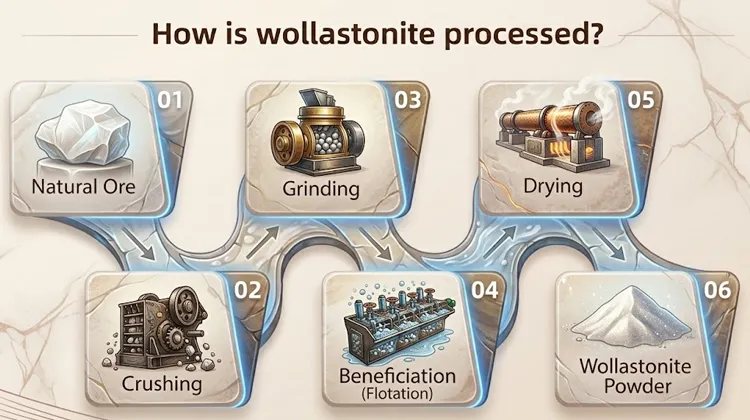
Industrial processing of wollastonite involves a series of mechanical and mineral separation steps designed to transform raw ore into high-purity, application-specific powder products. Because the commercial value of wollastonite largely depends on particle size distribution, aspect ratio, and chemical purity, processing technology plays a decisive role in determining final product performance.
A typical wollastonite processing plant includes crushing, grinding, beneficiation, classification, and drying stages. Depending on the ore characteristics and target market requirements, the processing flow can be adjusted to produce coarse aggregates, standard filler-grade powder, ultrafine powder, or high-aspect-ratio acicular products.
3.1 Primary Crushing and Size Reduction
The first step in wollastonite processing is ore size reduction. After mining, large blocks of raw wollastonite ore must be broken down into manageable particle sizes for further treatment.
Primary crushing is typically performed using a jaw crusher, which reduces large feed material into intermediate sizes. This stage ensures consistent feed for secondary crushing equipment.
Secondary crushing is commonly carried out using cone crushers or impact crushers to further reduce the material to a controlled size range suitable for grinding.
Efficient crushing improves downstream grinding efficiency and reduces overall energy consumption. Proper control of particle size at this stage also minimizes excessive fines generation, which can negatively affect beneficiation performance.
3.2 Grinding and Milling Technology
Grinding is one of the most critical stages in wollastonite powder production. The objective is not only to reduce particle size but also to preserve the natural acicular structure of the mineral as much as possible.
Depending on the required fineness, different milling technologies may be selected:
Raymond mills are commonly used for producing standard mesh wollastonite powder for ceramics and construction materials.
Ball mills are suitable for producing uniform particle sizes in medium-fineness applications.
Vertical roller mills are increasingly adopted in modern mineral processing plants due to their energy efficiency and stable output.
For ultrafine wollastonite powder, equipment such as high-pressure suspension mills or ultrafine grinding mills can achieve micron-level particle sizes.
Careful control of grinding parameters is essential. Excessive milling may shorten the needle-like crystals, reducing reinforcement performance in plastics and composites. Therefore, industrial processors aim to balance fineness and aspect ratio retention.
3.3 Beneficiation and Purification Methods
Raw wollastonite ore often contains impurities such as calcite, garnet, diopside, quartz, or iron-bearing minerals. To meet the quality standards required by high-end applications, beneficiation is necessary.
Flotation is widely used to remove carbonate minerals and silicate gangue. By adjusting reagent systems and pH levels, wollastonite particles can be selectively separated from unwanted minerals.
Magnetic separation is applied when iron-containing impurities are present. High-intensity magnetic separators effectively reduce iron content, improving whiteness and chemical purity.
In some cases, gravity separation techniques may be introduced to enhance concentrate grade before fine grinding.
The goal of beneficiation is to increase calcium silicate purity, enhance whiteness, and ensure stable chemical composition for downstream industries such as coatings and engineering plastics.
3.4 Classification and Particle Size Control
After grinding, particle size classification ensures uniform product quality. Air classifiers or cyclone separators are used to control mesh size distribution.
Different industrial sectors require different particle specifications:
Coarse-grade wollastonite may be used in metallurgical flux applications.
Standard powder grades are commonly applied in ceramics and construction materials.
Fine and ultrafine powders are used in coatings, plastics, and rubber reinforcement.
High-aspect-ratio needle powder is specifically engineered for composite reinforcement and friction materials.
Precise classification improves consistency, enhances product performance, and strengthens competitiveness in export markets.
3.5 Drying and Moisture Control
Moisture control is essential in wollastonite powder production, especially for applications in plastics and coatings. Residual moisture can affect dispersion, processing stability, and final product quality.
Rotary dryers are commonly used to remove excess moisture from beneficiated ore or milled powder. The drying temperature must be carefully controlled to avoid altering mineral structure.
In advanced processing plants, drying systems are integrated with dust collection and environmental control units to meet industrial emission standards and maintain safe working conditions.
3.6 Surface Modification and Value-Added Processing
In high-performance applications, wollastonite powder may undergo surface treatment to improve compatibility with polymer matrices.
Surface modification methods include silane coupling agent treatment and organic coating processes. These treatments enhance dispersion in plastics, improve interfacial bonding, and increase mechanical strength.
Modified wollastonite is widely used in automotive plastics, polypropylene compounds, and flame-retardant composite materials.
Value-added processing significantly increases product market price and expands industrial applications.
3.7 Quality Control and Industrial Standards
Industrial-grade wollastonite products are evaluated based on multiple quality indicators, including:
Chemical purity (CaSiO₃ content)
Whiteness index
Particle size distribution
Aspect ratio
Oil absorption value
Iron content
Consistent quality control ensures compliance with international industrial standards and customer specifications.
Modern processing plants utilize automated monitoring systems, laboratory testing equipment, and standardized packaging solutions to ensure product reliability in global trade.
3.8 Challenges in Wollastonite Processing
Processing wollastonite presents several technical challenges.
Preserving the needle-like crystal structure during grinding requires optimized equipment selection.
Removing complex mineral impurities without excessive loss of valuable material demands precise beneficiation control.
Energy efficiency and environmental compliance are increasingly important factors in plant design.
Producers must continuously upgrade processing technology to meet stricter industrial performance requirements and reduce production costs.
4. Industrial Applications of Wollastonite Powder
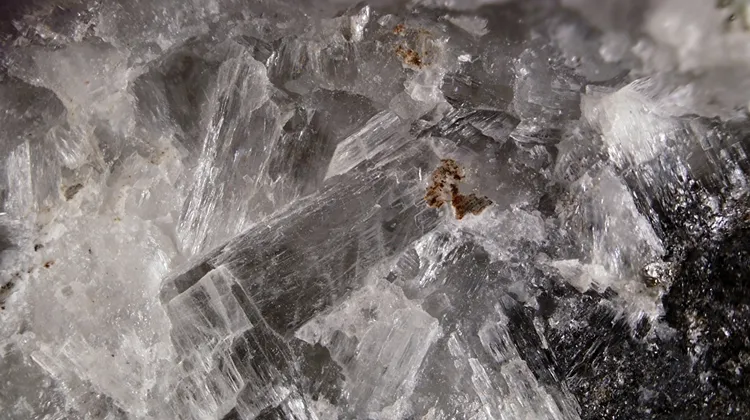
Wollastonite powder is widely used as a functional mineral filler and performance-enhancing additive across multiple industrial sectors. Unlike ordinary fillers that serve primarily as cost reducers, wollastonite contributes mechanical reinforcement, thermal stability, dimensional control, and chemical resistance.
Its needle-like particle morphology, chemical stability, and compatibility with various matrices make it an essential raw material in modern manufacturing industries, including plastics, ceramics, coatings, construction materials, metallurgy, and automotive components.
4.1 Wollastonite in Plastics and Polymer Compounds
One of the fastest-growing applications of wollastonite powder is in thermoplastics and engineering polymers. In polypropylene (PP), polyethylene (PE), polyamide (PA), and polyvinyl chloride (PVC) systems, wollastonite acts as a reinforcing mineral filler.
The elongated particle structure improves tensile strength, flexural modulus, and impact resistance. At the same time, it enhances dimensional stability by reducing shrinkage and warping during injection molding.
Wollastonite-filled plastics are widely used in:
Automotive interior panels
Bumpers and dashboards
Electrical housings
Appliance components
Industrial containers
In flame-retardant polymer systems, wollastonite also contributes to improved fire resistance and heat distortion temperature. Compared with traditional fillers such as calcium carbonate, wollastonite offers superior mechanical reinforcement without significantly increasing weight.
4.2 Wollastonite in Paints and Coatings
In the coatings industry, wollastonite powder is used as a functional extender pigment. It can partially replace titanium dioxide in certain formulations, reducing raw material costs while maintaining performance.
Wollastonite enhances coating properties by:
Improving film thickness control
Increasing crack resistance
Enhancing abrasion resistance
Improving anti-corrosion performance
Providing better weather resistance
Because of its low oil absorption and high whiteness, wollastonite allows formulators to maintain desirable viscosity and brightness levels.
It is commonly used in:
Industrial protective coatings
Marine anti-corrosion paints
Architectural exterior paints
Powder coatings
Water-based coatings
Its chemical inertness ensures stability in both solvent-based and water-based systems.
4.3 Wollastonite in Ceramics and Tile Manufacturing
Wollastonite plays a crucial role in ceramic body formulations. In ceramic tile production and sanitary ware manufacturing, it functions as a fluxing agent and structural stabilizer.
During firing, wollastonite promotes the formation of stable crystalline phases that improve mechanical strength and reduce firing shrinkage. It also lowers sintering temperature, contributing to energy savings in kiln operations.
Applications include:
Ceramic wall and floor tiles
Porcelain products
Electrical insulators
Sanitary ceramics
Tableware
The addition of wollastonite improves surface smoothness and reduces the risk of cracking and deformation during thermal treatment.
4.4 Wollastonite in Construction Materials
In construction applications, wollastonite powder is incorporated into cement-based products, dry-mix mortars, and composite building panels.
It improves mechanical performance by acting as a micro-reinforcement fiber within cement matrices. The mineral enhances flexural strength and impact resistance while reducing shrinkage cracks.
Wollastonite is also used as an asbestos substitute in fiber cement boards and fire-resistant panels. Unlike asbestos, it does not present the same regulatory and health concerns, making it a safer reinforcement alternative in modern building materials.
Typical construction uses include:
Fiber cement boards
Fireproof panels
Wall cladding materials
Roofing sheets
Floor tiles
Its thermal stability contributes to improved fire resistance in structural materials.
4.5 Wollastonite in Metallurgy and Welding Applications
In metallurgical processes, wollastonite serves as a fluxing material and slag conditioner. Because it contains calcium and silicon, it contributes to slag formation and helps remove impurities during metal refining.
In welding electrodes, wollastonite functions as a stabilizing component that improves arc performance and slag detachability. It enhances weld quality and reduces defects.
It is also used in continuous casting mold powders and metallurgical protective slags.
Industrial benefits include:
Improved metal surface quality
Enhanced thermal stability
Reduced impurity inclusion
Better process efficiency
Its chemical composition makes it compatible with various steelmaking and metal treatment operations.
4.6 Wollastonite in Friction Materials
Wollastonite powder is widely used in brake pads and clutch facings. The acicular structure enhances structural integrity in friction composites.
It provides:
Improved wear resistance
Stable friction coefficient
Thermal resistance under braking conditions
Reduced material cracking
As automotive manufacturers shift toward asbestos-free friction materials, wollastonite has become an important reinforcement mineral in brake system formulations.
4.7 Wollastonite in Rubber and Sealants
In rubber products and sealants, wollastonite improves dimensional stability and tear resistance. It enhances hardness and reduces deformation under pressure.
Applications include:
Industrial rubber sheets
Sealing gaskets
Conveyor belts
Adhesive systems
Because of its reinforcing capability, it allows manufacturers to optimize performance while controlling material costs.
4.8 Emerging and Advanced Applications
With the development of advanced materials, wollastonite is gaining attention in new application areas.
In lightweight composite materials, it contributes to weight reduction while maintaining structural strength.
In 3D printing materials, mineral fillers such as wollastonite improve thermal control and mechanical durability.
In environmentally friendly construction products, it supports the production of sustainable and asbestos-free materials.
As industries increasingly demand multifunctional fillers with both reinforcement and stability properties, wollastonite continues to expand its application range.
Conclusion
Driven by demand for sustainable construction materials and high-performance composites, the global wollastonite market continues to expand. Product quality, ultrafine grinding capability, and high aspect ratio control will shape future competitiveness.
For mineral processing enterprises, investing in advanced crushing, grinding, beneficiation, and drying technologies is essential to meet international standards and capture high-end market opportunities.


 English
  Russian
  Arabic
  Vietnamese
  Spanish
  French
  Portuguese
  Japanese
  Chinese