


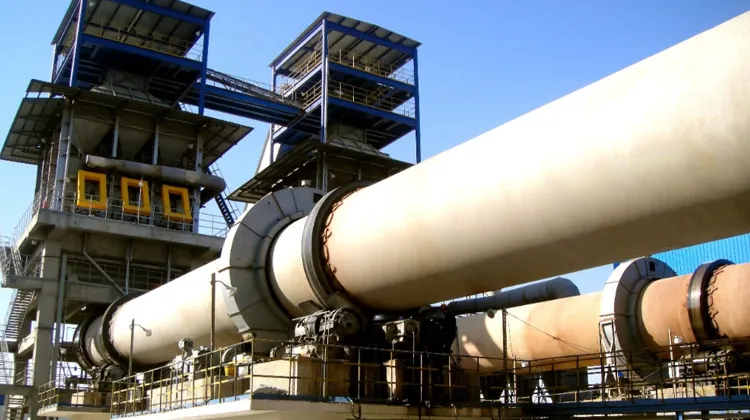
Introduction: Rotary Kiln as the Core of Modern Cement Manufacturing
In modern cement manufacturing plants, especially those adopting the dry-process production route, the rotary kiln is universally recognized as the heart of the clinker production system. It is not simply a piece of high-temperature equipment, but the central technological platform upon which clinker quality, production capacity, energy efficiency, emission performance, and long-term operational reliability are built.
From raw meal entering the preheater to clinker discharge and cooling, all critical thermal and chemical transformations ultimately converge in the rotary kiln. For this reason, the selection, design, and operation of the rotary kiln system have a decisive impact on the overall competitiveness of a cement plant.
As the cement industry continues to evolve toward larger production scales, higher automation levels, stricter environmental regulations, and lower carbon intensity, the rotary kiln remains the most mature, adaptable, and reliable calcination technology available today.
Fundamental Requirements of Cement Clinker Production
Cement clinker formation is a complex high-temperature industrial process involving multiple physical and chemical reactions. These reactions include moisture evaporation, raw material preheating, decarbonation of limestone, and the formation of clinker minerals such as alite (C₃S), belite (C₂S), aluminate (C₃A), and ferrite (C₄AF).
To ensure stable clinker quality, the calcination system must satisfy several fundamental requirements:
First, it must operate continuously at temperatures exceeding 1400°C, with a stable thermal profile that can be maintained over long production cycles.
Second, it must provide sufficient and controllable material residence time in the high-temperature zone to allow complete mineral formation.
Third, it must ensure uniform heat transfer and material mixing to avoid underburning, overburning, or localized sintering.
Rotary kilns inherently meet all these requirements through their rotating cylindrical structure, making them uniquely suitable for clinker production in modern cement plants.

Working Principle of a Rotary Kiln and Its Process Advantages
A rotary kiln is a long, cylindrical vessel installed at a slight inclination, typically between 2 and 5 degrees. The kiln rotates slowly around its longitudinal axis, driven by a main drive system consisting of a motor, gearbox, and girth gear.
Raw meal enters the kiln from the inlet (kiln tail) and gradually moves toward the outlet (kiln head) under the combined effect of rotation and gravity. During this movement, the material is continuously lifted and cascaded, ensuring thorough mixing and constant exposure to high-temperature gases.
This dynamic motion creates several critical process advantages. Heat transfer between gas and material becomes highly uniform, temperature gradients remain smooth, and chemical reactions proceed in a controlled and stable manner. Compared with static or intermittent calcination equipment, rotary kilns provide superior process stability and operational control.
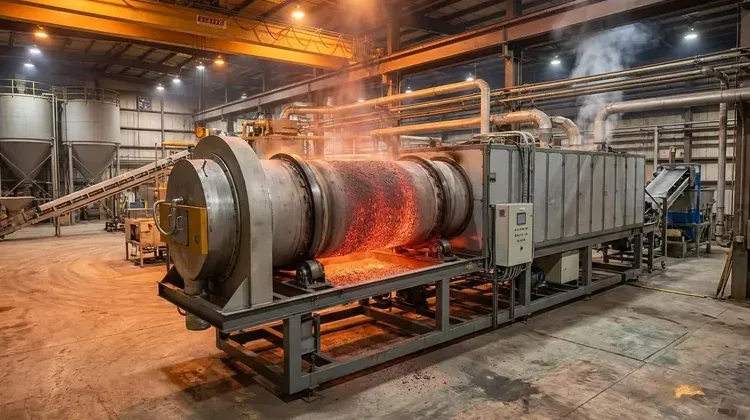
Integration with Modern Dry-Process Cement Technology
Modern cement plants predominantly use dry-process technology, which relies on multi-stage cyclone preheaters and precalciner systems to maximize thermal efficiency. In these systems, more than 85% of the raw meal decarbonation occurs before the material enters the rotary kiln.
As a result, the rotary kiln is optimized to focus on the final sintering and clinker formation stages rather than full decarbonation. This division of thermal tasks significantly reduces specific heat consumption and allows for higher production capacities without increasing kiln size disproportionately.
Rotary kilns are highly adaptable to different preheater configurations, including four-stage, five-stage, and six-stage cyclone systems, as well as inline and separate-line calciners. This flexibility makes them suitable for a wide range of plant capacities, from 2,500 tpd to over 12,000 tpd clinker production.
Role of Rotary Kiln in Clinker Quality Control
Clinker quality stability is the foundation of consistent cement performance. Variations in free lime content, mineral composition, or clinker nodulization directly affect cement strength development, grindability, and durability.
The rotary kiln allows precise control over critical process parameters, including burning zone temperature, material residence time, kiln atmosphere, and heat input distribution. Advanced instrumentation and control systems enable real-time monitoring and adjustment of these parameters, ensuring stable clinker mineralogy.
A well-designed and properly operated rotary kiln produces clinker with low free CaO content, uniform crystal structure, and good nodulization. This not only improves cement quality but also reduces downstream energy consumption in cement grinding.
Energy Efficiency and Fuel Flexibility
Energy consumption represents a significant portion of cement production costs. Rotary kilns offer superior energy efficiency due to their compatibility with advanced thermal systems and alternative fuels.
Rotary kilns can operate with a wide range of fuels, including pulverized coal, petroleum coke, natural gas, heavy oil, and various alternative fuels such as RDF, biomass, and industrial waste-derived fuels. This fuel flexibility allows cement producers to optimize operating costs and adapt to changing energy markets.
Furthermore, rotary kiln systems can be easily integrated with waste heat recovery power generation, low-NOx burners, staged combustion techniques, and advanced emission control technologies. These features are essential for meeting increasingly stringent environmental regulations while maintaining economic viability.
Key Equipment and Components of a Rotary Kiln System
A rotary kiln system is not a single piece of equipment but a complex assembly of interconnected subsystems. The main components include the kiln shell, support rollers and thrust rollers, drive system, burner system, kiln seals, and refractory lining.
The kiln shell must be manufactured with high dimensional accuracy and structural integrity to withstand thermal expansion and mechanical stress. Support and thrust roller systems ensure stable kiln rotation and axial positioning, while the drive system provides reliable torque transmission under heavy load conditions.
The burner system plays a critical role in flame shape, heat distribution, and fuel efficiency. Modern burners are designed to support multi-fuel operation and low-NOx combustion. High-quality refractory lining protects the kiln shell and ensures efficient heat retention, directly affecting energy consumption and maintenance cycles.
Automation, Monitoring, and Operational Reliability
Modern rotary kilns are equipped with advanced automation and monitoring systems, including DCS control platforms, infrared scanners, shell temperature monitoring, vibration sensors, and kiln alignment systems.
These technologies enable predictive maintenance, early fault detection, and optimized process control. By continuously monitoring kiln conditions, operators can minimize unplanned downtime, extend refractory life, and maintain stable production.
High operational reliability is particularly important in large cement plants, where even short production interruptions can result in significant economic losses.
Rotary Kiln from an EPC and Lifecycle Cost Perspective
From an EPC project perspective, the rotary kiln represents one of the largest capital investments in a cement plant. However, initial equipment cost should never be the sole selection criterion.
A high-quality rotary kiln system delivers long-term value through reduced maintenance costs, lower energy consumption, higher availability, and improved clinker quality. These factors significantly influence the total lifecycle cost of the plant.
Well-engineered rotary kiln solutions also provide greater flexibility for future upgrades, capacity expansion, and integration of new technologies such as alternative fuels or carbon capture systems.

Comparison with Other Kiln Technologies
Compared with vertical shaft kilns and other calcination technologies, rotary kilns offer clear advantages in capacity, product quality, process control, and environmental performance.
Vertical shaft kilns are typically limited to small-scale production and lack the flexibility and efficiency required for modern cement manufacturing. Rotary kilns, by contrast, are designed for continuous large-scale operation and can meet the demands of industrial cement production worldwide.
Environmental Performance and Sustainability Considerations
Sustainability has become a central concern in the cement industry. Rotary kilns play a critical role in reducing environmental impact through efficient fuel utilization, emission control, and compatibility with alternative raw materials.
Advanced rotary kiln systems support low-NOx combustion, SO₂ control, dust reduction, and the utilization of waste-derived fuels and raw materials. These capabilities are essential for compliance with international environmental standards and long-term industry sustainability.
Future Outlook: Rotary Kiln in a Low-Carbon Cement Industry
Despite increasing pressure to decarbonize cement production, rotary kilns remain the most viable platform for technological innovation. Improvements in thermal efficiency, fuel substitution, digital control, and carbon capture integration continue to enhance their performance.
Rather than being replaced, rotary kilns are evolving to meet the challenges of low-carbon cement manufacturing. Their adaptability ensures they will remain the dominant clinker production technology for decades to come.
Conclusion
Considering process fundamentals, equipment reliability, energy efficiency, fuel flexibility, environmental performance, and lifecycle value, the rotary kiln remains the optimal and indispensable choice for cement manufacturing plants worldwide.
It is not merely a piece of equipment, but the technological backbone of modern cement production.


 English
  Russian
  Arabic
  Vietnamese
  Spanish
  French
  Portuguese
  Japanese
  Chinese