



Diatomite is a naturally occurring mineral formed from the fossilized remains of microscopic aquatic organisms known as diatoms. Although these organisms are invisible to the naked eye, their silica-rich skeletons accumulated over millions of years and eventually formed one of the world’s most useful industrial minerals.
Today, diatomite is widely used in filtration systems, cement production, environmental protection, agriculture, construction materials, coatings, and industrial absorbents because of its lightweight structure, high porosity, and excellent adsorption capacity.
Among global producers, Kenya is known for its significant diatomite deposits located in the East African Rift Valley. The country’s mining industry has made diatomite an increasingly important resource for industrial development and mineral processing applications.
This article explores what diatomite is, how it forms, where it is mined, how it is processed, and why it plays such an important role in modern industry.
1. Understanding Diatomite
What Exactly Is Diatomite?
Diatomite, also called diatomaceous earth or kieselguhr, is a siliceous sedimentary rock formed from the fossilized skeletal remains of diatoms.
Diatoms are microscopic algae that once lived in freshwater lakes, rivers, and marine environments millions of years ago. Their cell walls were rich in silica, and after these organisms died, their remains gradually settled at the bottom of lakes and oceans.
Over time, geological pressure and sedimentation transformed these silica-rich deposits into soft mineral layers known as diatomite.
Because diatomite originates from biological materials rather than volcanic or metallic processes, it possesses a highly porous internal structure that makes it very different from ordinary rocks and minerals.
2. Mineral Properties of Diatomite

Chemical Composition
The primary chemical component of diatomite is:
which is silicon dioxide.
High-quality diatomite consists almost entirely of silica, although small amounts of aluminum oxide, iron oxide, calcium compounds, and organic materials may also be present depending on the geological conditions in which the deposit formed.
Physical Characteristics
Diatomite is usually white, cream-colored, light gray, or pale brown. It has a soft texture and can easily be crushed into fine powder.
Its surface often feels smooth and lightweight because the material contains countless microscopic pores created by fossilized diatom shells.
Its Mohs hardness is approximately:
Mohs Hardness=6Mohs\ Hardness=6
Despite containing silica, diatomite remains much lighter than dense silicate rocks because of its naturally porous structure.
3. Advantages and Limitations of Diatomite
Why Is Diatomite Valuable?
Diatomite combines several industrially valuable properties within a single natural material.
Its low density allows manufacturers to reduce the weight of industrial products and building materials. Its enormous surface area and pore structure give it exceptional absorption and filtration capabilities.
In industrial applications, diatomite is highly valued because it offers:
- Excellent adsorption performance
- Strong thermal insulation
- High porosity
- Chemical stability
- Wear resistance
- Low thermal conductivity
- High brightness
These characteristics make diatomite useful in filtration systems, industrial fillers, insulation materials, and absorbent products.
Health and Safety Considerations
Although diatomite is widely used in industrial and consumer products, excessive exposure to airborne dust may irritate the respiratory system.
Workers exposed to fine diatomite dust over long periods may experience coughing, shortness of breath, or irritation to the eyes and skin.
For this reason, modern processing plants often use dust collection systems and industrial ventilation equipment to improve workplace safety.
4. Diatomite Mining in Kenya

Kenya’s Importance in Diatomite Production
Kenya is one of the important producers of diatomite due to its large deposits in the East African Rift Valley.
Major mining areas include:
- Kariandusi
- Gilgil
- Kokitoin
These regions contain rich sedimentary deposits formed in ancient lake environments where massive populations of diatoms once existed.
The availability of high-quality diatomite has helped support mining activity and industrial development in these regions.
Geological Exploration and Drilling
Before mining begins, geological exploration and drilling operations are carried out to determine the size, purity, thickness, and economic value of the deposits.
Mining companies analyze silica content, moisture levels, impurity concentration, and porosity characteristics to evaluate the quality of the ore.
Open-Pit Mining and Quarrying
Most diatomite extraction in Kenya is performed using open-pit mining and quarrying methods.
Heavy machinery is used to remove the overburden layers and expose the soft diatomite ore beneath the surface.
Because diatomite is softer than many metallic ores, extraction generally requires less blasting and lower energy consumption compared with hard-rock mining operations.
5. How Is Diatomite Processed?

Raw diatomite extracted from mines usually contains impurities, moisture, and uneven particle sizes. To improve its industrial performance, the material must undergo several processing stages.
The processing system directly influences the final product’s purity, porosity, adsorption capacity, filtration efficiency, and particle size distribution.
6. Main Diatomite Processing Steps
Extraction and Primary Crushing
After mining, raw diatomite ore is transported to the processing plant where large pieces are crushed into smaller particles.
This stage commonly uses:
- Jaw crushers
- Impact crushers
- Vibrating screens
The crushing and screening process removes oversized impurities and creates a more uniform material suitable for further processing.
Calcination Process
Calcination is one of the most important stages in diatomite processing.
During this process, the material is heated at high temperatures inside a:
The heat removes moisture and organic matter while increasing porosity, adsorption capacity, and structural stability.
Calcined diatomite is especially important for filtration and industrial absorbent applications.
Milling and Grinding
After calcination, the material is ground into fine powder using equipment such as:
- Raymond mills
- Ultrafine grinding mills
- Vertical roller mills
This process produces lightweight diatomite powder with controlled particle sizes suitable for different industrial applications.
Modern vertical roller mills are often preferred in large-scale production because they provide efficient grinding performance and stable operation.
Drying Process
Moisture control is essential during processing because excessive water content can reduce product quality and affect storage stability.
Industrial drying systems such as:
- Rotary dryers
are commonly used to reduce moisture content to below 1%.
This helps maintain stable physical and chemical properties during transportation and storage.
Particle Classification
The final stage involves particle classification.
Different industries require different particle sizes, so classifiers and screening systems are used to separate the powder into multiple grades.
Fine powders are often used in filtration and cosmetics, while coarser grades may be used in agriculture or insulation products.
7. What Is Diatomite Used For?
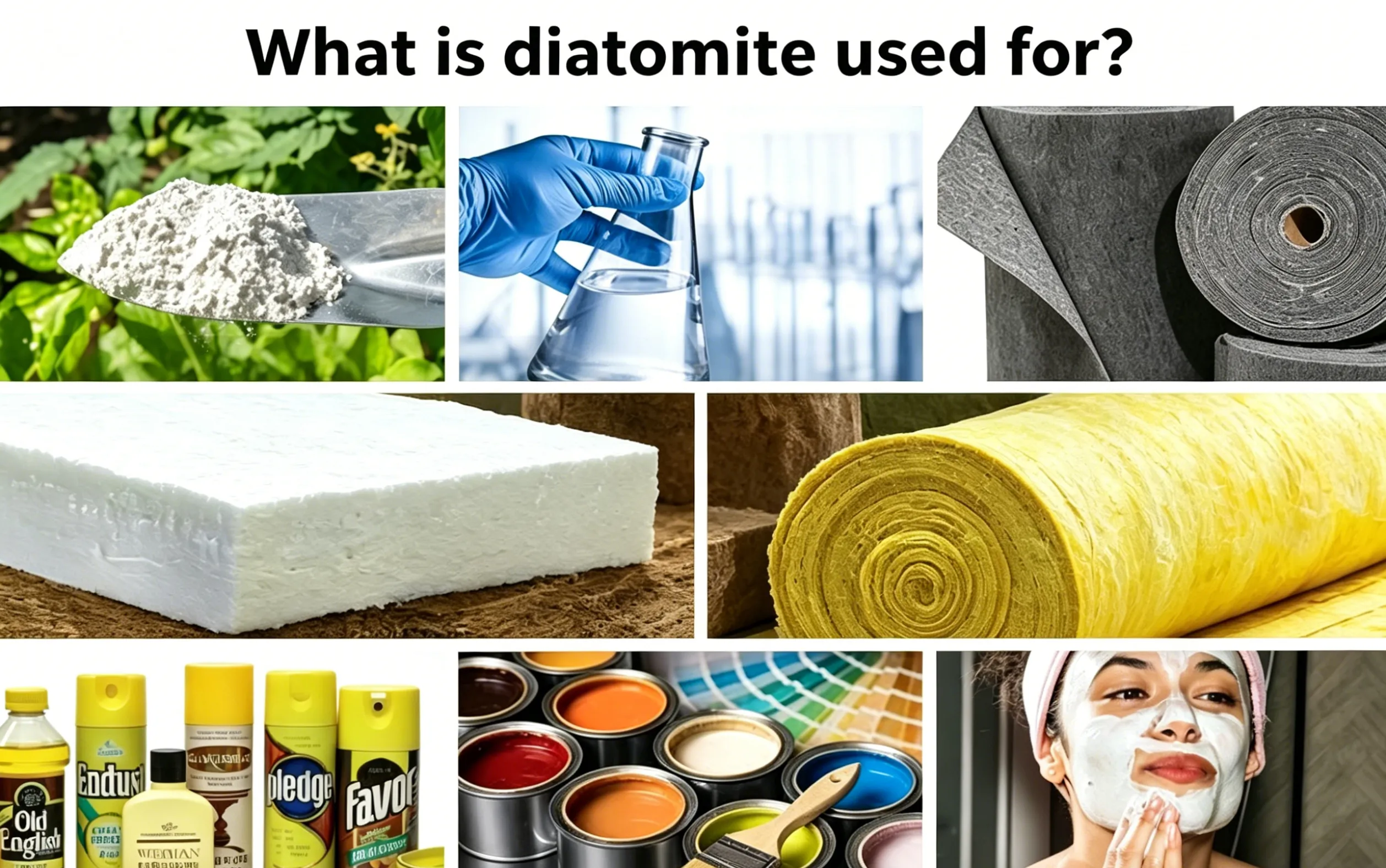
Agricultural Applications
In agriculture, diatomite is commonly used as a soil conditioner because its porous structure improves soil aeration and water retention.
It is also used as:
- A fertilizer anti-caking agent
- An inert carrier for pesticides
- An additive in animal feed
These applications help improve fertilizer performance and soil quality.
Filtration Applications
One of the most important uses of diatomite is liquid filtration.
Its microscopic pore structure allows liquids to pass through while trapping extremely small particles and impurities.
Because of this property, diatomite is widely used in:
- Beverage production
- Pharmaceutical manufacturing
- Water treatment
- Food processing industries
Many industrial filtration systems rely on diatomite filter aids for efficient purification.
Industrial Absorbents
Diatomite is also widely used as an absorbent material for:
- Cat litter
- Oil spill cleanup
- Chemical absorption
- Industrial leak control
Its high adsorption capacity allows it to absorb liquids rapidly while remaining lightweight and easy to handle.
Thermal Insulation Materials
Diatomite’s low thermal conductivity makes it highly suitable for insulation products used in buildings and industrial equipment.
It helps reduce heat transfer and improve energy efficiency in high-temperature environments.
Abrasives and Cleaning Products
Finely processed diatomite is used in polishing compounds, cleaning agents, and toothpaste because of its mild abrasive properties.
It can effectively clean surfaces without causing excessive damage.
Paints and Coatings
In paints and coatings, diatomite is used as a filler and matting agent.
It improves texture, durability, coating stability, and fire resistance while enhancing the final surface appearance.
Cosmetics and Personal Care Products
Natural diatomite is increasingly used in beauty and skincare products such as:
- Face masks
- Creams
- Deodorants
- Anti-perspirants
Its absorbent characteristics help improve texture and moisture control in cosmetic formulations.
Conclusion
Diatomite is a remarkable mineral formed from microscopic aquatic organisms millions of years ago, yet today it has become an essential industrial material used across a wide range of industries.
From filtration systems and agriculture to insulation materials, absorbents, cement production, and cosmetics, diatomite continues to demonstrate its versatility and industrial value through its unique physical and chemical properties.
In Kenya, diatomite mining and processing contribute significantly to industrial development and mineral production. As industrial demand for high-performance natural materials continues growing, diatomite is expected to remain an increasingly important mineral resource in the future.
FAQ About Diatomite
1. Is diatomite environmentally friendly compared with synthetic industrial materials?
Diatomite is generally considered a more environmentally friendly mineral material because it is naturally occurring and requires relatively limited chemical treatment during processing. Many industries prefer diatomite as an alternative to synthetic absorbents or fillers because it offers natural porosity, low toxicity, and strong filtration performance while reducing reliance on artificial chemical materials.
2. Why does particle size matter in diatomite products?
Particle size has a major influence on how diatomite performs in industrial applications. Finer diatomite powders are often used in filtration systems and cosmetics because they provide a larger surface area and better filtration precision. Coarser grades are more suitable for insulation materials, absorbents, and agricultural applications where airflow and moisture retention are important. Different industries therefore require carefully controlled classification during processing.
3. Can diatomite be reused after industrial applications?
In some applications, yes. Certain filtration-grade or absorbent-grade diatomite materials may be partially recycled or reused depending on contamination levels and processing conditions. However, reuse depends heavily on the industry, the type of impurities absorbed, and local environmental regulations. In many industrial systems, spent diatomite is safely disposed of or repurposed for secondary applications such as construction fillers or soil improvement materials.


 English
  Russian
  Arabic
  Vietnamese
  Spanish
  French
  Portuguese
  Japanese
  Chinese