



Industrial waste, hazardous waste, medical waste, and sludge require stable equipment and strict environmental control. Compared with many conventional incineration systems, a rotary kiln incinerator offers strong material adaptability, long residence time, good mixing, and reliable high-temperature treatment.
Rotary kiln waste incineration is not simply about burning waste. A reliable system must consider waste composition, calorific value, moisture content, feeding method, combustion temperature, secondary combustion, flue gas cleaning, and automatic control. For industrial companies, environmental engineering contractors, and cement equipment-related projects, understanding the rotary kiln incineration process helps make better equipment and project decisions.
What Is Lò quay Waste Incineration?
Rotary kiln waste incineration is a high-temperature thermal treatment process. Waste is fed into a slightly inclined, slowly rotating cylindrical kiln through a sealed feeding system. As the kiln rotates, the waste tumbles, mixes, and moves forward through the kiln.
Inside the kiln, waste goes through drying, pyrolysis, combustion, and ash discharge. The high-temperature flue gas usually enters a secondary combustion chamber for further burnout, then passes through heat recovery and flue gas treatment systems before emission.
A complete rotary kiln incineration system usually includes:
| System Component | Chức năng chính |
|---|---|
| Waste pretreatment system | Crushing, mixing, homogenizing, or dewatering |
| Sealed feeding system | Prevents gas leakage and air infiltration |
| Rotary kiln body | Completes drying, pyrolysis, and combustion |
| Đầu đốt | Provides startup and auxiliary heat |
| Secondary combustion chamber | Burns remaining combustible gases |
| Flue gas treatment system | Controls dust, acid gases, heavy metals, and dioxins |
| Automatic control system | Controls temperature, pressure, oxygen, kiln speed, and feeding rate |
How Does a Rotary Kiln Incinerator Work?
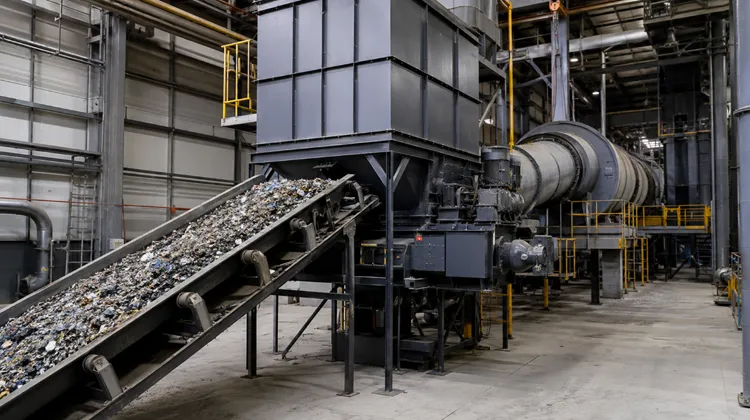
The process usually starts with waste pretreatment. Because waste can vary greatly in physical form, different materials require different feeding systems. Solid waste, liquid waste, sludge, drummed waste, and mixed waste cannot always be handled in the same way.
After entering the kiln, the waste is continuously turned over by the rotating kiln shell. This improves contact with heat and oxygen, making combustion more complete. Kiln temperature, speed, inclination, residence time, and air supply all affect the final treatment result.
A typical process includes:
| Process Stage | Sự miêu tả |
|---|---|
| Feeding | Waste enters the kiln through a sealed device |
| Sấy khô | Moisture in the waste is evaporated |
| Pyrolysis | Organic materials decompose and release combustible gases |
| Main combustion | Solid and semi-solid waste burns inside the kiln |
| Secondary combustion | Flue gas is further oxidized in the secondary chamber |
| Ash discharge | Ash or slag is discharged from the kiln outlet |
| Flue gas treatment | Gas is cooled, neutralized, filtered, adsorbed, and treated before emission |
What Waste Can Be Treated by a Rotary Kiln Incinerator?
The main advantage of a rotary kiln incinerator is its flexibility. It is suitable for waste streams with complex composition, variable heating value, and unstable physical form.
Các ứng dụng phổ biến bao gồm:
| Waste Type | Typical Source |
|---|---|
| Hazardous waste | Chemical, pharmaceutical, coating, and petrochemical industries |
| Medical waste | Hospitals, laboratories, and disease control centers |
| Industrial sludge | Wastewater plants, chemical plants, and electroplating plants |
| Oil sludge | Refineries, oilfields, and storage tank cleaning |
| Waste solvents | Coating, printing, pharmaceutical, and fine chemical production |
| Solid industrial waste | Contaminated packaging, production residues, and scraps |
| Chemical residues | Pesticide, resin, pigment, and additive production |
However, not all waste can be fed directly into the kiln. Waste with high chlorine, sulfur, moisture, ash, or heavy metal content requires analysis and blending design before treatment. Otherwise, it may cause slagging, corrosion, emission fluctuation, or secondary pollution.
Advantages of Rotary Kiln Waste Incineration
Rotary kiln incineration is widely used for complex waste treatment because of several practical advantages.
1. Strong material adaptability
A rotary kiln can process solids, liquids, sludge, semi-solids, and mixed waste. This flexibility is important for projects with variable waste sources.
2. Long residence time
Waste stays inside the kiln for a relatively long time, which supports drying, pyrolysis, and complete combustion.
3. Good mixing effect
The rotating kiln continuously turns the waste, improving heat transfer and oxygen contact.
4. Suitable for high-temperature treatment
With proper refractory lining, the rotary kiln can operate under high temperature and harsh chemical conditions.
5. Easy to combine with flue gas treatment
The system can be connected with a secondary combustion chamber, quench tower, acid gas removal system, baghouse filter, activated carbon injection, and denitrification system.
Key Design Factors
When selecting a rotary kiln incinerator, capacity and price are not the only factors. Waste characteristics and process design have a direct impact on system stability.
| Design Factor | Impact |
|---|---|
| Hàm lượng độ ẩm | Affects drying load and auxiliary fuel consumption |
| Calorific value | Determines combustion stability and fuel demand |
| Hàm lượng tro | Affects ash volume and slagging risk |
| Chlorine content | Influences corrosion, dioxin control, and acid gas load |
| Sulfur content | Affects SO₂ emissions and flue gas treatment |
| Kim loại nặng | Influences fly ash handling and emission control |
| Hình thức vật lý | Determines feeding and pretreatment method |
| Treatment capacity | Determines kiln size, gas volume, and system configuration |
Kiln sealing, refractory lining, burner design, air distribution, and control logic are also critical. If one part is poorly designed, the system may face unstable combustion or excessive load on the flue gas treatment section.
Flue Gas Treatment

In waste incineration projects, the flue gas treatment system is as important as the rotary kiln itself. The goal is not only volume reduction, but safe disposal under environmental standards.
Common flue gas treatment units include:
| Đơn vị | Chức năng |
|---|---|
| Secondary combustion chamber | Burns CO, VOCs, and unburned organics |
| Waste heat boiler | Recovers heat and reduces gas temperature |
| Quench tower | Rapidly cools gas to reduce dioxin reformation risk |
| Acid gas removal system | Removes HCl, SO₂, HF, and other acid gases |
| Activated carbon injection | Adsorbs dioxins, mercury, and some heavy metals |
| Baghouse filter | Captures dust and reaction products |
| SCR/SNCR denitrification | Controls NOx emissions |
| Online monitoring system | Continuously monitors emission data |
Because emission standards vary by country and region, the flue gas cleaning system should be designed according to waste composition and local requirements.
Common Problems in Operation
Common operating problems include unstable combustion, high CO emissions, slagging, refractory damage, flue gas corrosion, and emission fluctuation.
These problems are usually not caused by a single machine. They are related to waste blending, feeding stability, kiln temperature, air distribution, refractory selection, and flue gas treatment operation.
| Operating Problem | Common Cause |
|---|---|
| Unstable combustion | Variable heating value, high moisture, unstable feeding |
| High CO emissions | Low oxygen, poor mixing, insufficient secondary chamber temperature |
| Slagging or ring formation | Low ash melting point, high temperature, poor waste blending |
| Refractory damage | Thermal shock, chemical attack, mechanical wear |
| Flue gas corrosion | High chlorine or sulfur waste, acid corrosion |
| Emission fluctuation | Large feeding variation or unstable gas treatment control |
Stable operation does not simply mean increasing temperature. It requires proper waste blending, stable feeding, accurate combustion control, and reliable flue gas treatment.
How to Choose a Rotary Kiln Incinerator
When choosing a rotary kiln incinerator, consider the following questions:
| Selection Factor | Key Question |
|---|---|
| Waste type | Is it solid, liquid, sludge, drummed waste, or mixed waste? |
| Treatment capacity | How much waste must be treated per hour or per day? |
| Heating value | Can the waste burn by itself or does it need auxiliary fuel? |
| Emission requirement | Must HCl, SO₂, NOx, dioxins, and heavy metals be controlled? |
| Automation level | Is DCS, CEMS, interlock protection, or remote monitoring required? |
| Heat recovery | Is a waste heat boiler or steam system needed? |
| Maintenance condition | Are refractory service and spare parts available locally? |
For complex waste treatment projects, it is better to choose a supplier that can provide complete process design, feeding system, combustion control, flue gas treatment, and automation solution, rather than only a single rotary kiln body.
Phần kết luận
Rotary kiln waste incineration is an important technology for treating hazardous waste, industrial waste, medical waste, and sludge. It offers strong material adaptability, long residence time, good mixing, and high-temperature treatment capability, making it suitable for complex and variable waste streams.
A reliable rotary kiln incineration system should be designed as a complete process, including waste characteristics, feeding method, combustion control, secondary combustion, flue gas treatment, refractory lining, and automation. For industrial companies, environmental engineering contractors, and cement equipment projects, choosing the right rotary kiln incineration system can improve waste treatment efficiency, reduce operating risks, and support long-term environmental compliance.


 Vietnamese
  English
  Russian
  Arabic
  Spanish
  French
  Portuguese
  Japanese
  Chinese