


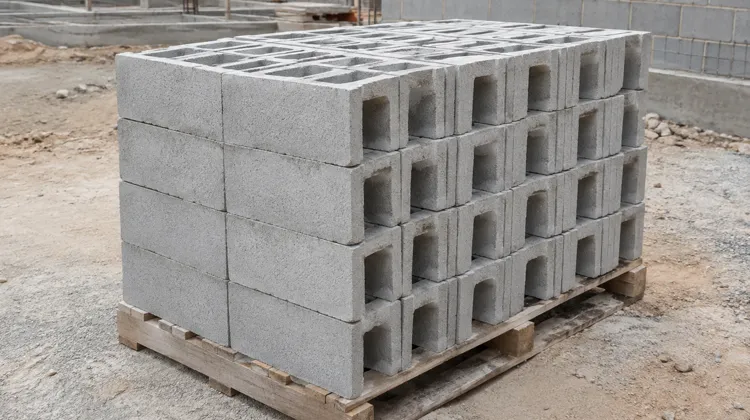
“How much does a cement block weigh?” is a common question for material purchasing, manual handling, pallet loading, and transportation planning. Although many people call them cement blocks or cinder blocks, the products commonly used today are concrete masonry units, often called CMUs.
A concrete block does not have one fixed weight. Its weight depends on dimensions, hollow or solid construction, aggregate type, density, moisture content, and the manufacturer’s mix design.
A common 8 x 8 x 16 inch hollow concrete block typically weighs about 28–38 lb, or 13–17 kg. Lightweight blocks are usually at the lower end of that range, while normal-weight blocks may be heavier. For accurate labor, forklift, pallet, and freight planning, always use the supplier’s published product data.
How Much Does a Standard Cement Block Weigh?
In North American construction, the 8 x 8 x 16 inch unit is one of the most common nominal concrete block sizes. Its actual dimensions are usually slightly smaller to allow for mortar joints.
Most concrete blocks are hollow rather than fully solid. Hollow cores and internal webs reduce material use and unit weight. The table below provides common reference ranges.
| Nominal Size | Common Type | Typical Unit Weight |
|---|---|---|
| 4 x 8 x 16 in. | Hollow concrete block | About 18–28 lb (8–13 kg) |
| 6 x 8 x 16 in. | Hollow concrete block | About 25–33 lb (11–15 kg) |
| 8 x 8 x 16 in. | Lightweight hollow block | About 28–32 lb (13–15 kg) |
| 8 x 8 x 16 in. | Normal-weight hollow block | About 33–38 lb (15–17 kg) |
| 8 x 8 x 16 in. | Solid or high-density block | 45 lb or more (20 kg or more) |
| 12 x 8 x 16 in. | Hollow concrete block | About 45–55 lb (20–25 kg) |
These are typical ranges, not universal product specifications. Blocks made with sand, gravel, or crushed-stone aggregate are generally heavier than units made with lightweight aggregate. Newly manufactured or rain-soaked blocks may also weigh more than dry units.
Why Do Cement Block Weights Vary?

Size and Wall Thickness
Larger blocks contain more concrete and therefore weigh more. Even blocks with the same outside dimensions can have different weights because face-shell thickness, web thickness, and core dimensions vary from one design to another.
Hollow vs. Solid Construction
Hollow concrete blocks have internal cores that reduce their weight and material use. Those cores can also accommodate reinforcing steel, grout, or insulation when required by the wall design.
Solid blocks have few or no internal voids, so they weigh more and require more attention during handling and transport.
Aggregate Type and Density
Normal-weight concrete blocks are typically made with sand, gravel, crushed stone, or other higher-density aggregates. Lightweight units may use expanded shale, expanded clay, pumice, or other lightweight aggregates to reduce unit weight.
A lightweight block is not automatically a lower-quality block. Its strength, absorption, durability, and intended use should be evaluated using the applicable product standard and manufacturer test data.
Moisture Content and Curing Condition
Moisture affects the measured weight of a concrete block. Units stored outdoors after rain, recently cured units, or blocks kept in a humid environment can weigh more than dry blocks. This is why published unit weights are usually reference values, while actual shipping weight can vary.
How to Calculate Total Concrete Block Weight
Use the following formula when estimating the weight of a batch of blocks:
Total weight = Unit weight × Number of blocks + Pallet weight + Packaging weight
For example, a pallet holding 90 standard 8 x 8 x 16 inch hollow blocks, at 35 lb per block, has a block weight of:
90 × 35 lb = 3,150 lb
After adding the wooden pallet, corner protection, wrapping, and strapping, the gross pallet weight may exceed 3,200 lb, or about 1.45 metric tonnes.
Before arranging shipment, confirm:
- Dry unit weight or published shipping weight;
- Number of blocks per pallet;
- Gross pallet weight;
- Pallet dimensions and loading method;
- Protective packaging requirements;
- Payload limits for containers, flatbeds, or local delivery trucks.
Why Does Concrete Block Weight Matter on Site?

Block weight affects manual handling productivity, masonry speed, scaffold loading, and jobsite safety. Heavier normal-weight units may provide greater density, but they also increase worker fatigue and repetitive lifting demands.
For larger blocks, solid blocks, or high-density units, plan forklifts, lifting devices, material platforms, or mechanical handling in advance. A block may be liftable by one person, but moving hundreds of blocks repeatedly creates a significant handling load.
Transport and Storage Considerations

Concrete blocks are commonly shipped on pallets. Before loading, verify gross pallet weight and vehicle payload capacity to avoid overloading. Export projects must also consider container payload limits, pallet height, container loading layout, and forklift availability at the destination.
Store blocks on level, firm ground. Avoid leaving pallets tilted for long periods or exposed to standing water at the base. If the blocks will be used for exterior or structural masonry, protect corners from impact during transportation and unloading.
How to Choose the Right Concrete Block Weight
Weight should not be the only selection criterion. Lightweight blocks can reduce manual handling demands and dead load, and may improve some thermal properties. Heavier units may be appropriate where greater density, sound control, or specific structural performance is required.
Consider the wall application, structural design, local climate, insulation needs, installation method, transport capacity, and project standards. For load-bearing walls, basement work, equipment rooms, and industrial buildings, block strength, density, and wall construction should be selected by qualified project professionals.
Conclusion
There is no single answer to how much a cement block weighs. A common 8 x 8 x 16 inch hollow concrete block usually weighs about 28–38 lb, but aggregate type, core design, wall thickness, and moisture content all make a difference.
For purchasing, freight planning, and jobsite handling, the most reliable approach is to request the product data sheet and confirm unit weight, blocks per pallet, and gross pallet weight. This allows more accurate planning for labor, forklifts, vehicles, and storage.
FAQs
How much does an 8 x 8 x 16 cement block weigh?
A normal-weight hollow block typically weighs about 33–38 lb. Lightweight models often weigh about 28–32 lb. Always check the manufacturer’s product data for the exact unit weight.
How much do 100 cement blocks weigh?
If each block weighs 35 lb, 100 blocks weigh about 3,500 lb, or approximately 1,588 kg. Add pallet and packaging weight for the total shipment weight.
Is a cinder block the same as a concrete block?
The terms are often used interchangeably in everyday language. However, modern masonry units are more accurately described as concrete blocks or concrete masonry units.
Can a regular pickup truck carry concrete blocks?
It depends on the truck’s payload rating, block weight, pallet weight, and loading method. Concrete blocks are heavy, so always check the vehicle payload label rather than estimating only by bed space.


 English
  Russian
  Arabic
  Vietnamese
  Spanish
  French
  Portuguese
  Japanese
  Chinese