



Cement quality cannot be evaluated simply by looking at its color or feeling how fine the powder is.
Reliable quality control requires a combination of chemical analysis and physical testing, including cement fineness, setting time, soundness, consistency, and compressive strength.
For a cement plant, these tests do more than determine whether the final product passes a specification. They also help identify problems in raw material proportioning, clinker burning, gypsum dosing, grinding, classification, and blending.
Cement quality testing therefore begins before the raw materials enter the kiln and continues until the finished cement is ready for dispatch.
Why Is Cement Quality Testing Important?
Cement performance depends strongly on production consistency.
Even when the same plant and equipment are used, changes in limestone chemistry, clinker burning conditions, gypsum dosage, grinding fineness, or supplementary cementitious materials can affect setting behavior and strength development.
A reliable quality-control system helps a cement producer verify compliance with the required market standard and, more importantly, provides feedback for process control.
ASTM C150/C150M specifies chemical and physical requirements for Portland cement in markets using ASTM standards, while EN 197-1 defines composition and mechanical, physical, and chemical requirements for common cements under the European system.
Laboratory results can also point directly to production problems. A change in cement fineness may indicate a grinding or separator issue, while unstable setting time may require investigation of gypsum dosage, clinker chemistry, or mill temperature.
How Is Cement Quality Controlled in a Cement Plant?
Quality control normally takes place at several stages of production.
Raw Material Testing
Limestone, clay, corrective materials, gypsum, and supplementary materials are analyzed before or during production.
Their chemical composition and moisture content influence raw meal proportioning. If calcium, silica, alumina, or iron levels change, the raw material dosing system must compensate to maintain a stable kiln feed.
Modern cement plants therefore combine laboratory testing with process sampling and, in many cases, online analysis.
Clinker Testing
Clinker is the most important intermediate product in Portland cement manufacturing.
Its chemical composition, free lime, burning condition, mineral development, and grindability influence the final cement.
Under-burned clinker may contain excessive free CaO, while changes in burning or cooling conditions can affect clinker reactivity and subsequent strength development.
Finished Cement Testing
Before cement is dispatched, its chemical and physical properties must be checked against the applicable product specification.
Typical quality tests include chemical composition, fineness, normal consistency, setting time, soundness, density, and compressive strength.
1. Chemical Composition Testing
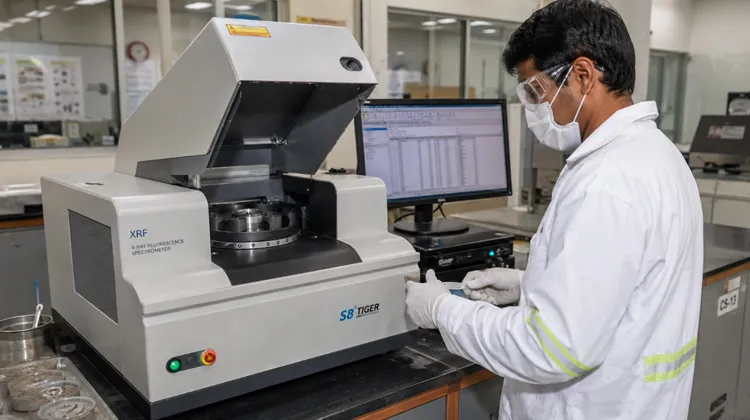
Chemical analysis is a fundamental part of cement quality control.
Typical components monitored include:
- CaO;
- SiO₂;
- Al₂O₃;
- Fe₂O₃;
- MgO;
- SO₃;
- Na₂O and K₂O;
- Loss on ignition;
- Chlorides and other regulated constituents where applicable.
ASTM C114 covers chemical analysis of hydraulic cement and permits analytical procedures that demonstrate acceptable precision and bias.
Modern cement laboratories often use X-ray fluorescence analysis because multiple elements can be measured quickly. Fast chemical feedback allows operators to adjust raw meal proportioning, kiln operation, gypsum addition, or supplementary material dosage.
The objective is not simply to generate laboratory numbers. Chemical testing is used to maintain consistent composition from raw meal to clinker and finished cement.
2. Cement Fineness Testing

Fineness affects hydration rate, early strength, heat evolution, and water demand. It is also one of the most important indicators for controlling a cement grinding circuit.
Two widely used approaches are Blaine specific surface testing and sieve residue testing.
Blaine Specific Surface
The Blaine method evaluates the specific surface area of cement by measuring the resistance of a compacted cement bed to airflow.
ASTM C204-26 covers the determination of hydraulic cement fineness using an air-permeability apparatus and expresses the result as specific surface area per unit mass.
EN 196-6 also includes air-permeability testing and notes that Blaine testing is particularly useful for monitoring consistency in the grinding process of the same plant.
Sieve Residue
Sieve testing provides information about the proportion of coarse cement particles.
ASTM C430-26 specifies determination of hydraulic cement fineness using a 45 μm sieve.
A cement may show an acceptable Blaine value while still containing an undesirable proportion of coarse particles. For this reason, many quality-control programs consider both specific surface and particle residue rather than relying on a single number.
3. Normal Consistency Test
Before certain cement paste tests can be performed, the amount of water required to reach standard consistency must be established.
ASTM C187-25 provides a method for determining the water required to prepare hydraulic cement paste at normal consistency.
Normal consistency is not a direct strength measurement, but it creates a controlled starting condition for tests such as setting time.
If the water demand of the same cement changes significantly, the plant may need to investigate cement fineness, particle-size distribution, clinker characteristics, or changes in blended materials.
4. Setting Time Test

Cement must remain workable long enough for concrete to be mixed, transported, placed, and finished, but it must also develop structure within a reasonable period.
Setting time is commonly measured using a Vicat apparatus.
ASTM C191 determines the setting time of hydraulic cement using the Vicat needle and can be used to evaluate compliance with applicable specification requirements.
EN 196-3 also covers standard consistence, setting times, and soundness of cement.
Unexpected setting behavior can indicate several process issues, including unstable gypsum dosage, high cement temperature, changes in clinker aluminate phases, variation in supplementary materials, or excessive grinding.
For a cement producer, setting-time data are therefore useful for both product verification and process diagnosis.
5. Cement Soundness Test
Cement should remain dimensionally stable after hardening.
Excessive free CaO or MgO can hydrate slowly after setting and may cause delayed expansion.
ASTM C151/C151M evaluates potential delayed expansion of hardened cement paste under autoclave conditions and provides an indication of expansion associated with CaO or MgO hydration.
EN 196-3 includes the Le Chatelier method for evaluating cement soundness.
An abnormal soundness result may therefore indicate that the clinker-burning process, raw material chemistry, or overall process control needs to be investigated.
6. Compressive Strength Testing

Strength is one of the most important performance characteristics of cement.
Cement strength is normally evaluated using standardized mortar rather than by compressing a block of neat cement paste.
ASTM C109/C109M-26 determines the compressive strength of hydraulic cement mortar using 50 mm cube specimens. ASTM also notes that mortar test results should not be used as a direct prediction of actual concrete strength.
EN 196-1 specifies the determination of compressive strength and optional flexural strength of standardized cement mortar.
Testing at specified ages allows the plant to evaluate both early and later strength development.
A reduction in early strength may be related to cement fineness, clinker reactivity, clinker mineral composition, or the proportion of supplementary materials. Later strength problems may require a broader review of clinker quality and cement formulation.
7. Cement Density Testing
Cement density is used mainly for mixture proportioning and quality control.
ASTM C188-26 provides a method for determining the density and relative density of hydraulic cement and notes its use in the design and control of cement and concrete mixtures.
Density becomes particularly useful when a cement contains significant quantities of slag, fly ash, limestone, or other supplementary components, because these materials may change the overall density of the finished product.
Common Cement Tests and Laboratory Equipment
| Test | What It Evaluates | Typical Equipment |
|---|---|---|
| Chemical analysis | CaO, SiO₂, Al₂O₃, SO₃ and other constituents | XRF analyzer and laboratory chemistry equipment |
| Fineness | Grinding level and coarse-particle content | Blaine apparatus and sieving equipment |
| Normal consistency | Standard water demand | Vicat apparatus |
| Setting time | Initial and final setting behavior | Vicat needle apparatus |
| Soundness | Potential abnormal expansion | Autoclave or Le Chatelier apparatus |
| Compressive strength | Strength development | Mortar mixer, molds, curing equipment, compression tester |
| Density | Cement volume and mixture-control data | Le Chatelier flask or density apparatus |
No single test provides a complete picture of cement quality. Reliable assessment requires the results to be considered together.
How Are Test Results Used to Control Cement Production?
A strong quality-control system does not treat the laboratory as a final inspection station.
Test results should be linked back to production parameters.
For example, if cement fineness gradually decreases, operators may inspect mill feed rate, grinding media condition, mill ventilation, roller pressure, or separator speed.
If SO₃ fluctuates, the gypsum storage and dosing system should be checked.
If early compressive strength falls, simply grinding the cement finer may not be the correct solution. The plant may also need to review clinker reactivity, supplementary material dosage, sulfate balance, and particle-size distribution.
Connecting laboratory data with real-time process information helps operators identify the actual cause rather than correcting only the visible symptom.
How Does Cement Production Equipment Affect Quality?

Cement quality is not created in the laboratory. It is created by the production line and verified by the laboratory.
Raw Mill and Homogenization System
Stable raw meal chemistry is the foundation of consistent clinker.
Poor proportioning or homogenization causes kiln-feed chemistry to fluctuate, making clinker mineral development more difficult to control.
Rotary Kiln and Calciner
Burning temperature, residence time, combustion conditions, and kiln stability influence clinker formation.
Under-burning can increase free lime, while excessive burning may produce hard-to-grind clinker and unnecessary fuel consumption.
Clinker Cooler
Cooling influences clinker mineral structure and subsequent grindability.
Efficient cooling also recovers heat for the kiln and calciner, improving overall thermal efficiency.
Cement Mill and Separator
Ball mills, vertical roller mills, roller presses, and high-efficiency separators determine finished cement fineness and particle-size distribution.
If classification efficiency is poor, finished fine particles may repeatedly return to the mill. This increases power consumption and can overgrind part of the cement.
A well-designed grinding circuit should therefore control specific surface, sieve residue, and particle distribution together.
Dosing and Blending Systems
Clinker, gypsum, slag, fly ash, limestone, and other components must be fed at stable rates.
Accurate weigh feeders and automatic dosing systems reduce formulation variation, which becomes particularly important for multi-component and low-clinker cements.
What Do Abnormal Cement Test Results Indicate?
| Test Result | Production Areas to Check |
|---|---|
| Low fineness | Grinding efficiency, mill loading, separator operation |
| Excessive coarse residue | Separator performance and circulating load |
| Fast setting | Gypsum dosage, C₃A, cement temperature |
| Slow setting | Sulfate balance and supplementary material dosage |
| SO₃ variation | Gypsum feeding and dosing |
| Low early strength | Clinker reactivity, fineness, formulation |
| Poor soundness | Clinker burning and free CaO/MgO |
| Large batch variation | Raw material homogenization and dosing control |
This is why modern cement quality control increasingly connects laboratory information with plant automation and process-control systems.
Which Standards Are Used for Cement Quality Testing?
The applicable testing system depends on the cement type and target market.
Common ASTM methods include:
- ASTM C114 for chemical analysis;
- ASTM C204 for Blaine fineness;
- ASTM C430 for 45 μm sieve fineness;
- ASTM C187 for normal consistency;
- ASTM C191 for Vicat setting time;
- ASTM C151/C151M for autoclave expansion;
- ASTM C109/C109M for mortar compressive strength.
European testing commonly refers to:
- EN 196-1 for strength;
- EN 196-3 for consistency, setting time, and soundness;
- EN 196-6 for fineness.
The acceptance limits must always come from the applicable cement product specification and current requirements of the destination market, rather than from a test method alone.
Conclusion
Cement quality testing is not limited to compressive strength.
A complete quality-control program combines chemical analysis, fineness, consistency, setting time, soundness, density, and strength testing.
For cement manufacturers, the most valuable use of these tests is to connect laboratory results with raw material proportioning, clinker burning, grinding, classification, and dosing.
Consistent cement quality ultimately depends on the coordinated performance of production equipment, process automation, material control, and laboratory testing.
FAQs
What is the most important cement quality test?
There is no single test that defines overall cement quality. Strength is important, but fineness, setting time, soundness, and chemical composition are also essential.
How is cement strength tested?
Standard cement mortar specimens are prepared and cured under controlled conditions before being tested using a compression testing machine.
Why is cement fineness tested?
Fineness affects hydration, early strength, and water demand, and it is also an important indicator of cement mill and separator performance.
How is cement setting time tested?
A Vicat apparatus is commonly used to determine when cement paste reaches initial and final setting conditions.
How often should a cement plant test cement quality?
Testing frequency depends on the applicable standard, plant quality system, product type, and process stability. Continuous process monitoring is typically combined with scheduled laboratory testing and final product verification.
Can online analyzers replace laboratory testing?
Not completely. Online analyzers provide rapid process feedback, while standardized laboratory tests remain important for product verification, compliance, and final quality confirmation.


 English
  Russian
  Arabic
  Vietnamese
  Spanish
  French
  Portuguese
  Japanese
  Chinese