



The most important transformation in cement manufacturing takes place during pyroprocessing.
After raw materials have been ground and homogenized, the raw meal passes through the подогреватель, precalciner, and вращающаяся печь. During this journey, it is heated, calcined, chemically transformed, partially melted, and finally converted into hard clinker nodules.
In a modern cement plant, not everything happens inside the rotary kiln itself. Much of the heating and limestone decomposition occurs in the cyclone preheater and precalciner before the material reaches the kiln. The rotary kiln then provides the high-temperature conditions required for final clinker formation, typically at approximately 1,400–1,450°C.
How Does a Rotary Cement Kiln Work?
A rotary cement kiln is a large, slightly inclined steel cylinder lined with refractory material.
Preheated raw meal enters at the higher kiln inlet. As the shell rotates slowly, the material is lifted, rolled, and gradually moved toward the lower discharge end.
The main burner is installed near the kiln outlet. Hot combustion gases move in the opposite direction to the solids, creating a counter-current heat-transfer system.
As the raw meal travels toward the flame, it encounters progressively higher temperatures and undergoes a series of physical and chemical transformations.
What Happens Before the Raw Meal Enters the Kiln?
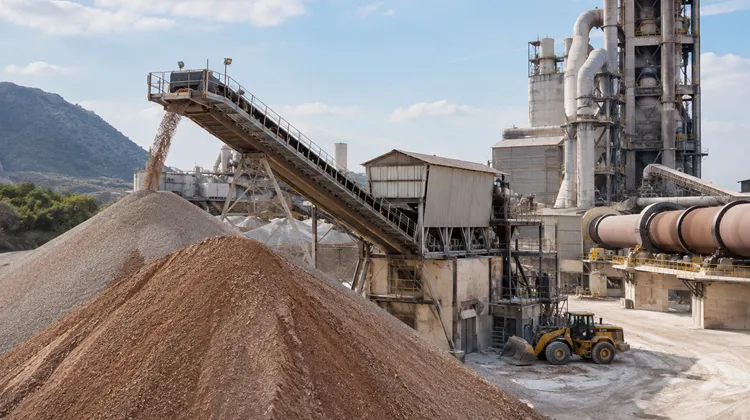
In a modern dry-process cement plant, the material entering the rotary kiln has already undergone substantial thermal processing.
Preheating the Raw Meal
The ground raw meal first passes through a multi-stage cyclone preheater.
Hot exhaust gas from the kiln and calciner transfers heat to the suspended raw meal particles. Moisture is removed and the material temperature rises rapidly.
The American Cement Association explains that the preheater uses heat generated by the plant to begin reactions in the raw materials before kiln firing, improving overall process efficiency.
Calcination in the Precalciner
At approximately 850–900°C, calcium carbonate begins to decompose significantly:
CaCO₃ → CaO + CO₂
This reaction is known as calcination.
Modern precalciners are designed so that most carbonate decomposition takes place before the material reaches the rotary kiln. U.S. Department of Energy material describes the precalciner as the stage where most carbonate in the raw meal decomposes at approximately 850–900°C.
The rotary kiln can therefore focus mainly on completing calcination and forming the high-temperature clinker minerals.
What Are the Main Zones Inside a Cement Kiln?
The exact boundaries vary with kiln design and operating conditions, but the material passes through several general reaction zones.
| Kiln Zone | Material Condition | Main Process |
|---|---|---|
| Kiln inlet / final calcination | Hot powder | Remaining CaCO₃ decomposition |
| Transition zone | Solid reacting material | Solid-state reactions between CaO, silica, alumina, and iron compounds |
| Burning or sintering zone | Partially molten material | Rapid clinker mineral formation, especially C₃S |
| Kiln discharge | Hot clinker nodules | Clinker formation is completed before cooling |
1. Final Calcination Is Completed
When raw meal enters the rotary kiln, most limestone decomposition may already have occurred in the precalciner.
Any remaining calcium carbonate continues to break down as the temperature rises.
This step matters because incomplete calcination increases the thermal load on the hottest section of the kiln. If too much uncalcined material reaches the burning zone, clinker formation becomes more difficult and fuel consumption may increase.
2. Solid-State Reactions Begin
As the temperature rises further, the material no longer behaves simply as a mixture of limestone, clay, and corrective minerals.
CaO begins reacting with silica, alumina, and iron compounds to form new calcium silicate, aluminate, and ferrite phases.
Dicalcium silicate, commonly called C₂S or belite, forms during the lower-temperature stages of clinker development.
This illustrates an important point: clinker is not simply raw material that has been “baked hard.” Its chemistry and mineral structure have been fundamentally changed.
3. The Material Reaches the Burning Zone

The highest material temperatures occur near the kiln outlet and main burner.
Clinker production typically requires material temperatures around 1,450°C. The U.S. Department of Energy describes cement manufacturing as a roughly 1,450°C process, while the American Cement Association notes that the material is heated to around 2,700°F during kiln firing.
This value refers mainly to the clinker material temperature. The actual flame temperature can be considerably higher.
At these temperatures, part of the raw mix forms a liquid phase. This liquid helps accelerate chemical reactions between lime and the other mineral components.
4. Alite Forms in the Burning Zone
One of the most important clinker minerals is tricalcium silicate, known as C₃S or alite.
C₃S contributes strongly to the early strength development of Portland cement, making its formation an important clinker-quality objective.
Under high-temperature and partial-liquid conditions, CaO reacts further with previously formed C₂S to produce C₃S.
If the burning temperature is too low, residence time is too short, or raw meal chemistry is unsuitable, free lime may remain in the clinker.
If temperature is unnecessarily high or the material remains in the burning zone too long, the clinker can become excessively dense and difficult to grind, increasing both kiln fuel consumption and finish-grinding power demand.
Why Does Clinker Form Nodules?
Clinker usually leaves the kiln as hard gray or dark-colored nodules rather than as fine powder.
This nodulization is related to the liquid phase created in the burning zone.
Partially molten material causes smaller particles to stick together. As the kiln rotates, the material repeatedly rolls and tumbles, allowing particles to agglomerate into clinker nodules.
The American Cement Association describes clinker as gray, marble-sized balls formed by the complex reactions taking place during kiln firing.
Abnormal clinker size or nodulization may indicate problems with kiln temperature, liquid-phase formation, raw meal fineness, fuel combustion, or kiln draft.
How Are the Main Clinker Minerals Formed?

Portland cement clinker contains four principal mineral phases.
C₃S — Tricalcium Silicate
C₃S forms mainly during high-temperature burning and is an important contributor to early cement strength.
Insufficient burning can reduce C₃S formation and leave excessive free lime.
C₂S — Dicalcium Silicate
C₂S forms at lower temperatures than C₃S and is also a major clinker silicate.
It hydrates more slowly and therefore contributes more strongly to later-age cement strength.
C₃A — Tricalcium Aluminate
C₃A forms from calcium- and aluminum-containing components.
Because it reacts rapidly with water, gypsum is later added during cement grinding to regulate its hydration and control cement setting time.
C₄AF — Tetracalcium Aluminoferrite
C₄AF forms from calcium, aluminum, and iron-containing compounds.
It contributes to liquid-phase formation during burning and also influences clinker burnability and color.
The final proportions of these minerals depend on raw meal chemistry, burning conditions, residence time, and clinker cooling.
What Does the Main Kiln Burner Do?
The main burner at the kiln outlet supplies a major part of the heat required for clinker sintering.
Pulverized coal, petroleum coke, natural gas, and properly prepared alternative fuels may be introduced through the burner.
Modern multi-channel burners allow fuel and primary air to be controlled separately so that operators can adjust flame shape, momentum, length, and mixing.
A good flame provides stable heat distribution through the burning zone rather than simply producing the highest possible temperature.
A flame that is too long can move the effective burning zone, while an excessively short or concentrated flame may expose refractories to unusually high local temperatures.
Burner performance therefore influences clinker quality, kiln coating, fuel efficiency, NOx formation, and refractory life.
What Is Kiln Coating?
During stable operation, a layer of clinker material normally builds up on the refractory lining in the burning zone. This is known as kiln coating.
A stable coating protects the refractory lining from direct contact with extremely hot material and combustion gases. It also reduces heat transfer to the steel kiln shell.
However, thicker is not always better.
Large coating losses can expose the refractory lining and increase kiln-shell temperature. Excessive buildup can form rings that restrict the effective kiln diameter and interfere with material and gas flow.
Maintaining stable kiln coating is therefore an important part of rotary kiln operation.
How Do Kiln Speed and Slope Move the Material?
A rotary kiln is installed with a slight downward slope from the inlet toward the discharge end.
As the shell rotates, raw material is lifted and then falls through the kiln bed. This repeated movement mixes the material while gradually moving it toward the burner end.
Kiln speed, slope, feed rate, and material filling level together influence residence time.
If material passes through the burning zone too quickly, clinker reactions may remain incomplete. Excessively long residence time can contribute to over-burning and unnecessary energy consumption.
Operators therefore adjust kiln speed together with feed, draft, temperature, kiln drive load, and clinker-quality data.
Why Must Hot Clinker Be Cooled Quickly?

Clinker leaving the rotary kiln is still extremely hot and immediately enters the clinker cooler.
Rapid cooling performs two important functions.
First, it helps preserve the mineral structure created during high-temperature burning and supports suitable clinker reactivity.
Second, the hot clinker contains a large quantity of recoverable thermal energy.
Modern grate coolers pass large amounts of air through the clinker. The heated air can then return to the rotary kiln and precalciner as combustion air.
The American Cement Association notes that heat recovered during clinker cooling is returned to the kiln system, reducing fuel consumption and improving burning efficiency.
The clinker cooler is therefore both a product-quality device and a major energy-recovery component.
What Controls Clinker Quality Inside the Kiln System?
Producing good clinker involves much more than simply reaching 1,450°C.
Raw Meal Chemistry
The proportions of CaO, SiO₂, Al₂O₃, and Fe₂O₃ determine which clinker minerals can form.
Large fluctuations in raw meal chemistry cannot always be corrected simply by changing kiln temperature.
Тонкость сырой муки
Coarse particles react more slowly and may leave localized free lime in the clinker.
Raw mill and separator performance therefore influence the kiln-burning process as well as grinding efficiency.
Degree of Calcination
A modern precalciner should complete most carbonate decomposition before material enters the kiln.
Poor precalciner operation transfers additional thermal load into the rotary kiln.
Burning Temperature and Flame
Insufficient heat can cause under-burning, while consistently excessive temperatures increase fuel use, refractory stress, and the risk of over-burned clinker.
Gas Flow and Combustion
Kiln draft affects fuel combustion, flame characteristics, heat transfer, and pressure balance throughout the preheater–calciner–kiln system.
Охлаждение клинкера
Cooling conditions influence both mineral stability and clinker grindability.
Common Problems Inside a Cement Kiln
High Free Lime
Excessive free CaO generally indicates that lime has not reacted completely with the other clinker components.
Possible causes include insufficient burning, unsuitable raw meal chemistry, coarse feed, short residence time, or unstable kiln conditions.
Ring Formation
Material can accumulate continuously at certain locations inside the kiln and develop into a ring.
Severe ring formation restricts material movement and gas flow, reducing production and potentially requiring a kiln shutdown.
Over-Burned Clinker
Excessive burning temperature or residence time can create unusually dense and hard clinker.
This may increase the electrical energy required in the cement grinding stage.
Kiln Coating Loss
Major coating loss exposes the refractory lining to harsher thermal conditions.
Modern plants therefore often use kiln-shell scanners to identify abnormal temperature zones before significant damage occurs.
What Equipment Works Together in a Cement Kiln System?

A clinker-burning line is not simply a rotary kiln.
Он циклонный предварительный нагреватель recovers heat from exhaust gas and transfers it to the raw meal.
Он precalciner carries out most limestone decomposition before the kiln.
Он вращающаяся печь provides the final high-temperature environment for clinker mineral formation.
Он горелка печи controls fuel combustion and flame characteristics.
Он охладитель клинкера rapidly cools clinker and recovers thermal energy.
Он ID fan and gas-handling system maintain airflow and negative pressure through the complete pyroprocessing line.
Reliable clinker production depends on the balance between all of these components rather than the performance of one individual machine.
Why Is the Kiln System Important for Energy Use and Emissions?
Clinker manufacturing requires temperatures around 1,400–1,450°C, making pyroprocessing one of the most energy-intensive areas of a cement plant.
Cement kiln emissions also come from more than fuel combustion.
When CaCO₃ decomposes into CaO, CO₂ is chemically released from the raw material itself. Improving combustion efficiency cannot completely eliminate these process emissions.
This is why modern cement plants combine kiln-efficiency improvements with clinker substitution, alternative fuels, waste heat recovery, electrification research, and carbon capture technologies.
Заключение
What happens inside a cement kiln is much more complex than simple heating.
Raw meal is first preheated and calcined, converting limestone into CaO. As the material enters the rotary kiln and moves toward the burning zone, CaO reacts with silica, alumina, and iron-containing compounds.
At approximately 1,450°C, a partial liquid phase develops and the major clinker minerals—including C₃S, C₂S, C₃A, and C₄AF—are formed.
The hot clinker then leaves the kiln and is rapidly cooled before being transported to cement grinding.
Consistent clinker quality therefore depends on the coordinated performance of the raw meal system, cyclone preheater, precalciner, kiln burner, rotary kiln, and clinker cooler.
Часто задаваемые вопросы
How hot is the inside of a cement kiln?
Clinker material normally reaches approximately 1,400–1,450°C in the burning zone. The burner flame itself can reach a considerably higher temperature.
Is cement produced directly inside the rotary kiln?
No. The rotary kiln produces clinker. After cooling, clinker must still be ground with gypsum and other permitted components to produce finished cement.
What happens to limestone in a cement kiln?
Calcium carbonate in limestone decomposes into calcium oxide and CO₂. In modern plants, most of this reaction normally occurs in the precalciner before the material enters the rotary kiln.
Why does a cement kiln rotate?
Rotation mixes and exposes the material to heat while gradually moving it through the slightly inclined kiln toward the discharge end.
Why does a cement kiln need refractory lining?
Refractory material protects the steel kiln shell from extreme temperature, chemical attack, and clinker abrasion.
Why is clinker cooled quickly?
Rapid cooling helps preserve desirable clinker mineral structures and allows the plant to recover heat for combustion in the kiln and precalciner.


 Russian
  English
  Arabic
  Vietnamese
  Spanish
  French
  Portuguese
  Japanese
  Chinese