



Cement clinkering is one of the most critical thermal processes in cement manufacturing. It determines clinker mineral composition, cement strength development, grindability, setting behavior, energy consumption, emissions, and long-term plant performance.
In simple terms, cement clinker is a semi-finished product formed by sintering properly proportioned oxide components in the presence of a reactive liquid phase. Although clinkering is often described as “burning raw meal into clinker,” the real process is much more complex. It involves raw material chemistry, thermodynamic equilibrium, mineral transformation, liquid-phase transport, combustion control, cooling kinetics, and environmental management.
As the global cement industry moves toward higher efficiency, lower emissions, and smarter plant operation, advances in cement clinkering technology are becoming increasingly important. The International Energy Agency identifies energy efficiency improvement, clinker-to-cement ratio reduction, low-emission fuel use, and carbon capture as key pathways for reducing emissions in the cement sector.
For cement plant owners, EPC contractors, and cement equipment buyers, understanding advances in cement clinkering is not only about understanding the production process. It is also about choosing a more stable, energy-efficient, and future-ready cement production line.
What Is Cement Clinker?

Cement clinker is the core intermediate product used to manufacture ordinary Portland cement and many blended cements. It is produced from calcareous, siliceous, aluminous, and ferruginous raw materials at high temperature.
The four major oxides in clinker are:
| Окись | Common Source | Основная функция |
|---|---|---|
| CaO | Limestone, chalk, marl | Forms calcium silicate minerals and provides the basis for strength |
| SiO₂ | Clay, sandstone, shale | Forms belite and alite |
| Al₂O₃ | Clay, aluminous corrective materials | Affects liquid phase formation and C₃A content |
| Fe₂O₃ | Iron ore, iron powder, industrial by-products | Lowers burning temperature and forms ferrite phases |
Minor and trace components such as MgO, TiO₂, Na₂O, K₂O, and SO₃ also influence clinker burning, mineral structure, coating behavior, alkali-sulfur circulation, and cement performance.
MgO requires special attention. If coarse MgO particles are not dissolved or properly incorporated into clinker phases, they may remain as free periclase. Periclase hydrates slowly and can cause delayed expansion in concrete, affecting durability. Therefore, MgO content, raw material quality, burning conditions, and cooling rate must be carefully controlled.
The Modern Cement Clinkering Process
Modern clinker production is usually based on the dry-process precalciner kiln system. The main equipment includes a suspension preheater, precalciner, rotary kiln, and clinker cooler.
A typical clinkering process includes:
| Process Stage | Temperature Range | Main Change |
|---|---|---|
| Raw meal preheating | About 100°C–800°C | Moisture evaporation and clay mineral dehydration |
| Precalcination | About 800°C–900°C | CaCO₃ decomposition and CO₂ release |
| Solid-state reaction | About 900°C–1300°C | Formation of intermediate phases and belite |
| Liquid-phase burning | Above about 1338°C | Melt formation and accelerated mineral reaction |
| Burning zone | Up to about 1450°C | Clinker minerals develop fully |
| Rapid cooling | After kiln discharge | Mineral structure is stabilized and heat is recovered |
The combination of a вращающаяся печь and suspension подогреватель is one of the most thermally efficient and widely used routes in modern cement production. Before entering the rotary kiln, the raw meal has already completed most of its preheating and precalcination in the preheater and calciner. This reduces the thermal load of the kiln and improves fuel efficiency.
Inside the rotary kiln, the material moves downward as the kiln rotates. It gradually enters the high-temperature burning zone, where the temperature may reach about 1450°C. At this stage, CaO, SiO₂, Al₂O₃, and Fe₂O₃ react to form hydraulic clinker minerals.
Dry Process vs. Wet Process: Why the Evolution Matters
Cement clinkering technology has evolved from wet and semi-dry processes to the modern dry process.
In older wet-process systems, raw materials were ground with water to form slurry before entering the kiln. This helped raw meal homogenization, but it required much more energy. The kiln had to evaporate a large amount of water before the material could undergo decarbonation at around 600°C–900°C.
Main limitations of wet and semi-dry processes include:
| Process Limitation | Impact on Production |
|---|---|
| High energy demand for water evaporation | Higher fuel consumption |
| Longer kiln design | Higher equipment and maintenance cost |
| Lower thermal efficiency | Higher cost per ton of clinker |
| Difficult environmental upgrading | Less suitable for modern low-carbon requirements |
With improvements in grinding, homogenization, dust collection, and preheater technology, the dry process has become the mainstream choice for new cement production lines. A modern dry-process precalciner kiln can significantly improve thermal efficiency, reduce fuel consumption, and integrate more easily with automation, low-NOx combustion, alternative fuels, and waste heat recovery systems.
Chemical Reactions During Clinkering
Clinkering is not a single reaction. It is a sequence of physical and chemical transformations.
During heating, volatile components such as H₂O and CO₂ are released. Non-combustible ash from fuels can also enter the raw meal system and contribute to clinker chemistry. As temperature increases, original minerals decompose, new phases form, intermediate compounds appear, and final clinker minerals develop.
The reaction sequence can be summarized as follows:
| Этап | Reaction Feature |
|---|---|
| Dehydration | Moisture and clay-bound water are released |
| Decarbonation | CaCO₃ decomposes into CaO and CO₂ |
| Solid-state reaction | CaO reacts with SiO₂, Al₂O₃, and Fe₂O₃ |
| Liquid phase formation | Melt accelerates ion migration and mineral rearrangement |
| Silicate phase formation | C₂S and C₃S form and grow |
| Cooling fixation | Clinker mineral structure is rapidly stabilized |
In the burning zone, the system approaches thermodynamic equilibrium. High-temperature mineral composition is strongly controlled by chemistry and temperature. During cooling, however, clinker does not simply follow slow equilibrium transformation. It is strongly influenced by cooling rate, which means the cooling process is kinetically controlled.
This is why clinker cooler performance matters. Cooling rate affects crystal size, glassy phase content, C₃S stability, and later cement strength development.
Intermediate Phases and Mineral Transformation
During clinker formation, temporary and intermediate phases may appear. Examples include spurrite, ferrite-related phases, and other calcium silicate or calcium aluminate intermediates. These phases may not remain in large quantities in the final clinker, but they are part of the pathway toward final clinker mineral formation.
As temperature rises, intermediate phases may decompose, dissolve, or transform, providing material for the final formation of alite, belite, aluminate, and ferrite phases.
This shows that clinker quality is not determined only by the maximum burning temperature. It also depends on:
| Control Factor | Influence |
|---|---|
| Raw meal fineness | Affects reaction speed and uniformity |
| Raw meal homogenization | Stabilizes clinker chemistry |
| Heating rate | Influences intermediate phase formation |
| Liquid phase amount | Controls mineral reaction and crystal growth |
| Время проживания | Affects alite development |
| Cooling rate | Influences clinker reactivity and microstructure |
For this reason, modern cement plants increasingly rely on online analysis, automatic proportioning, kiln monitoring, and expert control systems.
High-Temperature Equilibrium and Liquid Phase
The two most important silicate phases in clinker are alite and belite.
| Mineral Phase | Общее название | Cement Notation | Main Effect on Cement Performance |
|---|---|---|---|
| Alite | Tricalcium silicate | C₃S | Main contributor to early strength |
| Belite | Dicalcium silicate | C₂S | Important contributor to later strength |
Alite is one of the most important minerals in high-quality Portland cement clinker. Its formation requires sufficient CaO, a suitable liquid phase, proper burning temperature, and enough residence time. Belite forms at lower temperatures and can partly react further to form alite.
Above about 1338°C, a liquid phase begins to form in the clinker system. This liquid phase plays a decisive role. Unreacted CaO and SiO₂ dissolve into the melt and then form stable C₃S and C₂S crystals through a dissolution-precipitation mechanism.
The liquid phase affects clinker quality in several ways:
| Liquid Phase Function | Практическое воздействие |
|---|---|
| Accelerates material transport | Improves clinker mineral formation |
| Promotes alite formation | Improves early strength potential |
| Influences crystal size | Typical clinker crystals may range from about 5–50 µm |
| Affects nodulization | Influences clinker shape and kiln behavior |
| Controls burnability | Too little melt makes burning difficult; too much may cause rings or coating problems |
Impurity elements can also enter clinker minerals as solid solutions and change the polymorphism of alite and belite. These crystal form changes can affect mineral stability, hydration reactivity, and grinding behavior.
Sulfur Cycle and Gas-Phase Transport
In cement kiln systems, volatile components such as sulfur, alkalis, and chlorine can circulate in complex ways. They may evaporate in the high-temperature zone, condense in cooler zones, and return to the kiln with the material. This internal cycle can affect preheater coating, blockage, kiln inlet build-up, clinker chemistry, and cement performance.
The sulfur cycle may create problems such as:
| Issue | Possible Result |
|---|---|
| Unbalanced sulfur-alkali ratio | Higher risk of coating and blockage |
| Enrichment of volatile components | Reduced kiln stability |
| Poor SO₃ control | Setting time and strength problems |
| High chlorine input | Possible need for a kiln bypass system |
When alternative fuels or complex industrial wastes are used, sulfur, alkali, chlorine, and ash behavior must be evaluated carefully.
Alternative Fuels in Cement Clinkering
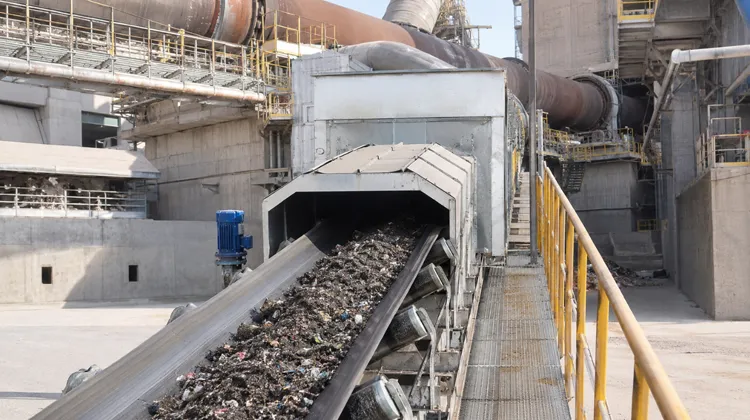
Modern cement kilns are suitable for co-processing certain combustible wastes because they provide high temperature, long residence time, and an alkaline process environment. In addition to traditional coal, oil, and natural gas, many cement plants now use waste tires, paper waste, waste solvents, RDF, biomass, sludge, and industrial waste as alternative fuels.
Benefits of alternative fuels include:
| Benefit | Explanation |
|---|---|
| Lower fossil fuel dependence | Reduces coal or gas consumption |
| Lower fuel cost | Some wastes have economic disposal value |
| Waste resource utilization | Reduces landfill and incineration pressure |
| Better sustainability profile | Supports low-carbon cement production |
However, alternative fuels also create process challenges. High moisture reduces combustion efficiency. Ash changes clinker chemistry. Chlorine and sulfur may intensify internal circulation. Variable calorific value can affect flame stability.
Therefore, an alternative fuel system should not be evaluated only by the feeding equipment. It should also include combustion control, online monitoring, kiln operation strategy, and possible bypass system design.
Clinker Cooling and Final Cement Grinding
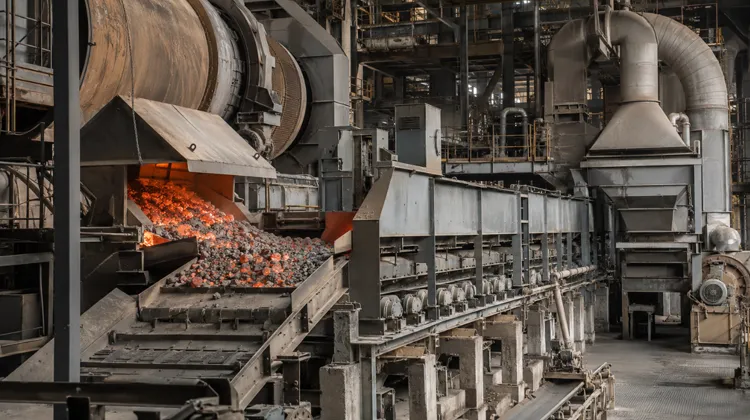
After clinker leaves the rotary kiln, it must be cooled rapidly. Rapid cooling not only recovers heat but also stabilizes clinker mineral structure and improves cement performance.
After cooling, clinker is ground with a proper amount of gypsum. Gypsum, with the chemical formula CaSO₄·2H₂O, is added to control cement setting time. Without gypsum, C₃A may react too quickly and cause flash setting.
Modern cement production may also use supplementary cementitious materials and blended components, such as:
| Материал | Функция |
|---|---|
| Limestone powder | Reduces clinker content and improves particle packing |
| Зола-унос | Improves later strength and workability |
| Шлак | Enhances durability and later strength |
| Микрокремнезем | Improves density and high-performance concrete properties |
| Metakaolin | Provides high pozzolanic reactivity |
These materials help reduce the clinker-to-cement ratio. The IEA low-carbon roadmap also identifies clinker factor reduction as an important pathway for lowering cement industry emissions.IEA Low-Carbon Transition Roadmap
Key Advances in Cement Clinkering Technology
Modern advances in cement clinkering are mainly reflected in the following areas.
1. More Efficient Preheater and Calciner Systems
Multi-stage cyclone preheaters and high-efficiency calciners improve heat exchange and allow most calcination to occur before the material enters the rotary kiln. This reduces fuel consumption and increases kiln capacity.
2. More Stable Low-NOx Combustion
Low-NOx burners and staged combustion technology help reduce NOx formation while maintaining stable flame shape and burning conditions. This is especially important in markets with strict environmental regulations.
3. Higher Alternative Fuel Substitution
Alternative fuel capability has become a key factor when cement plants evaluate new production lines or retrofit projects. Advanced feeding, combustion control, and online monitoring help increase substitution rates while reducing kiln instability.
4. More Efficient Clinker Cooler Systems
Modern grate coolers improve heat recovery through stable clinker bed control, zoned airflow, and automatic operation. This helps reduce fuel consumption and improve clinker quality.
5. Smarter Online Monitoring and Process Control
Kiln shell scanners, gas analyzers, flame monitoring systems, free lime testing, DCS, and expert control systems are helping cement plants move from experience-based operation to data-driven operation.
6. Lower-Carbon Clinker and Cement Production
Low-clinker cement, optimized supplementary materials, alternative fuels, waste heat recovery, and carbon capture technologies are shaping the future of cement manufacturing.
How to Choose a Cement Clinkering Solution
A cement clinkering system should not be selected only based on the price or specification of a single machine. It should be evaluated as part of the complete production line.
Ключевые факторы включают в себя:
| Evaluation Factor | Key Question |
|---|---|
| Raw material condition | Are limestone, clay, and corrective materials stable? |
| Fuel structure | Will the plant use coal, gas, RDF, biomass, or waste tires? |
| Clinker quality target | Is high C₃S, high early strength, or special cement performance required? |
| Emission requirement | Are NOx, SO₂, dust, and CO₂ limits strict? |
| Automation level | Does the plant need online analysis, DCS, or expert control? |
| Retrofit space | Is there enough space for new equipment in an existing line? |
| Operation and maintenance | Can the local team operate and maintain advanced systems? |
A good clinkering solution should improve five areas at the same time: capacity, quality, energy efficiency, emissions, and stable operation.
Заключение
Cement clinkering technology is moving from traditional high-energy production toward efficient, stable, low-emission, and intelligent operation. Clinker formation depends not only on high temperature, but also on raw material chemistry, liquid phase formation, mineral reaction, combustion control, and cooling behavior.
From dry-process precalciner kilns, high-efficiency preheaters, and low-NOx combustion to alternative fuels, intelligent control, low-clinker cement, and low-carbon production, every advance in clinkering technology can influence the future operating cost and competitiveness of a cement plant.
For customers planning a new cement production line, rotary kiln retrofit, alternative fuel upgrade, or clinker quality improvement project, choosing the right cement clinkering solution is a critical step toward long-term plant performance.


 Russian
  English
  Arabic
  Vietnamese
  Spanish
  French
  Portuguese
  Japanese
  Chinese