


As emission requirements for the cement industry become increasingly demanding, simply increasing ammonia-water injection is no longer an effective way to achieve stable NOx control.
A cement plant must balance several objectives at the same time:
- Maintain NOx emissions below the required limit;
- Reduce ammonia-water consumption;
- Minimize ammonia slip;
- Avoid excessive process fluctuations;
- Maintain stable clinker production;
- Reduce dependence on manual adjustment.
Conventional selective non-catalytic reduction systems usually adjust ammonia injection according to the NOx concentration measured at the kiln inlet, preheater outlet or stack.
However, there is a significant delay between ammonia injection in the calciner and NOx measurement at the downstream monitoring point. By the time the control system receives a changing NOx value, actual conditions inside the calciner may already be different.
High-efficiency precision ammonia injection addresses this problem by combining upstream process prediction, multi-zone reagent distribution, dual-fluid atomization, temperature-field analysis and closed-loop control.
Instead of responding only after NOx emissions change, the system predicts the trend and adjusts ammonia injection before a major fluctuation occurs.
What Is Precision Ammonia Injection Denitrification?
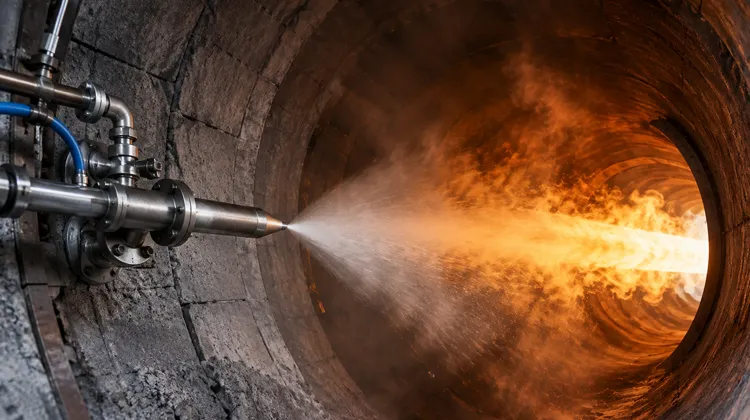
Precision ammonia injection is an intelligent control method developed to improve the performance of SNCR systems in أفران الأسمنت.
It is not simply a matter of installing more spray lances or increasing ammonia flow. The system determines how much reducing agent is required in different areas of the calciner according to real-time operating conditions.
The calciner, riser duct or related preheater section can be divided into several injection zones. Each zone is equipped with independently controlled branches.
The system can adjust:
- Ammonia-water flow;
- Atomizing-air flow;
- Injection pressure;
- Control-valve opening;
- Pump frequency;
- Spray-lance operation;
- Selection of injection level.
Its control process normally includes five stages:
- Measure process conditions;
- Predict the short-term NOx trend;
- Calculate reagent demand;
- Adjust each injection zone;
- Correct the model according to emission results.
This creates a measurement, prediction, control, feedback and optimization loop.
Why Conventional SNCR Systems Often Become Unstable
Delayed NOx Feedback
Many conventional SNCR systems use stack NOx concentration as the main control signal.
The difficulty is that ammonia must first be injected into the calciner, evaporate, mix with flue gas and react with NOx. The treated gas must then travel through the preheater and downstream ductwork before reaching the NOx analyzer.
Therefore, the measured NOx value represents an earlier operating condition.
A typical control problem may occur as follows:
- The downstream analyzer detects increasing NOx;
- The system increases ammonia-water flow;
- Actual NOx formation inside the calciner has already begun to decrease;
- Excess ammonia cannot fully participate in the reaction;
- Ammonia consumption and ammonia slip increase.
This delayed response can cause the ammonia-flow and NOx curves to fluctuate continuously.
Uneven Temperature Distribution
SNCR reactions are highly temperature-dependent.
If the injection temperature is too low, ammonia reacts too slowly with NOx. If the temperature is too high, ammonia may be oxidized instead of acting as an effective reducing agent.
A cement calciner does not have a perfectly uniform temperature field. Different sections may contain:
- High-temperature zones;
- Low-temperature zones;
- Oxygen-rich zones;
- Oxygen-deficient zones;
- High-CO areas;
- Local afterburning areas.
Using the same ammonia flow for every spray lance cannot provide optimum control under these conditions.
Uneven NOx and Gas-Velocity Distribution
NOx concentration and gas velocity may vary significantly across the calciner section.
This non-uniformity can be caused by:
- Calciner geometry;
- Tertiary-air distribution;
- Burner arrangement;
- Coal fineness;
- Alternative-fuel feeding;
- Raw-meal distribution;
- Production-load changes.
One section may have a high NOx concentration but insufficient ammonia coverage, while another section may receive more ammonia than required.
Excessive Dependence on Operators
In many existing systems, operators manually change ammonia flow according to NOx trends and operating experience.
Experienced operators may achieve good performance, but control results can vary between different shifts. Fixed operating rules may also become ineffective when raw materials, fuel quality, alternative-fuel ratio or production capacity changes.
How Does a Precision Ammonia Injection System Work?

1. Upstream Prediction
A precision control system does not rely exclusively on downstream NOx feedback.
It collects multiple process variables that influence NOx formation and SNCR efficiency, such as:
- Calciner outlet temperature;
- C5 cone and riser-duct temperatures;
- CO and O₂ concentrations;
- Tertiary-air temperature and flow;
- Kiln-tail coal feeding rate;
- Coal heating value and fineness;
- Alternative-fuel feeding rate;
- Raw-meal feed;
- Kiln speed and kiln current;
- Gas pressure and gas flow;
- Ammonia-water flow;
- Real-time and hourly-average NOx values.
By analyzing these variables together, the system can estimate whether NOx is likely to increase or decrease.
The ammonia-flow command can then be adjusted before the downstream NOx analyzer shows a major change.
2. Multi-Zone Independent Injection

The calciner or riser-duct cross-section is divided into several control zones according to the gas-flow field, temperature field and NOx distribution.
Each zone can have independent control of:
- Ammonia flow;
- Atomizing air;
- Injection pressure;
- Valve opening;
- Pump output;
- Lance operation.
If one section has higher NOx concentration or higher gas velocity, the system can increase reagent flow in that area.
If another section is outside the effective reaction-temperature range, ammonia flow can be reduced or transferred to another injection level.
Multi-zone control improves the matching between ammonia distribution and actual NOx loading.
3. Dual-Fluid Atomization

Spray-lance performance has a direct effect on SNCR efficiency.
A dual-fluid spray lance mixes ammonia water with compressed air to produce small and relatively uniform droplets.
Important spray-lance parameters include:
- Droplet size;
- Spray angle;
- Penetration distance;
- Cross-sectional coverage;
- Evaporation rate;
- Heat resistance;
- Wear resistance;
- Plugging resistance;
- Maintenance accessibility.
Droplets that are too large may not completely evaporate within the available residence time. Droplets that are too small may follow the local gas stream and fail to penetrate into the central section.
Spray-lance quantity, insertion depth, installation height and injection angle should therefore be determined according to actual calciner conditions rather than a standard arrangement.
4. Model Predictive and Fuzzy Control
Cement-kiln operation is nonlinear, strongly coupled and time-delayed. A single fixed formula is rarely sufficient for all production conditions.
A precision ammonia injection system can combine:
- Process control;
- Fuzzy control;
- Model predictive control;
- Historical operating data;
- Expert operating logic.
The system identifies different operating conditions, including:
- Stable operation;
- Increasing coal feed;
- Alternative-fuel changes;
- Calciner-temperature fluctuations;
- Increased C5 afterburning;
- High CO concentration;
- Raw-meal-feed changes;
- Production-load changes.
It then applies the relevant control strategy and coordinates ammonia flow with combustion and production parameters.
5. Closed-Loop Integration with the DCS or PLC
A precision control system can communicate with the existing cement-plant DCS or PLC through OPC or another industrial communication protocol.
The system reads process data, calculates optimized control values and sends commands back to the plant control system.
Possible output commands include:
- Ammonia-flow setpoint;
- Pump-frequency setpoint;
- Valve-opening setpoint;
- Spray-level selection;
- Individual-branch flow commands.
Safety limits, interlocks and control permissions must be clearly defined before automatic commands are enabled.
Key Factors Affecting Precision Ammonia Injection
Reaction Temperature
Temperature is one of the most important conditions for SNCR performance.
At an excessively low temperature, the reaction between ammonia and NOx becomes slow. At an excessively high temperature, ammonia may be oxidized and lose its reducing effect.
The correct injection point should therefore be determined from the actual operating temperature field.
For production lines with a wide temperature variation, multiple injection levels can be installed. The control system selects the most suitable level according to current temperature conditions.
Oxygen Concentration
A suitable oxygen concentration supports the SNCR reaction, but oxygen must be evaluated together with CO, temperature and combustion conditions.
Changing ammonia flow according to O₂ alone may produce an incorrect control response.
Carbon Monoxide
CO is an important indicator of the reducing atmosphere and combustion condition inside the calciner.
A controlled reducing zone may help suppress NOx formation. However, excessive CO can interfere with the active-radical chemistry required for effective SNCR reactions.
For this reason, continuously increasing ammonia injection during a high-CO condition may not improve NOx reduction.
The plant should first examine:
- Tertiary-air distribution;
- Coal-feed stability;
- Coal fineness;
- Burner condition;
- Alternative-fuel feeding;
- Local afterburning.
Ammonia-to-NOx Ratio
Insufficient ammonia results in incomplete NOx reduction, while excessive ammonia increases chemical cost and ammonia-slip risk.
The objective of precision control is not to achieve the lowest possible instantaneous NOx value. The objective is to maintain a stable balance between emissions, ammonia consumption, ammonia slip and production reliability.
Gas Residence Time
Even with suitable temperature and ammonia flow, insufficient residence time can reduce SNCR efficiency.
The injection point must provide enough distance and time for:
- Droplet evaporation;
- Ammonia distribution;
- Gas mixing;
- Chemical reaction.
Conventional SNCR vs. Precision Ammonia Injection
| غرض | Conventional SNCR | Precision Ammonia Injection |
|---|---|---|
| Main control signal | Downstream NOx feedback | Upstream prediction plus downstream feedback |
| Control method | Reactive adjustment | Predictive closed-loop optimization |
| Spray-lance control | Common flow adjustment | Independent zone and level control |
| Ammonia setpoint | Fixed ratio or operator experience | Dynamic calculation |
| Temperature adaptation | محدود | Injection-level selection according to temperature |
| NOx stability | Larger fluctuations may occur | More stable emission trend |
| Ammonia efficiency | Over-injection is common | Better reagent distribution |
| Operator dependence | Relatively high | Higher level of automation |
| Process adaptability | Manual retuning required | Model correction according to changing conditions |
| Expansion capability | محدود | Can integrate with combustion control and SCR |
Main Benefits of High-Efficiency Precision Ammonia Injection
More Stable NOx Emissions
The system identifies changes in coal feed, temperature, oxygen, CO and production load before the downstream NOx value changes significantly.
This predictive response helps reduce large emission fluctuations.
Lower Ammonia Consumption
Ammonia is distributed according to the actual demand of each injection zone.
Instead of increasing every spray-lance flow at the same time, the system sends more reagent only to the zones where it is needed.
Reduced Ammonia Slip
Ammonia slip may be caused by:
- Excessive injection;
- Unsuitable temperature;
- Poor atomization;
- Insufficient mixing;
- Inadequate residence time.
Precision flow control and improved spray coverage reduce the amount of unreacted ammonia entering downstream equipment.
Improved Operating Reliability
Stable reagent control can reduce the risk of ammonium-salt deposition, corrosion, filter contamination and downstream operating problems.
Less Dependence on Manual Experience
Expert operating knowledge can be converted into repeatable control logic, reducing differences between operating shifts.
Easier Future Upgrades
Precision SNCR control can be integrated with:
- Fuel-staging systems;
- Low-NOx combustion;
- Alternative-fuel control;
- SCR systems;
- Energy and carbon-management platforms.
Main Components of a Precision SNCR System
Ammonia Storage
Depending on the available space, safety requirements and reagent consumption, the system may use vertical or horizontal storage tanks.
The storage area normally requires level monitoring, spill containment, ventilation and safety protection.
Ammonia Transport
The transport unit may include pumps, filters, pressure instruments, recirculation lines and variable-frequency drives.
Stable pressure is necessary for accurate flow control and consistent atomization.
Distribution Unit
The ammonia-distribution unit can be designed as a centralized or zoned system.
A precision system normally uses independently metered and controlled branches.
Dual-Fluid Spray Lances
The spray lances atomize ammonia water with compressed air and inject it into the gas stream.
Lance material and nozzle design should be selected according to gas temperature, dust concentration and calciner structure.
Instrumentation and Control
تشمل المعدات النموذجية ما يلي:
- PLC or industrial server;
- Flowmeters;
- Pressure transmitters;
- Modulating valves;
- Variable-frequency drives;
- Temperature sensors;
- NOx, O₂ and CO analyzers;
- Human-machine interface;
- Historical-data and trend-analysis software.
Implementation Process
Step 1: Collect Operating Data
Collect historical and real-time data for NOx, CO, O₂, temperature, coal feed, alternative fuel, raw-meal feed, ammonia flow and production load.
The data should cover stable operation, load changes and different fuel or raw-material conditions.
Step 2: Analyze the Temperature and Gas-Flow Fields
Use field measurements, injection-point inspections or CFD analysis to identify the effective reaction zones and areas with high NOx loading.
Step 3: Evaluate the Existing Injection System
Check spray-lance quantity, location, atomization, coverage, plugging condition and branch-flow balance.
Step 4: Design the Zonal Control System
Determine the number of control zones, independent branches, flowmeters, valves and instruments.
Step 5: Develop the Prediction Model
Analyze the relationship between NOx and temperature, coal feed, gas flow, CO, O₂ and production load.
Develop predictive logic and dynamic ammonia-control rules.
Step 6: Commission and Optimize
Test the system under different production conditions and optimize flow limits, control speed, injection levels and temperature windows.
Step 7: Review Long-Term Performance
Regularly evaluate NOx variation, ammonia consumption, ammonia slip, automatic-control availability and equipment condition.
Control parameters should be updated when fuel, raw materials or production conditions change.
Integration with Other NOx Reduction Technologies
Precision SNCR and Fuel Staging
Fuel staging reduces NOx formation by creating an appropriate reducing zone and optimizing coal and tertiary-air distribution.
Precision SNCR then removes the remaining NOx.
This combination reduces the initial NOx load entering the SNCR reaction zone and can lower ammonia demand.
Precision SNCR and SCR
For cement plants with more demanding emission limits, SNCR and SCR can be used together.
Precision SNCR provides upstream reduction, while SCR performs deeper downstream removal.
Coordinated reagent control prevents excessive ammonia injection in the SNCR section and reduces the treatment load of the SCR reactor.
Precision SNCR and Combustion Optimization
NOx control should not be separated from kiln operation.
Coordinated adjustment of coal feed, air distribution, alternative fuel, kiln speed and calciner temperature can reduce NOx formation before ammonia is injected.
Which Cement Plants Can Benefit from Precision Ammonia Injection?
This technology is particularly suitable for production lines with:
- Frequent NOx-limit excursions;
- High ammonia-water consumption;
- Significant ammonia-flow fluctuations;
- High ammonia slip;
- Different control results between operating shifts;
- Large calciner-temperature or CO variations;
- High alternative-fuel ratios;
- Uneven spray coverage;
- Existing SCR systems requiring SNCR-SCR coordination;
- Conventional SNCR systems requiring automation upgrades.
What Should Be Considered When Selecting a System?
A suitable supplier should understand cement-kiln combustion, calciner operation and SNCR chemistry, rather than only supplying pumps, valves and spray lances.
Important evaluation criteria include:
- Temperature-field and gas-flow analysis;
- Independent zonal flow control;
- DCS or PLC data integration;
- Predictive control capability;
- Compatibility with existing equipment;
- Safety interlocks;
- Ammonia-consumption analysis;
- Similar kiln-type project experience;
- Long-term commissioning support.
A genuine precision ammonia injection solution must address reaction conditions, spray coverage, control logic and plant operation together.
الأسئلة الشائعة
Is precision ammonia injection simply the installation of more spray lances?
No. Spray-lance quantity is only one factor. Injection position, atomization, penetration, coverage, zonal control and flow calculation are more important.
Can an existing SNCR system be upgraded?
In many cases, yes. Existing tanks, pipelines or some spray lances may be retained. The main upgrade may involve the distribution unit, flowmeters, control valves, automation program and data interface.
How much ammonia can be saved?
The result depends on the original control performance, spray-lance arrangement, process variation and emission target. Plants with significant over-injection usually have greater optimization potential.
Why can ammonia consumption remain high when NOx is already low?
Possible causes include over-injection, unsuitable reaction temperature, poor atomization, uneven coverage or delayed NOx feedback. Low NOx does not necessarily mean economical operation.
Should ammonia flow be increased immediately when CO rises?
Not necessarily. High CO may reduce SNCR reaction efficiency. The plant should first examine combustion, tertiary-air distribution, coal feed and afterburning conditions.
Can precision SNCR completely replace SCR?
Not in every project. Optimized SNCR may be sufficient for some plants, while stricter emission limits or highly variable operating conditions may require an SNCR-SCR combination.
Can the system connect to an existing DCS?
Normally, yes. Data can be exchanged through OPC or another industrial communication protocol, subject to appropriate permissions, safety limits and interlocks.
How should project performance be evaluated?
The evaluation should include:
- Hourly-average NOx;
- NOx fluctuation range;
- Ammonia consumption per ton of clinker;
- Ammonia slip;
- Automatic-control availability;
- Stability under different loads;
- Maintenance frequency;
- Number of manual interventions.
خاتمة
High-efficiency precision ammonia injection is not about injecting more ammonia into the calciner.
It is about injecting the correct amount of reducing agent at the correct location, at the correct time and within the correct temperature range.
By combining upstream prediction, multi-zone control, dual-fluid atomization, temperature-field optimization and closed-loop adjustment, cement plants can achieve more stable NOx emissions while reducing ammonia consumption and ammonia slip.
For cement plants already operating conventional SNCR systems, precision ammonia injection provides a practical upgrade path from manual, feedback-based control to intelligent, data-driven NOx management.


 Arabic
  English
  Russian
  Vietnamese
  Spanish
  French
  Portuguese
  Japanese
  Chinese