


What Is a Centrifugal Bucket Elevator?
A centrifugal bucket elevator is a vertical conveying machine that uses relatively high operating speed and centrifugal discharge to move bulk materials. Spaced buckets are mounted on a belt or chain, loaded at the boot section and carried upward through an enclosed casing. As each bucket passes around the head pulley or sprocket, the material leaves the bucket and follows a defined trajectory into the discharge chute.
“Centrifugal” describes the discharge method rather than the traction component. The elevator may therefore use either a belt or chain, depending on the material temperature, bulk density, particle size, abrasiveness and required conveying capacity.
Compared with a continuous bucket elevator, a centrifugal design normally operates at a higher speed and uses buckets installed at defined intervals. It is best suited to dry, free-flowing powders, granules and small bulk solids that can tolerate relatively rapid loading and discharge.
How Does a Centrifugal Bucket Elevator Work?
Material enters the boot section through an inlet chute. Buckets mounted on a belt or chain move continuously under the power of the drive system. They collect or receive the material at the boot and carry it upward through the enclosed casing.
As each bucket passes around the head pulley or sprocket, the relatively high operating speed causes the material to leave the bucket through centrifugal action and inertia. It follows a defined trajectory into the discharge chute. The empty buckets then travel down the return side and begin another conveying cycle.
Reliable centrifugal discharge depends on the correct relationship between operating speed, head diameter, bucket profile, bucket spacing and outlet position. A stable, controlled feed is also essential to prevent bucket overfilling, material buildup in the boot and excessive fallback while maintaining the required conveying capacity.
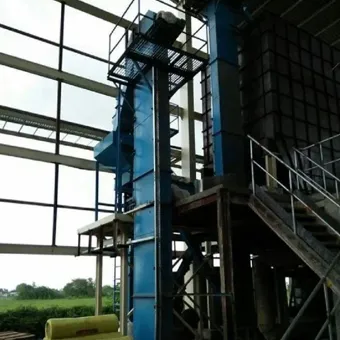
What Materials Can a Centrifugal Bucket Elevator Handle?
A centrifugal bucket elevator is best suited to dry, free-flowing powders, granules and small bulk solids that can tolerate relatively fast loading and discharge. Typical applications include:
- Grain and feed products: Wheat, corn, rice, seeds, beans, feed pellets and grain-processing by-products.
- Fertilizers and chemicals: Granular fertilizers, plastic pellets, resin granules and other consistently free-flowing chemical materials.
- Minerals and construction materials: Sand, limestone particles, mineral powders and selected mineral products with a controlled particle size.
- Food and light-industry products: Salt, sugar and other dry crystalline materials, provided that suitable hygienic and corrosion-resistant components are selected.
- Other industrial bulk materials: Biomass pellets, dry powders and small granular products that are not highly sensitive to impact.
Selecting a centrifugal bucket elevator should not be based on the material name alone. Maximum particle size, bulk density, moisture content, flowability, abrasiveness, temperature and degradation sensitivity must also be evaluated. The bucket profile, operating speed and discharge trajectory should be matched to these properties to reduce fallback, blockage, dust generation and component wear.
Sticky, wet, compacting or highly fragile materials are generally less suitable for centrifugal discharge. A continuous bucket elevator or another low-impact conveying system may provide more reliable and gentle handling for these applications.
Centrifugal Bucket Elevator Design Considerations
Designing a centrifugal bucket elevator involves more than determining the required capacity and lifting height. Operating speed, bucket geometry, head dimensions and discharge-chute position must work together to achieve reliable material flow. Proper design helps reduce fallback, blockage, dust generation and product degradation while supporting stable long-term operation.
Operating Speed and Discharge Trajectory
Operating speed determines whether the material can leave the buckets and enter the discharge chute correctly. Insufficient speed may cause fallback and reduce conveying capacity, while excessive speed can increase product degradation, dust and mechanical loads. The correct speed should therefore be calculated in relation to the head pulley or sprocket diameter, bucket profile and material properties.
Bucket Profile, Capacity and Spacing
Bucket opening, depth, volume and spacing should be selected according to particle size, bulk density, flowability and required capacity. Undersized buckets can limit throughput, while excessive filling may cause spillage and material buildup in the boot. Adequate spacing also provides enough room for clean centrifugal discharge without interference from adjacent buckets.
Inlet and Boot Design
The feeding system should deliver a continuous and controlled material flow into the boot. Sudden or excessive feeding can overload the buckets and cause accumulation at the bottom of the elevator. The inlet position should also follow the direction of bucket travel to reduce direct impact on the belt, chain and bucket attachments.
Head and Discharge-Chute Geometry
The head casing, throat plate and discharge chute should be arranged around the calculated material trajectory. Incorrect outlet positioning can cause material to strike the casing or fall into the return side, resulting in fallback, localized wear and reduced capacity. Replaceable wear liners may be installed in high-impact areas when abrasive materials are handled.
Drive and Traction System
The choice between belt and chain construction depends on material temperature, lifting load, abrasiveness and operating duty. Drive power should account for the normal lifting load, starting conditions, feed fluctuations and transmission losses. A backstop may also be fitted to prevent reverse movement after shutdown.
Sealing, Maintenance and Safety Monitoring
For dusty materials, suitable sealing and dust-extraction connections should be provided around casing joints, the inlet and the discharge area. Speed monitors, belt-misalignment sensors, blockage switches and bearing-temperature sensors can be integrated with upstream and downstream equipment. Access doors and maintenance platforms should also be positioned for safe inspection, cleaning and wear-part replacement.
Custom Centrifugal Bucket Elevator Solutions
Bulk materials vary considerably in flowability, bulk density, particle size, abrasiveness and temperature. A centrifugal bucket elevator should therefore be engineered around the actual application rather than selected by conveying capacity alone. We evaluate the material properties, required throughput, lifting height, operating duty and site layout to achieve stable loading, elevation and centrifugal discharge.
Available customization includes:
- Bucket system: Bucket profile, volume, material and spacing are selected according to particle size, bulk density and flow characteristics.
- Operating and discharge design: Belt or chain speed, head diameter, throat-plate position and discharge-chute geometry are coordinated to reduce fallback, material impact and product degradation.
- Belt or chain traction: The traction system is selected according to the lifting load, operating temperature, service duty and plant environment.
- Drive and casing configuration: Drive power, gearbox arrangement, inlet and outlet orientation, casing material, sealing and wear liners can be adapted to the project.
- Safety monitoring: Available options include backstops, speed monitors, misalignment sensors, blockage switches and bearing-temperature monitoring, with interlocks for upstream and downstream equipment.
For new production lines and equipment-retrofit projects, we can also support equipment selection, layout development, interface confirmation, installation drawings and commissioning guidance. Send us the material name, required capacity, bulk density, maximum particle size, lifting height and operating temperature to configure a suitable centrifugal bucket elevator for your application.
 Arabic
  English
  Russian
  Vietnamese
  Spanish
  French
  Portuguese
  Japanese
  Chinese